
Opel calls it the smallest crossover. I call it the most confused Adam — this is the Adam Rocks, the “muscular” version of Opel’s supermini, which sits 1 cm higher than the standard model and features numerous SUV-inspired decorative elements.

The Adam joined the race among stylish city cars around three years ago with the goal of shaking up segment leaders like the Mini and Fiat 500. The model immediately achieved solid market results, meeting Opel’s expectations of 40,000–50,000 sales during its first year on the market. Since then, sales have shown moderate but steady growth every year, reaching just over 55,000 units in 2015 (according to Left Lane). That was also the model year in which Opel decided to expand the Adam range with the bold proposition I had the chance to drive.
Design

In short, the design is impressive and controversial — the two descriptions often go hand in hand. During the time I spent driving the little Opel, I heard every possible opinion about its appearance: “cute”, “ugly”, “fantastic”, “weird”. The fact is that the Adam Rocks does not leave people indifferent, and its design combined with the bright paintwork, large wheels and two-tone bodywork constantly attracted attention.
My neighbours asked me about it, people at the car wash stared at it, colleagues inspected it, drivers at traffic lights smiled at it — the last car I drove that received this much attention had a trident in the grille.


In my opinion, the basic Adam design is extremely successful and distinctive, with the front end standing out thanks to the stylish grille and headlights, as well as the roof design that creates the illusion that the C-pillars end before they actually connect with the body. The large wheels also give the car a far more dynamic and harmonious appearance.
With the Rocks version, however, things are slightly different because all the decorative additions make the car feel as though it is trying a little too hard to be “cool”, even though it does not actually need to. Personally, I find all these details slightly excessive and unnecessary (although the additional 1 cm of ground clearance is definitely welcome).
Interior

The interior design of the Adam is a continuation of what you see on the outside — playful lines, attention to detail and decorative elements painted in the body colour. There is an interesting contrast between certain components. For example, the steering wheel is very charming and clearly received a lot of attention, the same applies to the climate control buttons, the seat upholstery and the instrument cluster in front of the driver (although perhaps they went a little too far with the theatrics there).
At the same time, it feels as though the designers became so absorbed in creating these elements that they forgot to spend more time on the door handles and the mirror adjustment controls. Not a major issue, but it definitely caught my attention 🙂


As for the materials, overall the quality is perfectly good for the car’s price class — we get the standard combination of hard and soft plastics and visually everything appears well-finished. The less pleasant impression once again comes from the doors, where cheaper-feeling plastic dominates.
Otherwise, the Adam offers a surprisingly spacious front row, excellent ergonomics and very generously sized door pockets. I personally found the seats uncomfortable — the seat base is short and back support, especially lumbar support, is not ideal. Of course, this is among the more subjective aspects, but it is worth noting that the extremely long options list includes Recaro seats — not bad for a car in this segment.
As for the second row, it is more symbolic than practical. I managed to fit relatively easily thanks to the huge doors, but my head touched the roof and my knees pressed against the front seat. The same applies to the boot — 170 litres of luggage space and the highest loading lip I have ever seen… then again, the Adam is not a delivery van, so for city use it gets the job done.


On the road
I will have to start negatively and no, the problem is not with the car, but with the incredibly low level of driving culture I keep witnessing on the streets of Sofia — ignorance of traffic laws, arrogant behaviour, complete disregard for basic rules, total lack of consequences and all of it topped with a solid dose of inferiority complexes.
Unfortunately, while driving the Adam Rocks I experienced these problems in full force. Besides the approving looks the little Opel attracted, perhaps precisely because of its size, it also attracted twice as much aggression. Fortunately, the Adam helped me escape every unpleasant situation thanks to its turbocharged three-cylinder engine and the surprisingly impressive performance it delivers.

The engine in question has a displacement of 999 cc and produces 115 hp and 170 Nm of torque. That is enough for 0–100 km/h in 9.9 seconds, but in reality, within the urban environment, the car feels quicker because acceleration and mid-range response at lower speeds are impressively rapid.
Alongside this enjoyable performance you get official fuel consumption figures between 4.1 and 6.3 l/100 km, as well as a more entertaining sound compared to conventional four-cylinder engines. In fact, at low revs the sound is quite distinctive — slightly unbalanced and uneven, which is actually rather charming. During more spirited driving, the turbo pressure release is clearly audible and definitely makes the car more fun to drive.
Naturally, I spent most of my time with the Adam Rocks driving around the city — the car is 100 percent urban-oriented. Overall, moving through city traffic is genuinely enjoyable. Besides being quick and agile, the car is manoeuvrable enough, while the steering system includes a dedicated city mode that makes turning the wheel incredibly light.
The start-stop system also works smoothly and without hesitation, helping to guarantee low fuel consumption. In fact, I measured city consumption of 5.5 l/100 km, which is lower than the official figure, although I must admit that I carefully choose my routes and rarely get stuck in the worst traffic jams.
While driving around Sofia, I inevitably hit a few potholes and my impression is that the car handles such obstacles relatively well considering the short wheelbase and low-profile tyres. In fact, dealing with typical road imperfections feels noticeably softer and more comfortable than I expected (the increased ground clearance certainly helps here), although deep potholes still make themselves known.
The suspension is relatively noisy, however, with tyre and road noise clearly noticeable both on normal surfaces and over bumps, although for urban use the levels remain perfectly acceptable.
Another thing worth mentioning is the fabric roof — an extremely pleasant feature in my opinion, perfectly suited to small urban cars and I strongly approve of its return to the market (the Peugeot 108 and company also offer something similar). During one of my evening drives, I even turned off the audio system just to listen to the rain falling on the soft roof… madness 🙂


Although the Adam Rocks is entirely city-focused, I still decided to take it outside Sofia. I drove along the motorway towards Vakarel and then continued on the old road to Panagyurishte.
At speeds around 130–140 km/h, the behaviour felt perfectly adequate. The car still feels stable and noise levels remain acceptable, although above 130 km/h aerodynamic noise around the retractable roof increases noticeably. Nevertheless, the car can absolutely handle motorway driving and maintain normal cruising speeds when necessary, while fuel consumption rises to just above 7 l/100 km.
So I left Vakarel and headed towards Panagyurishte, taking advantage of the opportunity to shoot a few “off-road” photos in line with Opel’s crossover marketing for the Adam Rocks 😉

My idea was to push the car harder on the way there to see what it was capable of, and because I suspected it would be fun to drive. Well, it really was fun.
Something between a go-kart and a bumper car, the Adam is extremely agile and nimble, changing direction with incredible ease, all combined with unexpectedly precise steering. The Adam genuinely surprised me. Combined with the small turbocharged engine, driving along the narrow road filled with corners and absolutely no traffic was hugely enjoyable.
Interestingly, despite weighing more than 1,150 kg, the Adam Rocks is heavier than one might expect, yet on twisty roads those kilograms never really made themselves known. Understeer also arrived later than I expected. Interestingly, the Adam uses a modified Fiat 500 platform, but the two cars behave very differently on the road. The Fiat, despite being noticeably lighter, suffers from earlier understeer.

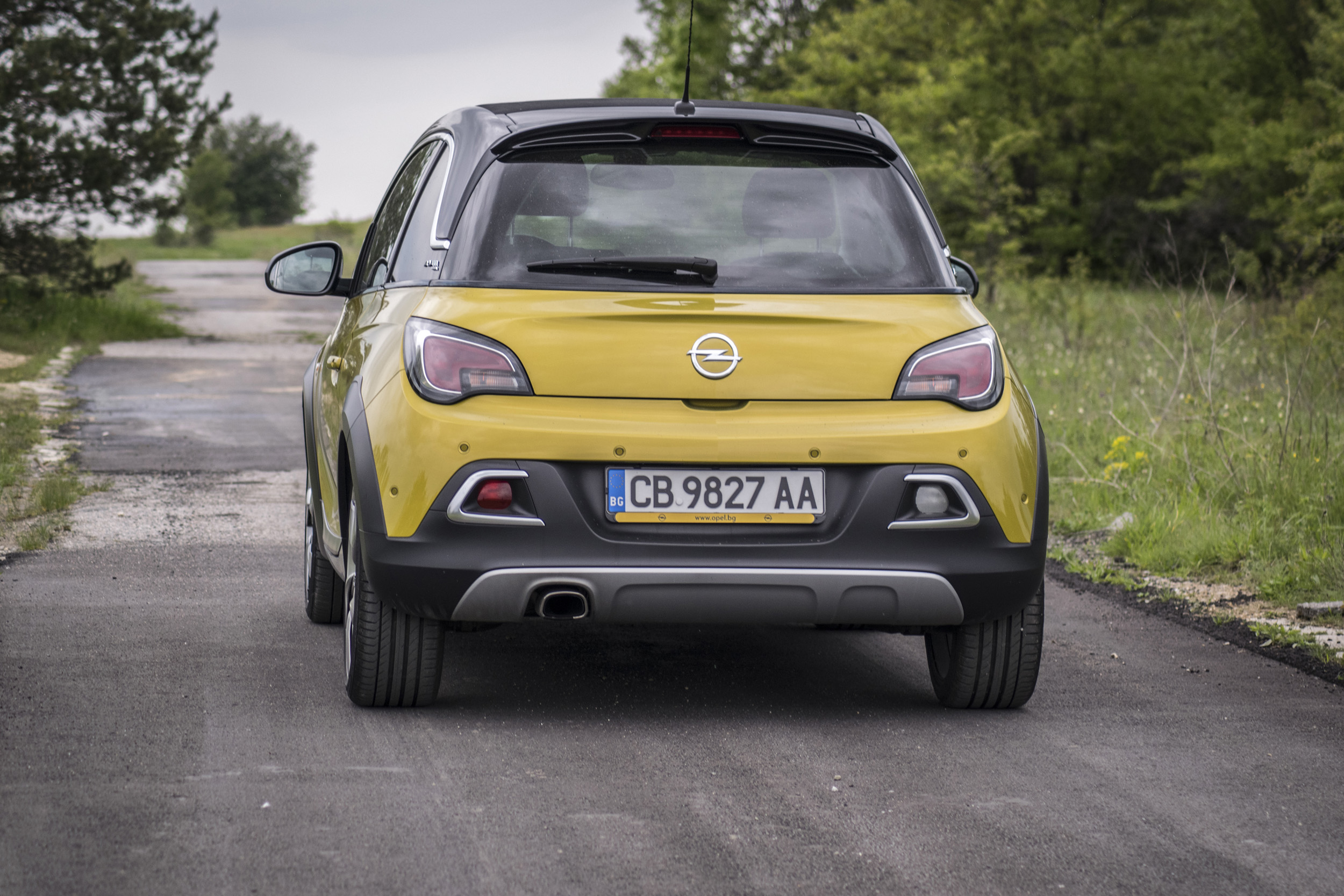
So I continued driving dynamically until I reached the village of Sredishina (fuel consumption during this section climbed to 6.9 l/100 km), after which I turned around and calmly returned to Sofia, recording extra-urban fuel consumption of 4.6 l/100 km during relaxed driving.
Conclusion
After spending several days with the Adam Rocks, the time came to ask myself why there are not more Adams of all varieties on the streets of our larger cities. Personally, I can only remember seeing two of them before.
The answer probably lies in the peculiar nature of our market, which is generally poor, strange and illogical. With a starting price of approximately €12,000, the Adam is not cheap, but rather a “boutique” city car — something between a Fiat 500 and a Mini — while a well-configured example requires at least €15,300.
As for the Rocks version, its starting price with the 1.2-litre 70 hp petrol engine is slightly above €15,300, while the very well-equipped test car with the lively three-cylinder turbo engine costs around €21,900, which is undeniably a high price for our unusual market.
But otherwise, the car is worth it — well-built, very enjoyable to drive, economical and equipped with memorable, attention-grabbing design. A perfect combination for busy urban traffic, although perhaps better suited to a slightly more developed society where people do not “crush” you on the road simply because your car is small…
Eng. Tsvetan Iliev


Comments are closed.