
The world of large executive sedans is a fascinating and tempting one — there are not many competitors, but those that exist are exceptionally strong, always come from manufacturers with rich traditions and in most cases offer all the important technologies found in the luxury flagship models (S-Class-type cars) of their respective brands.
Traditionally, the European market in this segment is dominated by the Germans, with annual sales reaching close to 100,000 units for each of the three German premium brands. Jaguar, meanwhile, is the strongest among the challengers, with sales fluctuating around and below 20,000 units. As for the other outsiders, among them the Volvo S80 (and soon the S90, which will definitely shake up the market) and the Maserati Ghibli, their sales figures remain far behind Jaguar.

But why am I once again starting with sales statistics? Because those sales figures illustrate very clearly what the executive sedan segment represents and what its buyers are like. This is a place with certain rules, where conservative styling backed by top-level technology and powerful engines is preferred, while models with more pronounced character remain in the background (or those that try too hard to stand out and end up being loudly ugly while lacking adequate drivetrain options — Lexus GS).
At first glance, the XF appears to balance successfully between the exclusivity and flamboyance of the Ghibli and the rationality of the German trio — the E-Class, 5 Series and A6.
Design
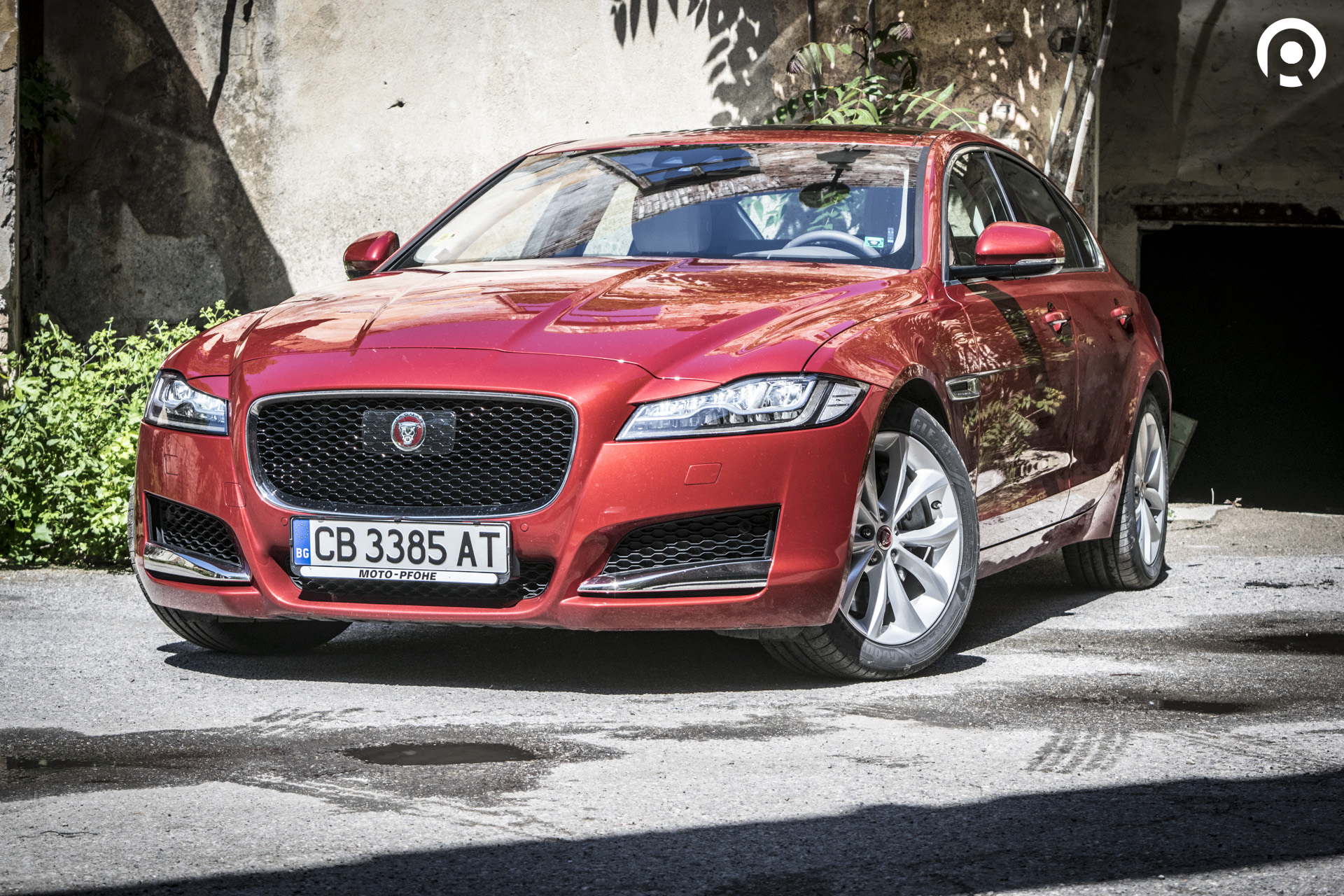
Let us not fool ourselves — the Jaguar XF is definitely a beautiful car. Its design cleverly combines lavish details, understated elegance and restrained aggression. The front end is very dynamic, yet in typical British fashion this has not been achieved through crude, demonstrative aggression. Something I appreciate immensely.
The side profile adds a sense of luxurious sophistication thanks to the elegant elongated silhouette and the classic low front and rear sections. The only detail that slightly spoils the overall impression is the crude roof antenna — why it was not integrated into the rear window remains a mystery to me.
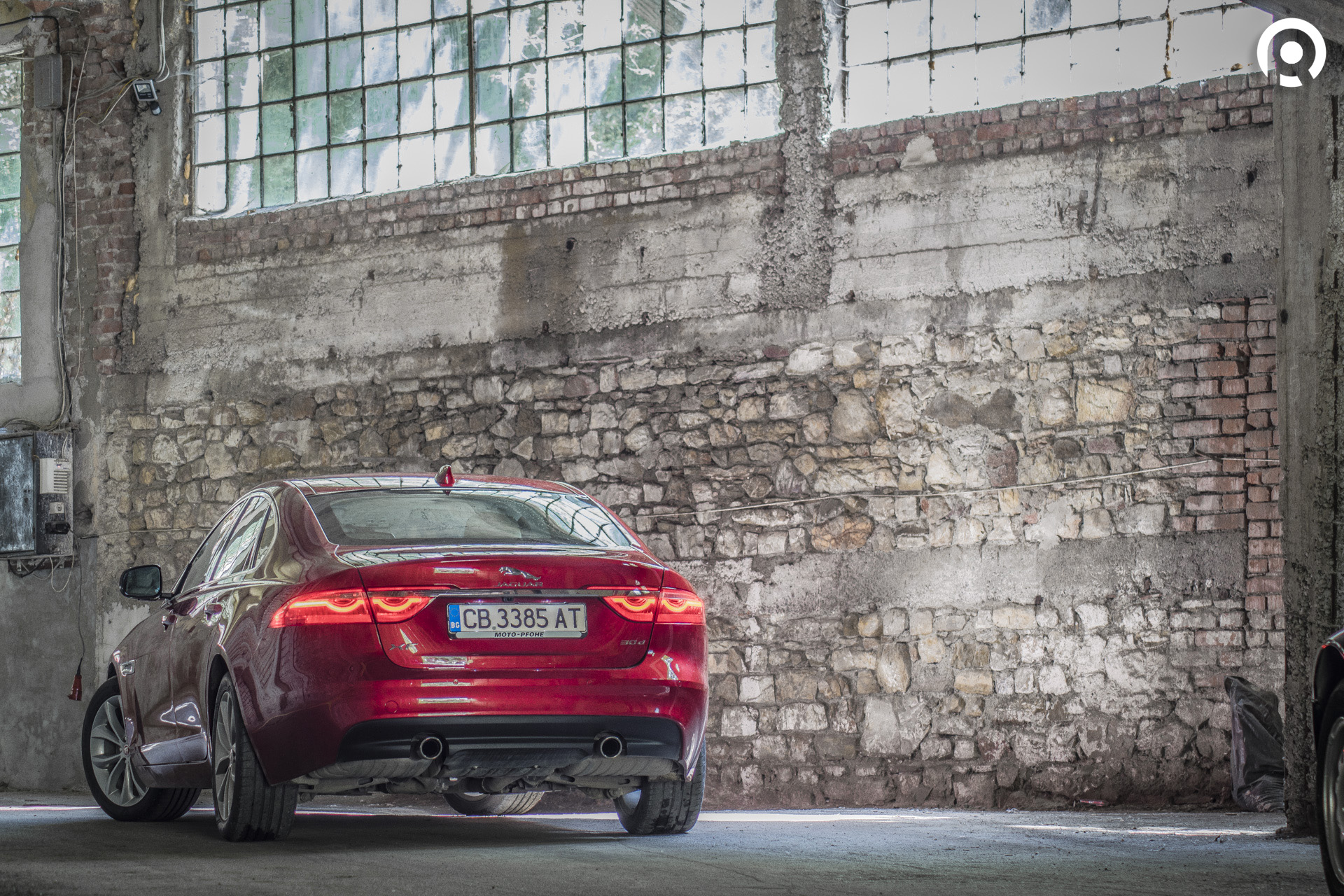
As for the rear, the design is simple but with something subtly rebellious about it. It immediately reminds me of the Jaguar MK2, the XF’s great-grandfather from the 1960s — a car that became famous as the favourite getaway vehicle of British gangsters at the time, including during the Great Train Robbery of 1963, when a well-organised gang managed to steal the modern equivalent of £50 million, most of which was never recovered.

Interior
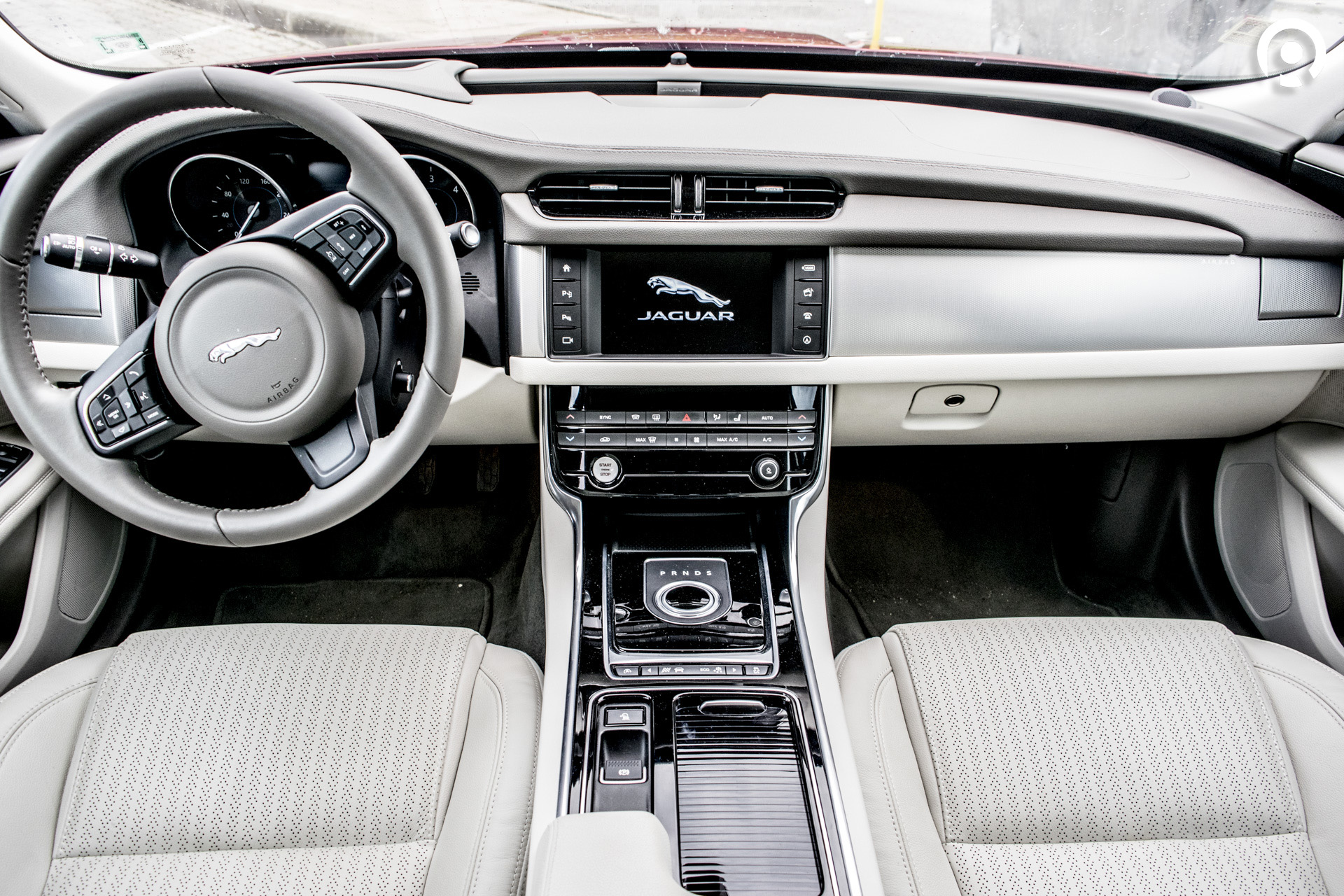
Looking inside the car, we discover the signature design language of the modern Jaguars — simple, modern, digital and naturally luxurious. While I was always a fan of Jaguar’s classic interiors with extensive wood trim, I also very much like the brand’s new direction and in the case of the XF specifically, I believe it offers the most aesthetically refined dashboard in Jaguar’s current sedan line-up.

The “digital” description I mentioned earlier comes from the small details such as the circular gear selector that rises from the centre console once the engine starts, while remaining hidden when the car is switched off, or the air vents that close when the engine is off. Unnecessary? Absolutely. But undeniably cool.
In terms of comfort, the XF performs more than well enough. The front seating position is excellent and unlike the smaller Jaguar XE, I had no issues with the armrests here — everything felt perfectly positioned. I was also very satisfied with the seats, to the point where I barely noticed them, simply sitting down and forgetting about them altogether.
The rear seats are also a pleasant place to spend time, offering generous space. I especially appreciated the relatively high seat base, which allows passengers to sit comfortably in a proper posture. This is complemented by plenty of knee room. Last but not least, enough light enters the cabin (in this case helped by the panoramic roof) and visibility forward and to the sides is good, making the rear seats suitable for long journeys without fatigue or boredom.

As for overall craftsmanship and details, I think the level is high. The build quality feels solid and premium, although there is certainly room for further improvement if Jaguar’s goal is to surpass the German and Swedish competition in perceived quality.
What left a slightly less positive impression was a barely noticeable creaking sound from the dashboard area over uneven surfaces. However, since it was extremely subtle, I suspect it may simply have been an issue with this specific car — after all, test cars are rarely treated gently.

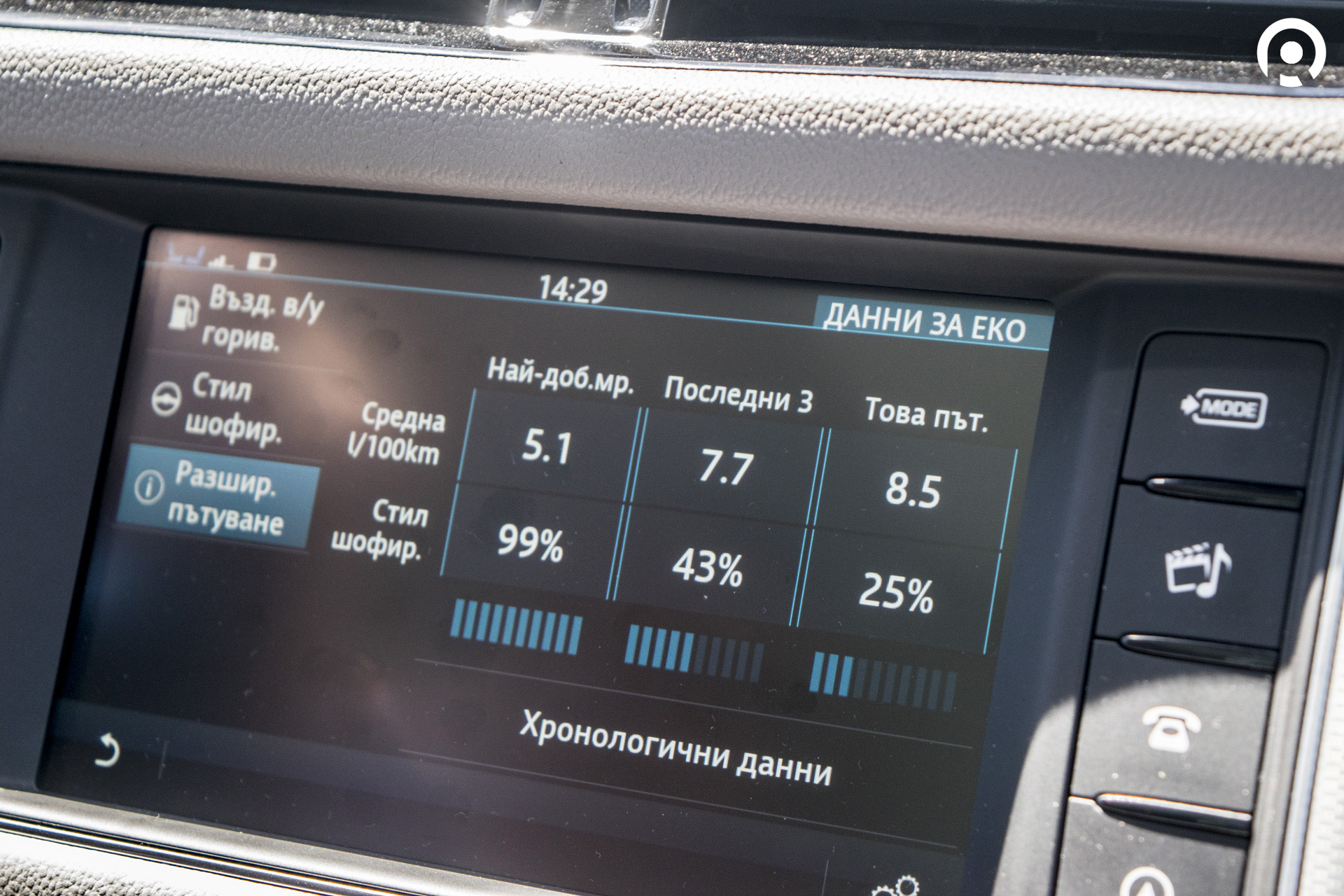

And finally, the infotainment system. This is JLR’s familiar setup, which is fairly simplified in terms of operation and generally easy to use. The graphics are good, the screen responds quickly and it is well protected from glare. The downside is the lack of an additional controller (such as a traditional rotary dial), because touchscreen operation is inevitably more distracting. I also dislike the fact that seat heating and ventilation are controlled solely through the display instead of physical buttons.
What I did enjoy, however, was the Meridian audio system, which delivers clean and rich sound at a very reasonable price — approximately €610.
On the road
Well yes, driving a red high-end Jaguar is an enjoyable experience in itself and it certainly kept me away from the unpleasant situations I had with the Opel Adam last week.
Fact number one — in Bulgaria, driving a car that looks good and clearly appears expensive from a distance completely changes the behaviour of other road users towards you.
Fact number two — without exaggeration, whenever I stop at a petrol station and step out of a “special” car, cashiers suddenly become friendlier, more cheerful, more talkative and generally in a better mood. Coincidence? Hardly.
So besides the advantages accompanying these realities of our society (which personally irritate me immensely), the XF definitely impressed me with its character and behaviour on the road.
I started the test rather actively because my first destination was the twisty roads after Bistritsa. However, during Friday afternoon traffic, I figured the quickest route from Moto-Pfohe in Lyulin would be via the motorway to Pernik before re-entering Sofia through Vladaya. So within the very first hour of my time with the XF, I had already driven it in city traffic, on the motorway, on open roads and along mountain roads filled with corners.
Unfortunately, by the time I passed IKEA and headed towards Bistritsa, Sofia was hit by a serious downpour, meaning my favourite corners were now covered in very wet asphalt. As you can easily imagine, the combination of dusty wet tarmac, rear-wheel drive, an enormous 700 Nm of torque and 300 hp is perhaps not the ideal one.
Still, being relatively competent at driving in such conditions (after all, I have driven on frozen lakes in Lapland… which were slightly more slippery), I allowed myself to push the car a little and have some fun.
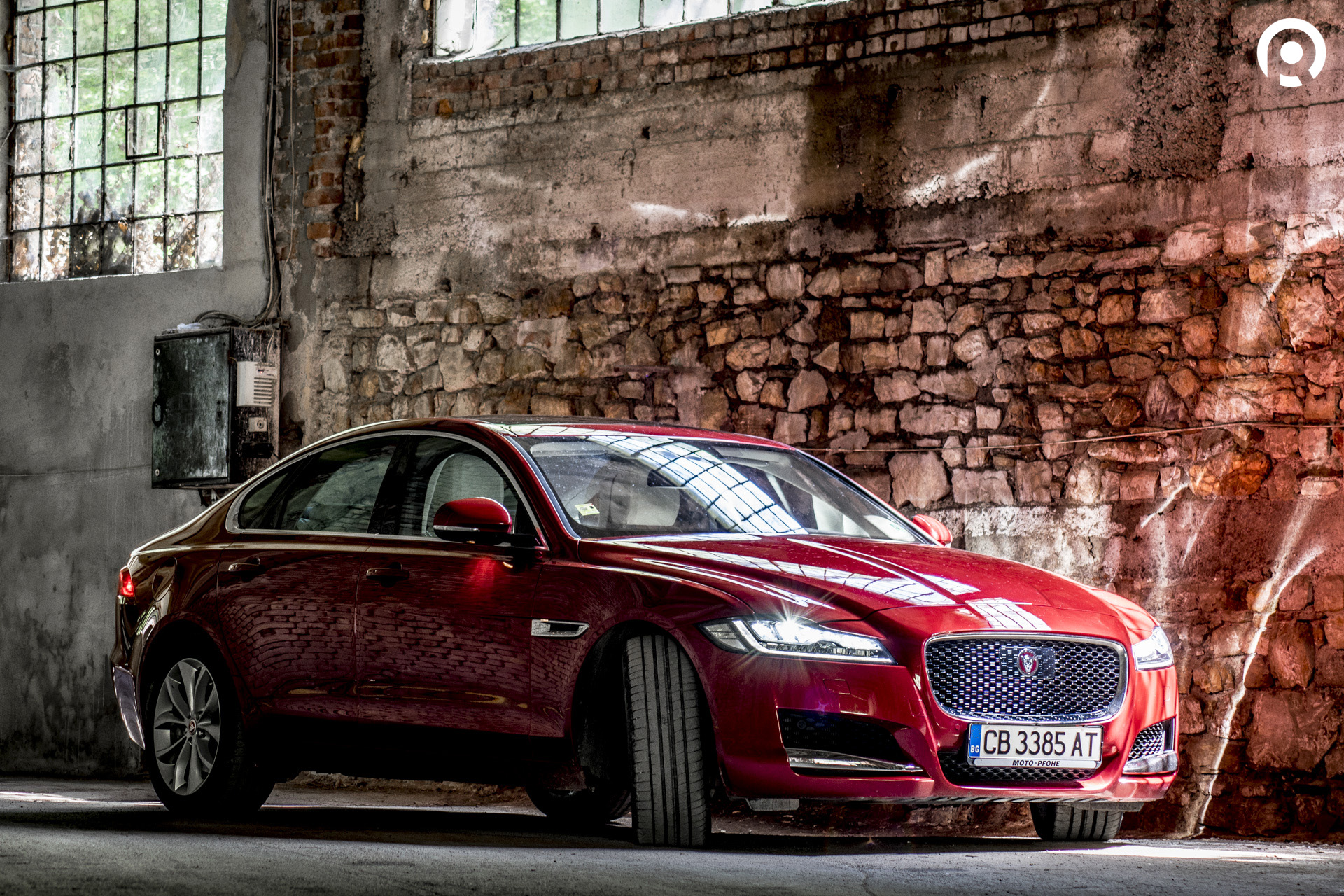
First impression — the XF is not really a car for this sort of behaviour. The Jaguar naturally encourages calmer driving and somehow feels slightly out of place in such an environment. Not that the corners challenge it, but it felt somewhat unnatural to me.
You can also sense this in the setup, especially in the exhaust system — the car is clearly designed to remain quiet. I rev the engine hard and there is barely any sound. Inside you hear a pleasant muted growl, while outside there is little more than a faint whistle. Better just listen for yourself:
https://www.youtube.com/watch?v=5sTWKU_SK10
Otherwise, the car handles corners very well and feels pleasant to drive. I believe the XF’s weight deserves much of the credit. With the large diesel engine I tested, the car weighs 1,750 kg (an equivalent BMW 5 Series weighs 60 kg more, the Mercedes E-Class 50 kg more, while the Audi A6 comes closer with roughly 20 kg extra). This is largely thanks to the XF’s aluminium body structure.
It is also worth adding that with the four-cylinder engines, the weight advantage over the German rivals becomes even greater, reaching up to 100–120 kg. Point for Jaguar!
In terms of handling, I was also pleased with the steering, which is sufficiently direct and informative. As for the suspension, however, I perhaps had slightly higher expectations. The test car featured the optional adaptive suspension, which certainly made itself felt during more dynamic driving by virtually eliminating body roll, but even in Comfort mode it did not feel truly comfortable to me.
It is certainly not uncomfortable, but in this class I feel road isolation should be slightly better. In that regard, and considering JLR usually handles suspension tuning very well, I actually believe the adaptive suspension is an unnecessary option in the XF (approximately €1,070).

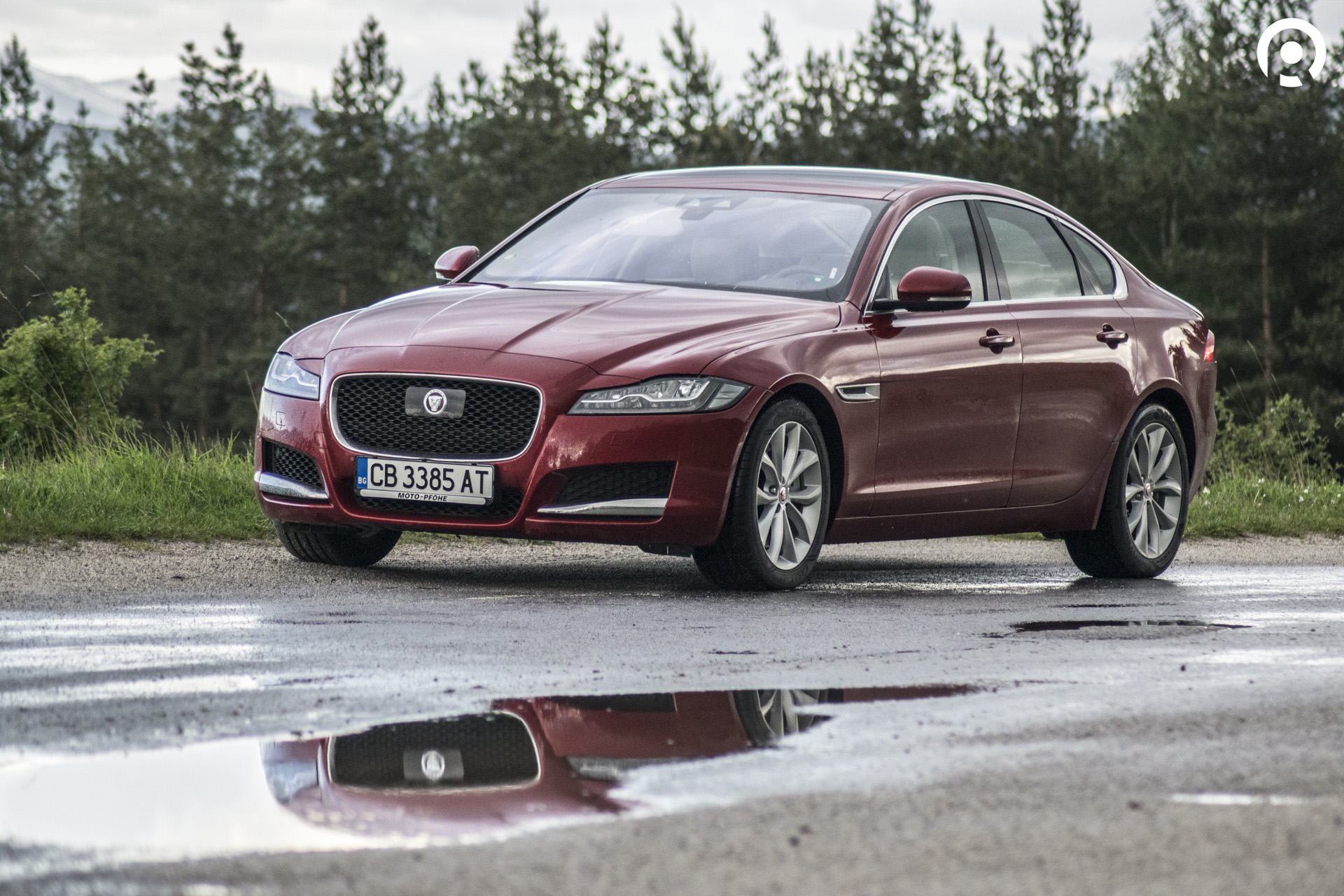
The following day began with new observations about the suspension while driving on the Trakia motorway. It seems to me that road noise is more noticeable than it should be. In fact, if memory serves me correctly, the smaller Jaguar XE was quieter in this regard. Once again, let me clarify — it is not annoyingly loud, but it is louder than what feels appropriate for this class. On the other hand, insulation from aerodynamic noise and the engine itself is absolutely up to standard.
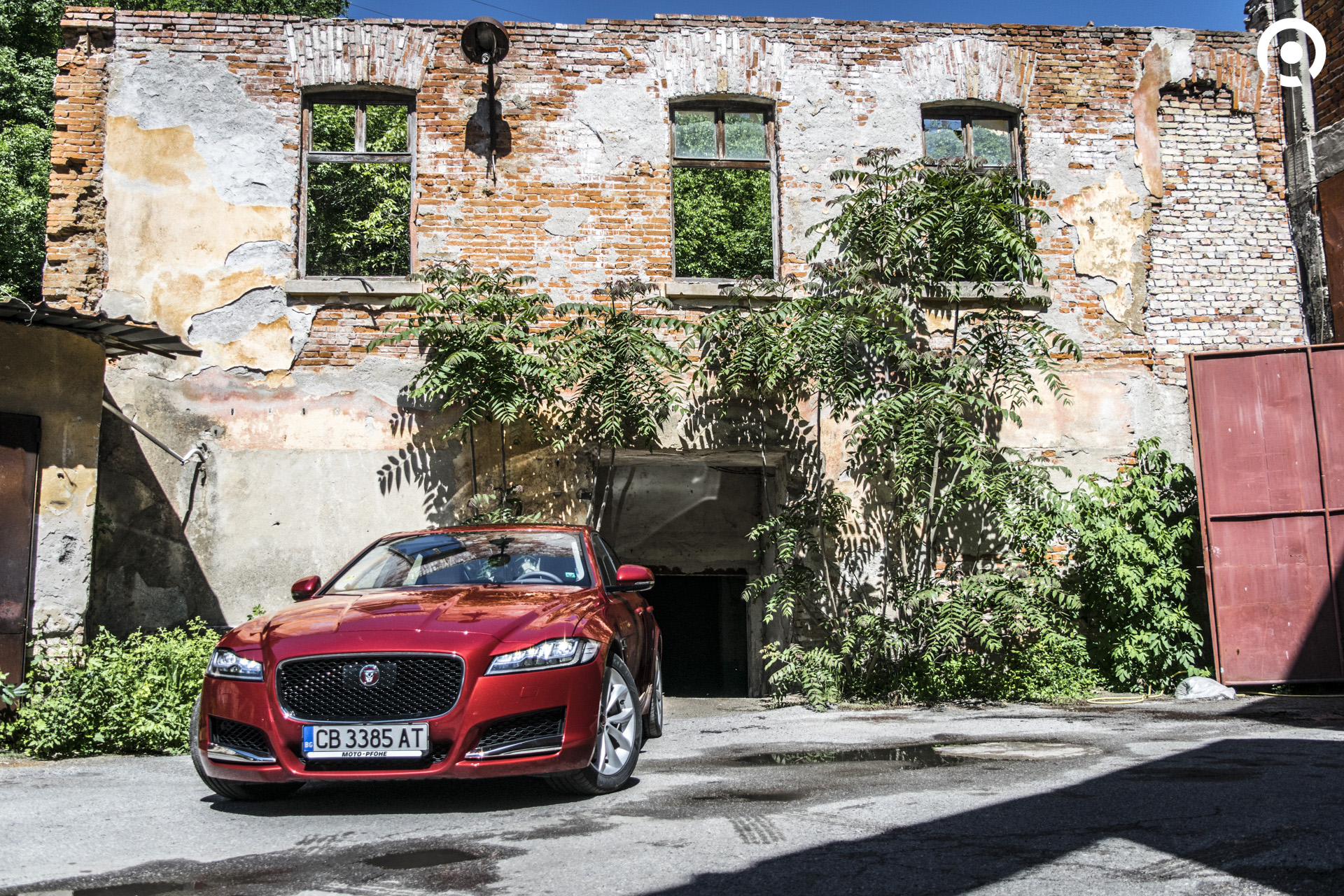
Anyway, early in the morning I headed down the Trakia motorway with the idea of doing a long-distance cruise to Sliven. I activated the adaptive cruise control and set off.
I think the car truly came into its own on the motorway — speed feels effortless and actually helps smooth out finer imperfections in the road surface (the ruts after Plovdiv are another story entirely). I liked the fact that the adaptive cruise control allows shorter following distances than similar systems I have experienced in other cars. This is extremely useful during overtaking manoeuvres when some rival systems suddenly slam on the brakes just as you move halfway into the left lane.
The test XF also featured lane keeping assistance and lane monitoring systems, both of which worked properly and naturally. Since I was travelling during a quiet period, I managed to maintain a very high average speed (high enough to exceed the legal limit, but low enough not to require slowing down near cameras and police radar traps).
Here I truly experienced the engine at its best because the immense torque provides strong acceleration at any speed. In every driving situation I encountered, there was always sufficient power available, yet it remained easy to control and manage.
As for fuel consumption, I left the motorway with an average of 8.5 l/100 km, which seems more than reasonable to me. During relaxed driving at 130–140 km/h it could easily drop below 7 l/100 km, while in extra-urban conditions 6 l/100 km sounds entirely achievable.
Not bad for a large luxury sedan with 300 hp under the bonnet, is it?

Conclusion
I believe Jaguar has succeeded in creating an excellent and unconventional representative of this segment. The car is available with a relatively broad engine range, from a 163 hp diesel all the way up to a 380 hp petrol engine, as well as optional all-wheel drive.
The XF offers high-quality craftsmanship, refined road manners and generous interior space. This is complemented by a distinctive appearance that may not be as dramatic as the Maserati Ghibli, but is certainly far more interesting than any equivalent model from Germany.
As for the downsides, yes, there are some, but nothing dramatic enough to spoil the overall impression. And although objectively speaking the XF is probably not the best car in its class, its style and the feeling that you are driving something more special are impossible to replace.
Eng. Tsvetan Iliev


Comments are closed.