Many years ago the original Mini appeared as an affordable and easy-to-maintain car that gave mobility and freedom to large parts of British society. Markets and customer expectations, however, evolve over time — especially when visionaries step in with new ideas.
One such visionary was John Cooper. In the early 1960s he recognised the motorsport potential of the tiny car and turned it into something far more exciting. That was the beginning of the legendary Mini Cooper.
John Cooper himself was deeply involved in racing — first maintaining racing cars and later building them. Behind the wheel of his company’s machines sat Formula 1 legends such as Stirling Moss and Bruce McLaren. This remarkable legacy is exactly what stands behind MINI’s performance sub-brand — John Cooper Works.

Design

MINI is a design icon that is instantly recognisable. Show almost any model from the brand to your least car-enthusiastic friend and they will still tell you it is a MINI. The design is that distinctive — and this is especially true for the classic three-door model.
This recognisability comes from the car’s silhouette, the shape of the headlights and the upright yet relatively low windscreen. Continuity between generations is maintained through smaller details that require a slightly more observant eye — the side mirrors, the design and placement of the fuel cap, the door handles and many others.


Things become more interesting because this car represents the second facelift of the current generation, introduced in Bulgaria in mid-2021. With redesigned bumpers, several new wheel designs, standard LED lighting and an optional black exterior styling package, the result is a very contemporary appearance.
I like this update because the current generation MINI has already been on the market for more than eight years, yet it still feels fresh. In today’s industry that is quite a long lifecycle, especially for a small car.


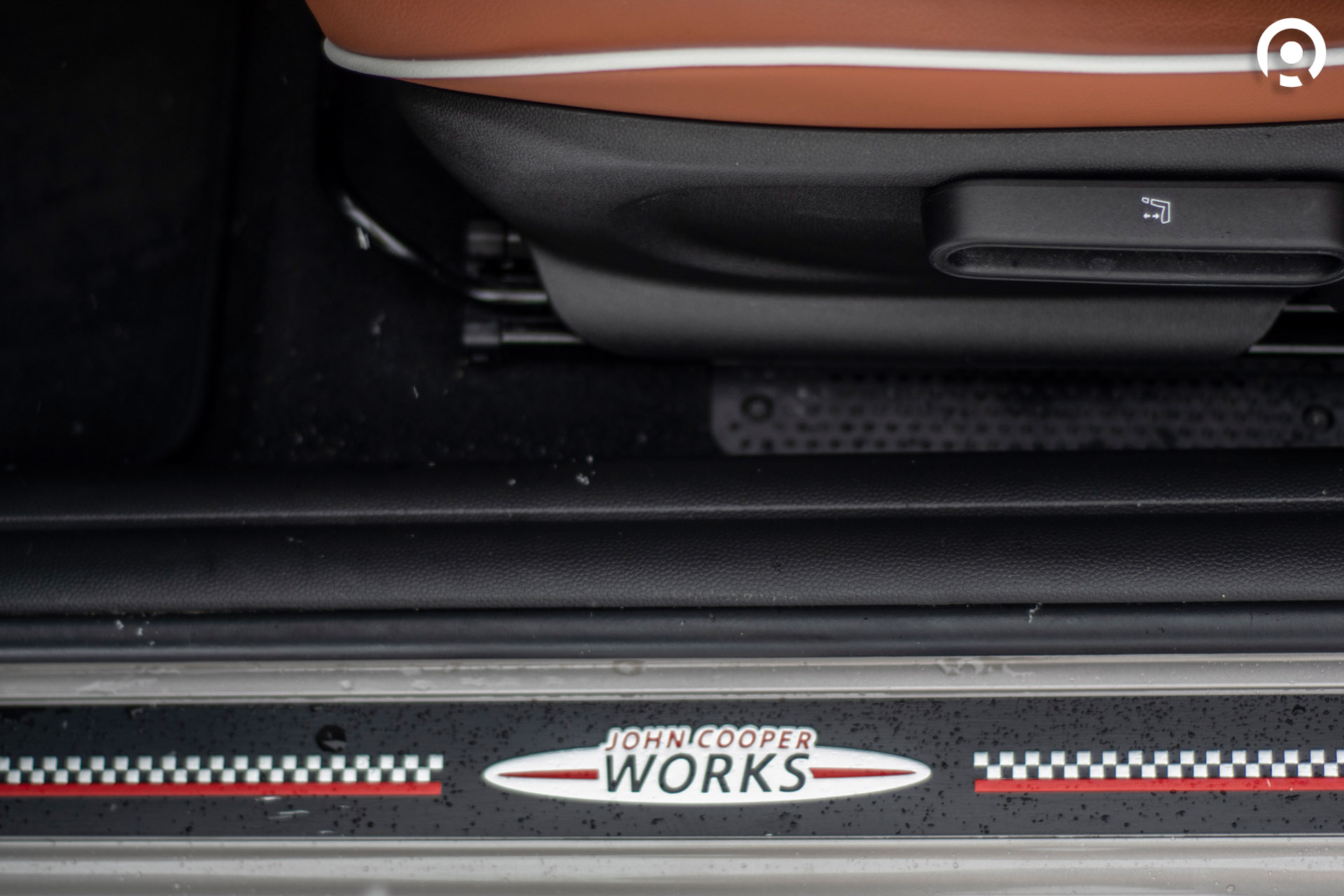
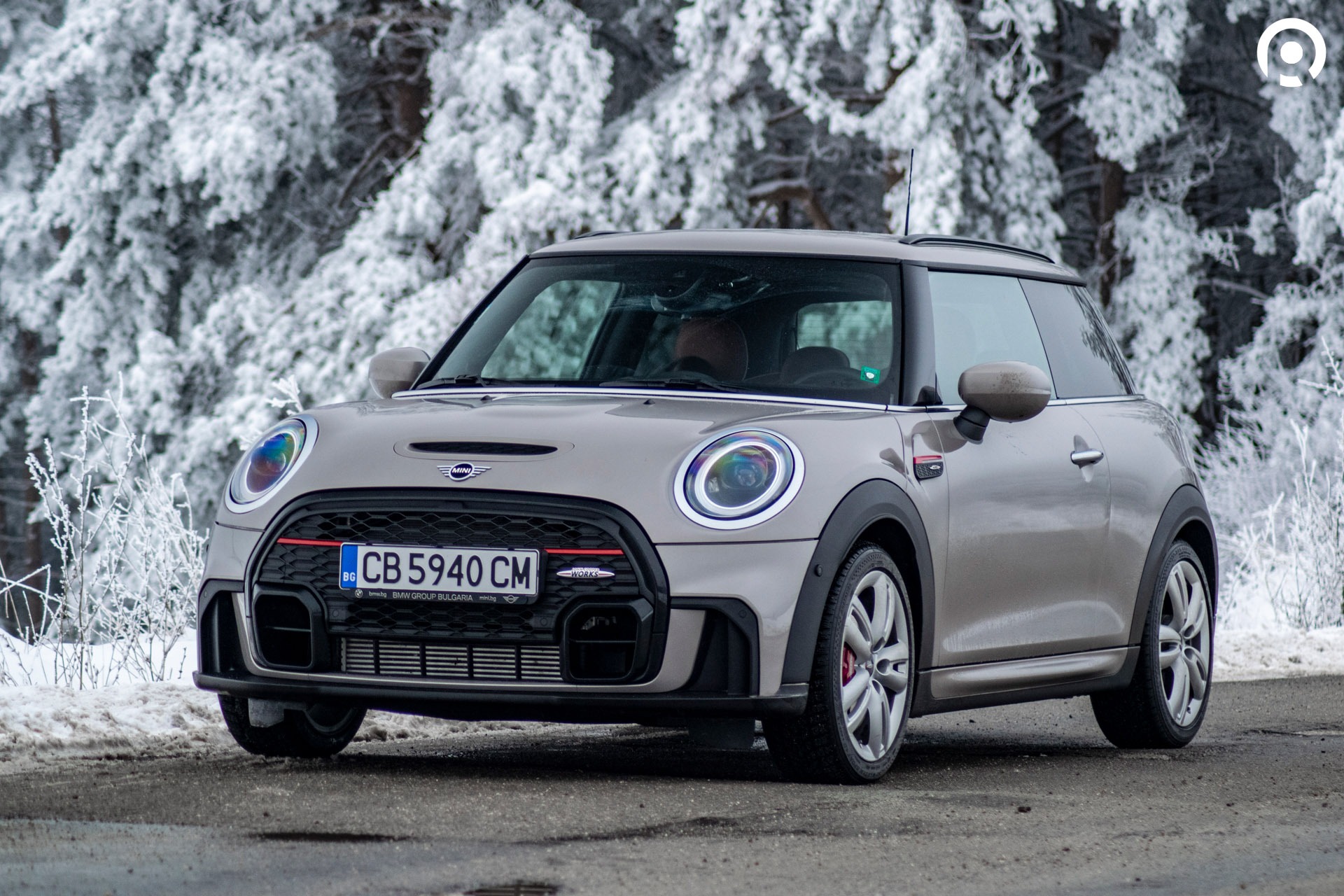
But now it is time to get to the most interesting part. The test car is not just part of the latest facelift — it is the range-topping MINI John Cooper Works. It comes with aggressive bumpers and grille, specific alloy wheels, 85 mm stainless steel exhaust tips, and large brake discs with calipers supplied by Brembo.
The result is a typical hot hatch — or, in MINI’s own spirit, a true “pocket rocket.” It clearly shows its sporting ambitions, yet it never becomes overly flashy.
That is partly thanks to the configuration of the test car: the subtle Moonwalk Grey metallic paint, a roof in the same colour and the absence of bonnet stripes.


Anyone looking for something more eye-catching can choose brighter colours combined with a roof in black, white, red or even a gradient blue. As tradition dictates, MINI offers an enormous number of personalisation options.
Interior
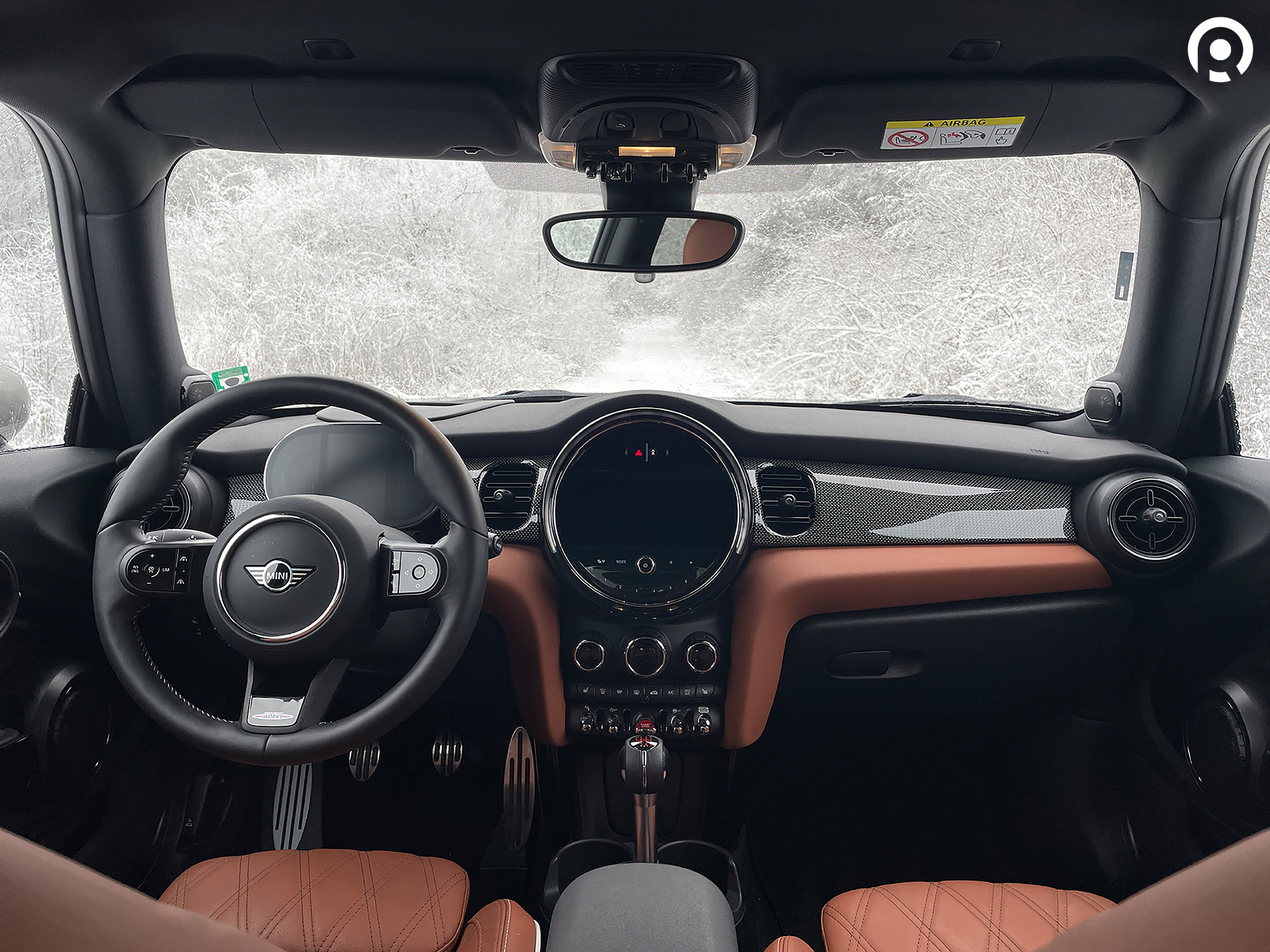
The interior of MINI is just as recognisable as its exterior. The most distinctive element remains the large central circular frame, which once housed the speedometer and now contains the infotainment screen along with several control buttons.
What impresses me most, however, is not the design itself but the build quality and sense of luxury — something rarely found in a car of this size.
The construction feels extremely solid. In addition to the many soft-touch surfaces, what really catches the eye are the chrome accents and toggle switches on the centre console, and especially the fantastic engine start switch. It turns an otherwise ordinary action into a small event.


The test car scores additional points thanks to the “Chester Malt Brown” leather interior. The combination of diamond stitching, contrasting piping and the colour itself looks excellent. It costs around €1,675, which is not insignificant, but for a JCW it feels entirely justified.
Another interesting detail is the digital instrument cluster. Normally I prefer traditional analogue gauges — properly crafted needles instead of screens. But this is the first car where I would willingly replace the analogue instruments with the digital display.
The standard configuration includes a traditional speedometer and tachometer, but they can be replaced with a digital cluster for about €200. I like the way it looks, how easy it is to read and the fact that the screen is matte and not overly large or intrusive. It fits perfectly within the modern MINI interior.

The infotainment system — typical for vehicles from BMW Group and MINI — is among the best in the industry. It is fast, visually appealing and intuitive to operate. Most importantly, it still features a rotary controller and shortcut buttons, which make it far easier to use while driving. If you enjoy making life harder for yourself, you can always use the touchscreen instead.
Apple CarPlay works flawlessly and, importantly, wirelessly, which is extremely convenient.
The test car also features the optional Harman Kardon sound system with 12 speakers. It costs around €810, but if you enjoy high-quality music it is absolutely worth the investment.


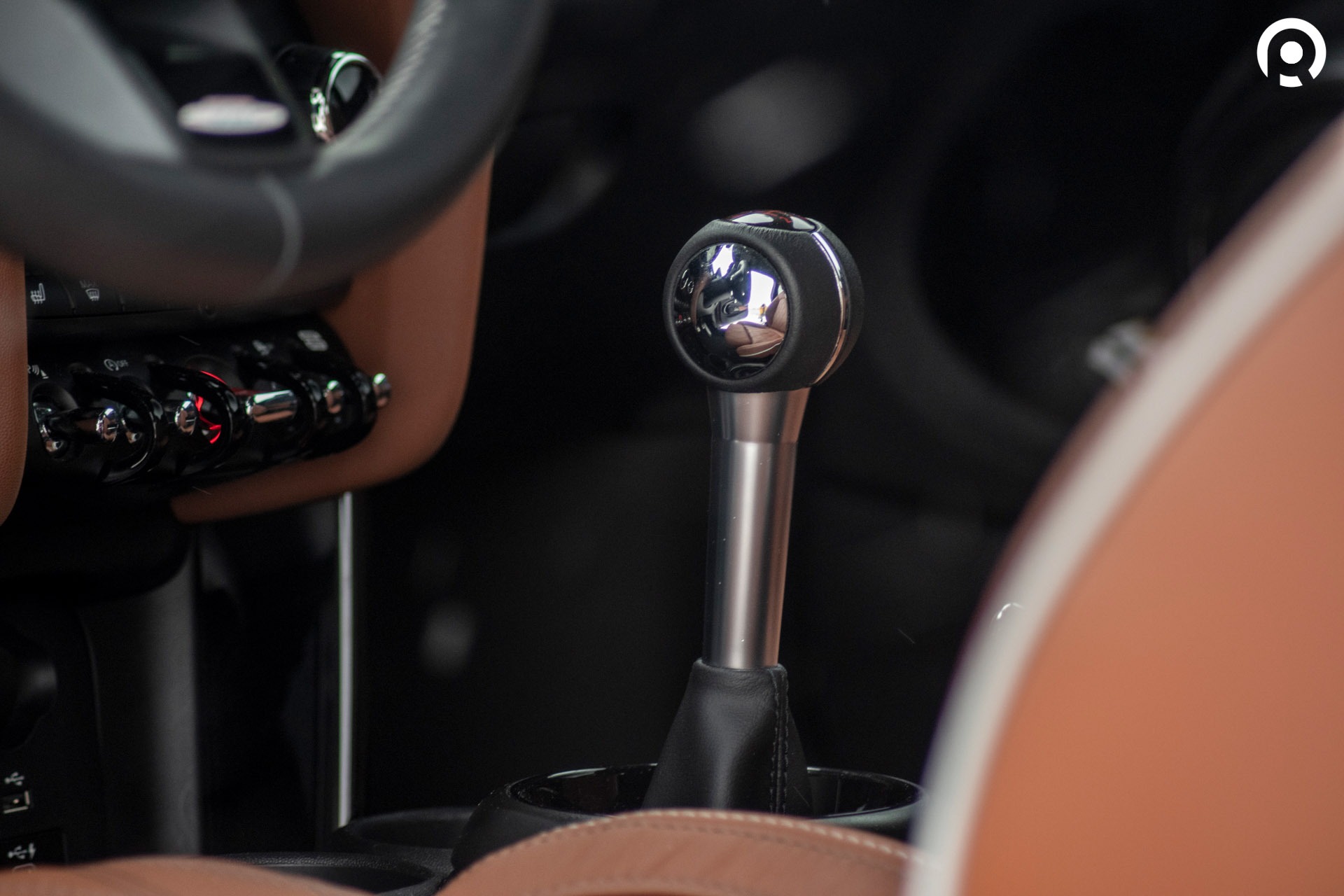
Another detail that grabs attention is the gear lever. Not only because it is a manual gearbox, which is becoming increasingly rare even among hot hatches, but also because of its construction. There is plenty of metal and the lever itself is unusually long. It instantly reminds me of the tall gear levers used in WRC rally cars from not so long ago.
Not everything in the JCW interior is perfect, however. One of the updates introduced with the facelift is the glossy “smoothed” steering wheel buttons. Yes, they look more modern, but they move slightly within their housings and therefore feel less solid than expected. At least they are not capacitive.

Then we come to the usual MINI limitations — space and practicality. This is a three-door MINI after all. The boot is just large enough for the weekly grocery run (assuming you do not buy too much), and the rear seats are best suited for people without legs. Anyone looking for more practicality should probably consider a different model.
One thing that could definitely be improved are the door pockets, which are far too narrow. MINI seems almost designed to encourage dehydration — there is simply nowhere to put a water bottle. Yes, there are two cupholders in front of the gear lever, but they are quite small. Even if they hold a taller bottle, it interferes with the gear lever and access to some of the centre console buttons.


Another detail I did not particularly like is the head-up display. Here it is one of the simpler systems that projects information onto a small transparent plastic screen rather than directly onto the windscreen. The problem is that even with height adjustment I struggled to find a seating position where the information was clearly visible without raising the seat excessively. Considering how good the digital instrument cluster already is, the optional head-up display feels somewhat unnecessary.

Finally, we come to a familiar issue — wireless phone charging. It charges slowly, and worse still, it tends to overheat the phone and cause it to shut down.
Despite these drawbacks, the overall impression of the MINI JCW interior remains extremely positive. The atmosphere inside the car genuinely makes me feel like I am driving something a little more special.
On the road

The MINI John Cooper Works is powered by a 2.0-litre turbocharged petrol engine producing 231 hp and 320 Nm of torque. There are no surprises when it comes to drivetrain layout — all that power goes to the front wheels.
The standard gearbox is a six-speed manual, and it is genuinely refreshing that MINI has not fully switched to automatic transmissions, as is increasingly the case in this segment. Acceleration from 0 to 100 km/h takes 6.3 seconds with the manual (6.1 seconds with the optional eight-speed automatic). Top speed is 246 km/h, while the official combined fuel consumption is 6.9–7.1 L/100 km.

The day I walked into the garage of BMW Group Bulgaria with the JCW keys in my pocket happened to be one of the first snowy days of the year. Overnight the snow had caught the cleaning companies off guard — and this time I was actually happy about it.
A few years ago I had a similar experience with another hot hatch, the Ford Fiesta ST. Back then I looked at the unploughed roads with slight horror, wondering how I would manage to properly test the car in those conditions and how I would take photos without the fast Ford looking like a moving pile of mud. In the end we had a fantastic time and I discovered that hot hatches are actually incredibly enjoyable in winter conditions.
As I stepped into the JCW, I already knew where I was heading — back to the same forgotten road where I had fun with the Fiesta, the one connecting Vakarel and Panagyurishte.
But first there was some work to do in the city.
This was my first time behind the wheel of a JCW and I expected something quite hardcore. I am not sure whether my personal Renault Megane R.S. has spoiled me, or whether European regulations have softened the character of the MINI, but even at startup the car seemed more civilised than I anticipated. Apart from a subtle crackle, the cold start is relatively quiet and balanced.
Soon enough I switched to Eco mode and set off through the streets of Sofia. As expected, the suspension is quite firm, although not to the point where it becomes intolerable. On certain sections of road it certainly feels harsh — but the blame there lies more with the heavily damaged asphalt.

In city driving the car behaves like a typical MINI — easy to drive, easy to park and quick when necessary. In Eco mode the JCW feels surprisingly civilised and perfectly suitable for relaxed driving.
Once again I found myself appreciating the high-quality interior, which creates a comfortable and somewhat luxurious bubble from which to observe the muddy streets outside and the countless poorly parked cars scattered across pavements, gardens and intersections.
One typical drawback of the model becomes noticeable in the city: limited upward visibility through the low windscreen. Its angle makes it difficult to see traffic lights if you are the first car at the intersection. Years ago, when I owned a previous-generation MINI, I often found myself looking at the traffic lights through the panoramic roof in such situations.


Soon I left the city and joined the Hemus motorway. Switching back to standard mode, I quickly accelerated to 140–150 km/h. At these speeds the MINI feels very stable, to the point where it is easy to forget that you are not driving a car with a longer wheelbase. Long-distance travel is surprisingly comfortable, although cabin noise at these speeds is noticeable — but not excessive.

The interesting part began once I left the motorway. As expected, the snowploughs had not yet reached the road I had chosen. Exactly what I was hoping for.
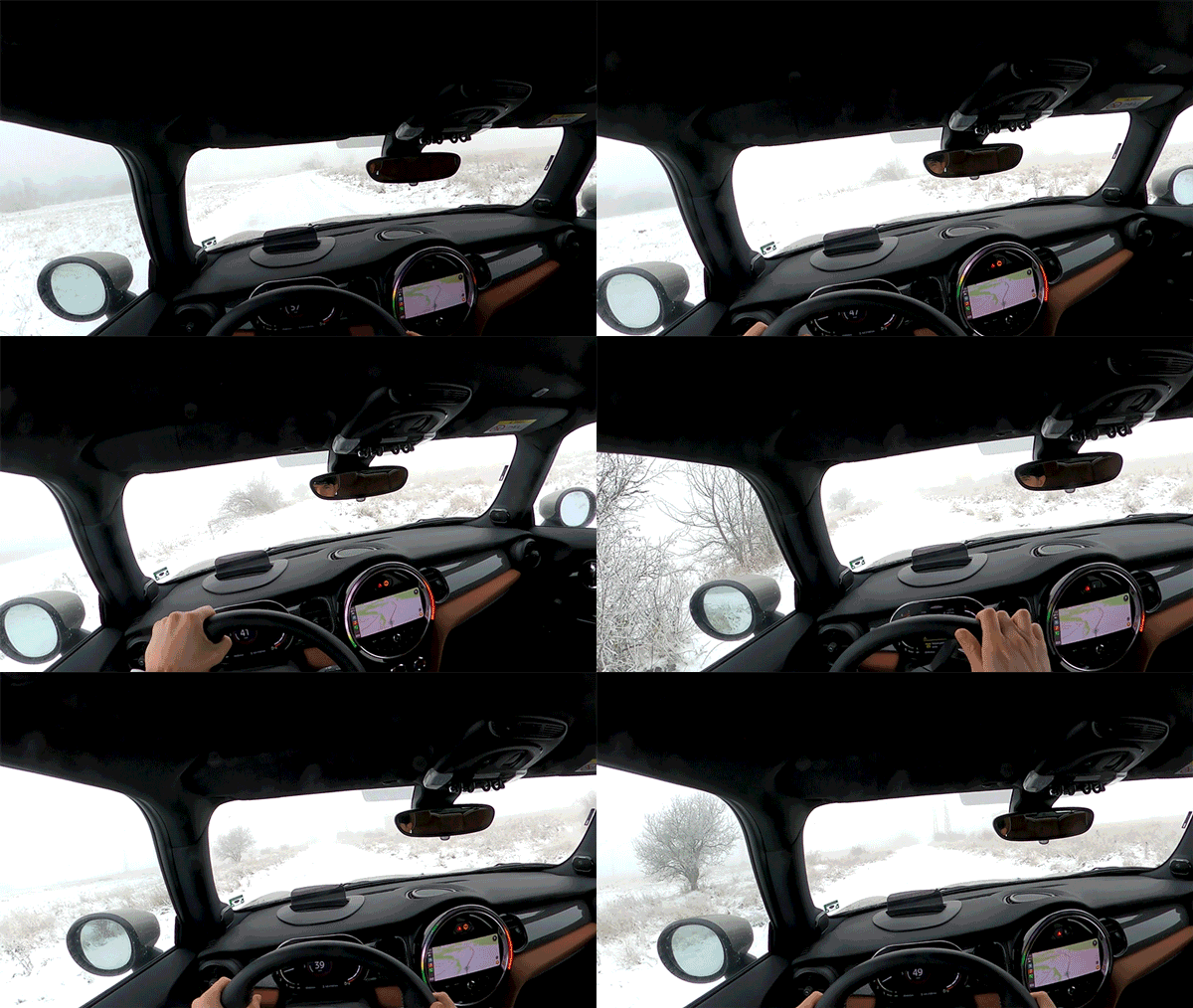
Finally switching to Sport mode, I began enjoying the snowy road with plenty of throttle, low speeds and a lot of sideways fun. Now the car became noticeably louder. It felt as if the exhaust valve had opened, and perhaps the sound was also slightly enhanced through the speakers. Whether that is the case or not, the sound itself is enjoyable, although I would have liked a bit more crackle.
Listen to the cold start and the cabin sound during more dynamic driving here:
A pleasant feature is that in Sport mode the car automatically blips the throttle when downshifting, matching engine revs. This makes dynamic driving easier and allows less experienced drivers to enjoy the full JCW experience.

The following day I was able to confirm my impressions on dry — or rather wet — asphalt around Plana and Vitosha. The car is extremely precise and stable in corners, easy to drive quickly and genuinely engaging. Using the full power of the engine is surprisingly easy — there is no sense of excess power struggling to reach the road, something that often happens with modern hot hatches.
That said, I expected the JCW to feel slightly more unruly. A bit more mechanical and purist in character. Instead, the little British hatch behaves in a rather refined way and in some situations even feels like a larger car.
Finally, I should mention one issue I encountered during the test. Occasionally the cruise control (not adaptive) would deactivate seemingly without any reason. I experienced the same behaviour previously in the MINI Cooper S Cabrio.
As for fuel consumption, the average during the entire test was 8.1 L/100 km. With normal everyday driving and the occasional sporty moment, I would expect a figure below 7.5 L/100 km, which is a very good result.
Conclusion
On the second day of my time with the MINI John Cooper Works I found myself saying: “I need to buy a MINI again.” That alone probably summarises my opinion.
The car is fantastic, and the few shortcomings I mentioned are relatively minor.
What makes the JCW unique is the way it combines luxury, style and technology typical of a higher class with a super-compact and charming package. In my view the JCW feels more like a fast everyday car than a raw, purist sports machine — which, to some extent, was my initial expectation.
Prices start at around €32,650 for the manual version, and in my opinion this is exactly the car that deserves a manual gearbox. As is typical for the brand, a large portion of the equipment is optional. A well-configured car will cost between €35,700 and €40,800, which is certainly a serious sum, but one that I believe is justified.
eng. Tsvetan Iliev