Everyone even slightly familiar with automotive history knows that the Volkswagen Golf is an institution. It is a model that has effectively defined an entire segment, with total sales exceeding 35 million units since the first generation debuted back in 1974.

The eighth-generation Golf has recently arrived on the market and, although at first glance it appears to be yet another conservative continuation of the lineage, beneath its modest exterior lie some of the most significant changes in the model’s history.
Design
At the launch of the Golf 8, I couldn’t help but think of another Volkswagen from the past — the Passat B3 and its controversial front-end design, particularly the lack of a traditional grille, which received mixed reactions back in the 1980s.
The front of the Golf 8 provokes similar emotions today. I’ve heard quite extreme opinions, and I have to admit — I’m not a fan either. There’s a lack of harmony between the sloping bonnet, the shape and positioning of the headlights, and the decorative elements in the bumper. It feels more like a design experiment than a resolved final product.

That said, once you look past the controversial front end, the rest of the car is unmistakably Golf. The silhouette holds no surprises and strongly resembles the previous generation, albeit with sharper, more modern lines.


The rear follows a similar evolutionary path, moving towards sharper forms and minimalist modernism. One element that leaves a poorer impression is the decorative chrome strip imitating exhaust outlets — the actual exhaust is hidden beneath the bumper, which feels unnecessary.

It’s worth noting the optional IQ.Light LED headlights and taillights (approximately €850), which add a noticeable touch of modernity and sophistication to the overall design.
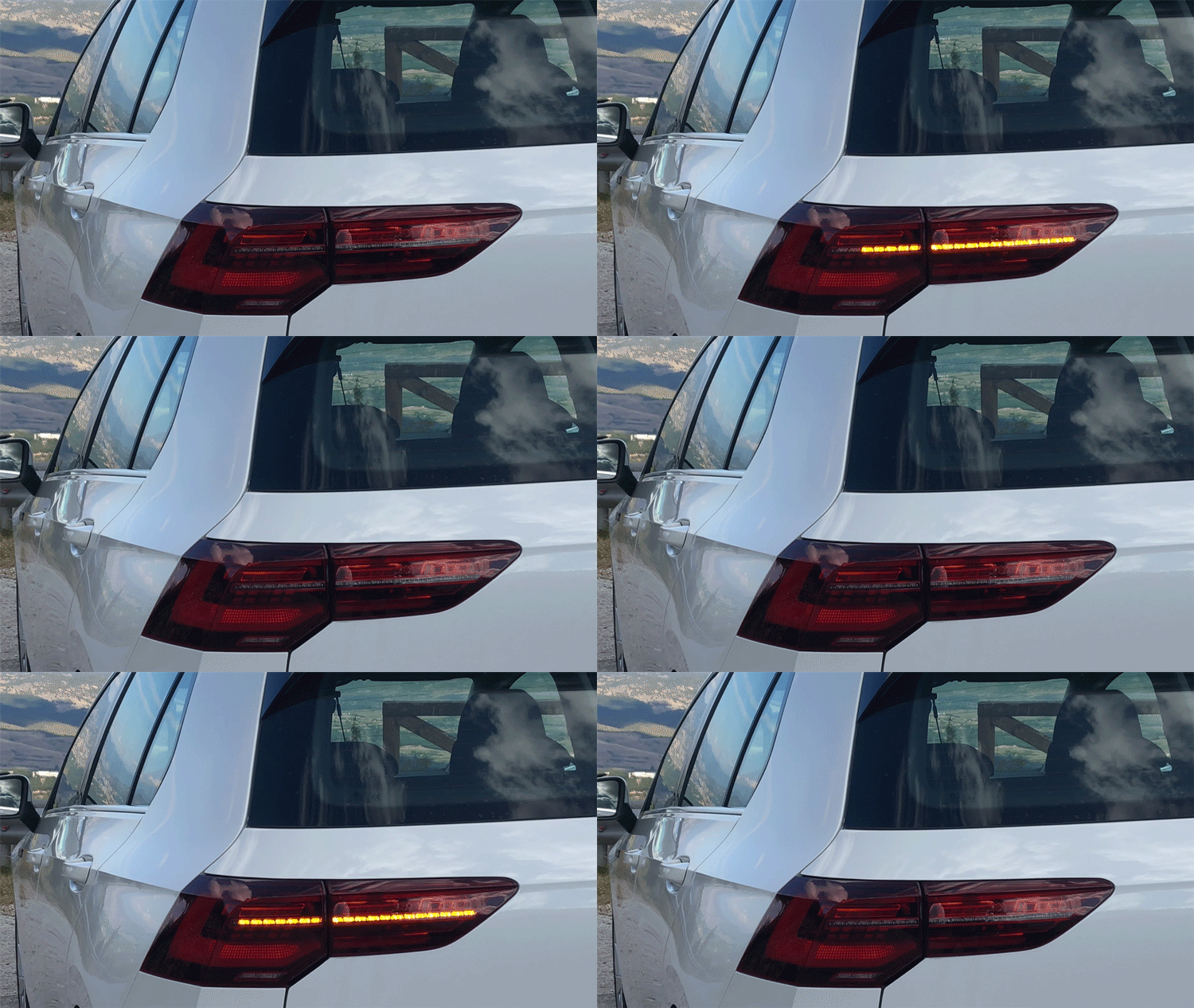

Overall, the Golf 8 retains Volkswagen’s conservative styling philosophy and builds upon the ideas introduced with the Golf 7… although, at least in my view, not entirely in the right direction. Then again, design is subjective and let’s be honest, the Golf’s long-standing success has never been driven by bold styling.
Interior
In complete contrast to its conservative exterior, the interior of the Golf 8 is surprisingly bold, modern, and digital something you wouldn’t necessarily expect from either the brand or the segment.

In fact, there is only one traditional physical button on the dashboard — the hazard lights switch. Everything else is controlled via capacitive touch surfaces or directly through the infotainment system, which comes with a standard 8.25-inch display or a larger 10-inch unit in our test car (Discover Media navigation, approx. €525).
These capacitive controls are grouped into three logical clusters:
- To the left of the instrument cluster are controls related to visibility — headlights and defrost functions for the front and rear windows.
- In the centre, around the hazard button, you’ll find quick shortcuts for key functions such as the main menu, driver assistance systems, climate control, and driving modes (Sport, Eco, Comfort, etc.).
- Just below the infotainment screen are the frequently used touch sliders, allowing you to adjust temperature for both zones and audio volume. A positive detail is that these surfaces are positioned parallel to the floor (similar to the Peugeot 2008), which makes them easier to use while driving.


Although I generally prefer traditional buttons for their ease of use on the move, I must admit that Volkswagen has achieved surprisingly good ergonomics without them. That in itself is impressive.
The modern theme continues with a standard digital instrument cluster, offering customisable information displays and clean graphics. The infotainment system is intuitive, logically structured, and supports wireless Apple CarPlay.

That said, there are some software shortcomings. For example, I accidentally turned off the climate control via the menu. When I then tried to increase the fan speed, the system displayed a message saying the function was unavailable. Logically, the system should simply reactivate the climate control when adjustments are made. Issues like this are perhaps inevitable with the rapid integration of digital technology into what has traditionally been a conservative industry – the upside is that they can be fixed with software updates.

What won’t be fixed with an update, however, is the choice of a glossy screen, which leads to distracting reflections. I’m also not particularly fond of the black gloss plastic surrounding the displays — it feels somewhat cheap and visually unappealing.
Another point worth mentioning is the gear selector in automatic versions. It is very small and frees up additional space, but its operation feels slightly unintuitive at first.

In more traditional areas, the Golf 8 scores well. Space is good, and the seats – marketed as “sport-comfort” – are genuinely comfortable, offering multiple adjustments. In the Style trim, the driver’s seat is electrically adjustable, includes memory, and even features an extendable seat base. That said, I wouldn’t call them particularly sporty, as shoulder support is lacking even during moderate driving.
Storage is practical, with large door pockets that can easily accommodate 1.5-litre bottles. The centre console includes a convenient phone compartment with wireless charging. However, in my case, the phone tended to heat up more than it actually charged, making this roughly €400 option one I would personally skip.

As for materials and build quality, the overall impression is good, with a mix of soft-touch and harder plastics — typical for the segment. Still, I expected a bit more given the German reputation for interior quality. The build feels solid, but the test car occasionally produced minor rattles from the instrument panel.


In the end, my impression is that the interior of the Golf 8 is bold, well thought-out, and genuinely impressive. I wouldn’t necessarily call it beautiful, but I do like it — although I would welcome a broader choice of colours, materials, and trim options.
On the Road
The progressive theme continues under the bonnet. With the launch of the model, Volkswagen announced a clear hybrid offensive — including mild hybrids with starter-generators and plug-in hybrids. That said, modern petrol and diesel engines are still available, while fully electric is left to the purpose-built ID.3.

Back to the Golf waiting for me in the parking lot of Porsche Sofia East on a sunny Friday afternoon. The badge on the tailgate read “eTSI”. This means a mild hybrid — a system where the electric motor does not drive the wheels but instead acts as a starter-generator. It’s a 48-volt system with a lithium-ion battery. The engine itself is a 1.5-litre petrol unit producing 150 hp, paired with a seven-speed DSG gearbox. It delivers a 0–100 km/h time of roughly 8.5 seconds and an average fuel consumption of 5.9 l/100 km.
If the acceleration figure sounds a bit uncertain — that’s because Volkswagen, like some other manufacturers, makes such data surprisingly difficult to find on their websites. Why? I genuinely don’t know.


Either way, it was time to set off. I decided to cross Sofia through the city centre to see how the car handles dense urban traffic. I grabbed the tiny gear selector with two fingers (I told you it feels unusual), shifted into D, and moved off.
In the city, the Golf 8 is easy to drive. The combination of light steering, compact dimensions (4.29 m long, 1.79 m wide), and a tight turning circle (10.9 m) makes it very manoeuvrable.
The hybrid system is particularly interesting. It works as an advanced start-stop system, shutting off the engine the moment you lift off the throttle — even at speeds of up to 80 km/h. Restarting is instant and almost imperceptible, whether you press the accelerator or the brake. The only indication is a faint, high-frequency sound from the electric motor.
Even more intriguing was something I noticed while waiting at a red light. With the engine off, the moment the car in front of me started moving, the Golf’s engine restarted before I even reacted. The car effectively “reads” the situation around it and communicates with the start-stop system. Combined with relaxed driving, this resulted in a city fuel consumption of 5.9 l/100 km.

After leaving Sofia, I headed towards Bansko. Somewhere near the Struma motorway, however, I took a wrong exit and ended up in… Pernik. Yes, the Golf and Pernik jokes may be overused, but when I parked at an OMV station and came back out, I found two Golf 4s parked on either side of the test car. Coincidence? Maybe not.
Once on the motorway, I floored the accelerator and reached a not particularly motorway-like 120 km/h. The car accelerates at a decent pace, although subjectively it feels slightly slower than expected. Under hard acceleration, the gearbox behaviour and engine sound resemble a CVT with simulated gear shifts.


At cruising speeds, with the adaptive cruise control engaged, the Golf feels composed. Road and wind noise are well contained, and the engine remains impressively refined. It continues to shut off when you lift off the throttle, even at higher speeds.


The suspension deserves special mention. I didn’t expect this level of comfort from a car in this segment — especially from a German manufacturer. It absorbs bumps, potholes, and road imperfections very effectively, although the body leans more in corners. It’s worth noting that versions up to 150 hp use a torsion beam rear suspension instead of an independent setup.

Since the car doesn’t really encourage spirited driving – and its target audience isn’t looking for that either – I decided to explore its efficiency. The next day, I set off from Bansko to Gotse Delchev with an economical driving approach. I activated the adaptive cruise control, which in this case is predictive – something I encountered for the first time in a mainstream car. The system adjusts speed according to road limits and begins slowing down even before a new speed sign becomes visible. It also uses navigation data to anticipate corners and reduce speed accordingly, often with the engine switched off.


The result is technically impressive, but not entirely enjoyable. First, the speeds the Golf considers appropriate for corners are, in my opinion, unnecessarily low. Second, this early deceleration quickly leads to a queue of impatient drivers behind you and given local driving culture, that can become a problem. After about ten kilometres, I switched off the system and took control myself. Without obstructing traffic, I reached Gotse Delchev with an impressive fuel consumption of just 3.0 l/100 km (helped by favourable elevation, but still noteworthy).


Finally, it was time to return to Sofia. I waited until nightfall to test the optional IQ.Light matrix headlights. I have to say — with the high beams constantly active, not a single driver flashed me. I’ve driven quite a few cars with matrix lights, and this is the first time the system worked flawlessly over such a long distance. In short — IQ.Light is an option well worth considering.

Over the entire test, including varied driving conditions, the average fuel consumption was 6.0 l/100 km – an excellent result.
Conclusion
The Volkswagen Golf 8 is genuinely interesting. It’s not by chance that I’ve spent more time on it than usual — it introduces technologies that will increasingly become standard in the cars we drive.
This is the first mainstream car I’ve driven that truly feels like it belongs to a more modern era of motoring. Connectivity, awareness of the surrounding environment, and communication between systems are already a reality. While not everything works perfectly yet, nothing leaves a truly negative impression.
I appreciate the refined operation of the drivetrain, the seamless engine start-stop transitions, and the solid performance of the DSG gearbox — as long as you don’t push it too hard. On the road, the Golf feels like a car from a higher class, mainly thanks to its impressively comfortable suspension. Practicality is strong for the segment, and overall, the Golf 8 remains a sensible choice. I have little doubt its sales, especially in Europe, will continue to be strong.
What it lacks is character, driving excitement, and a truly striking design — but then again, Volkswagen has traditionally targeted a different kind of buyer.
As for pricing, the base Volkswagen Golf Life with a 1.0-litre TSI engine starts at approximately €20,100. Even in this version, the car is well equipped. The more generously specified Style trim starts at around €23,000 and comes with the 1.5-litre 150 hp engine.
Eng. Tsvetan Iliev