
Not long ago, I came across the news that the one-millionth Peugeot 2008 had rolled off the production line. That makes it one of the brand’s most successful—and therefore most important—models, which is reason enough for me to spend some time with it.

Another reason I turned my attention to the 2008 is my disappointment with its smaller sibling, the 208. Some time ago, I reached the conclusion that I would rather use public transport than drive a Peugeot 208. So, getting to know a closely related—but slightly newer—model felt like a fair opportunity for redemption.
Design

The Peugeot 2008 has been on the market since 2013, has already received a facelift, and is now inevitably approaching the end of its lifecycle. This also means something else—its design language is starting to feel dated and no longer reflects Peugeot’s latest styling, which we see in models like the 3008 and 508, and which I find both distinctive and successful.
That said, the car isn’t irreversibly outdated and still looks reasonably current on the road (especially in higher trim levels). I think this is largely due to the ongoing trend of so-called SUVs. I say “so-called” because cars like the Peugeot 2008 are essentially modern successors to minivans and small city cars—they’re slightly taller and adopt some SUV styling cues, but don’t even offer all-wheel drive as an option.

Personally, I have a few issues with the design, most noticeable when looking at the car in profile. The first is the short wheelbase, combined with a rather large front overhang. The second is the “two-tier” roofline and the awkward trim above the rear doors. It strongly reminds me of a small commercial van—and I’m not sure why anyone would want their personal car to resemble one.

Interior
Inside, the situation is more interesting—at least from a design perspective. The dashboard layout is simple, but original and recognisably Peugeot.

The most striking feature is the high-mounted instrument cluster, which requires a smaller, lower-positioned steering wheel. I don’t have official confirmation as to why the French went for this layout, but my guess is that they aimed to replicate the functionality of a head-up display—allowing you to read key information without taking your eyes off the road.
In theory, that sounds fantastic. In practice, it feels like reinventing the wheel—and not very successfully. The layout forces an unusual driving position, which compromises ergonomics. On top of that, the steering wheel partially blocks the instrument cluster, which I find irritating.

Ergonomics are better when it comes to the high-mounted infotainment screen. I’m generally satisfied with it—it’s a bit slow, but acceptable for the car’s price range, and its positioning is convenient.
Material quality, however, is underwhelming. There’s a lot of rather cheap-feeling plastic, although some areas at least feature a pleasant texture. The seats are upholstered in fabric that I didn’t particularly like, though it’s worth noting that the test car is a base model—higher trims or optional upgrades offer noticeably better materials, including improved fabrics and leather. Still, despite the plastics, there is a sense of solid build quality.
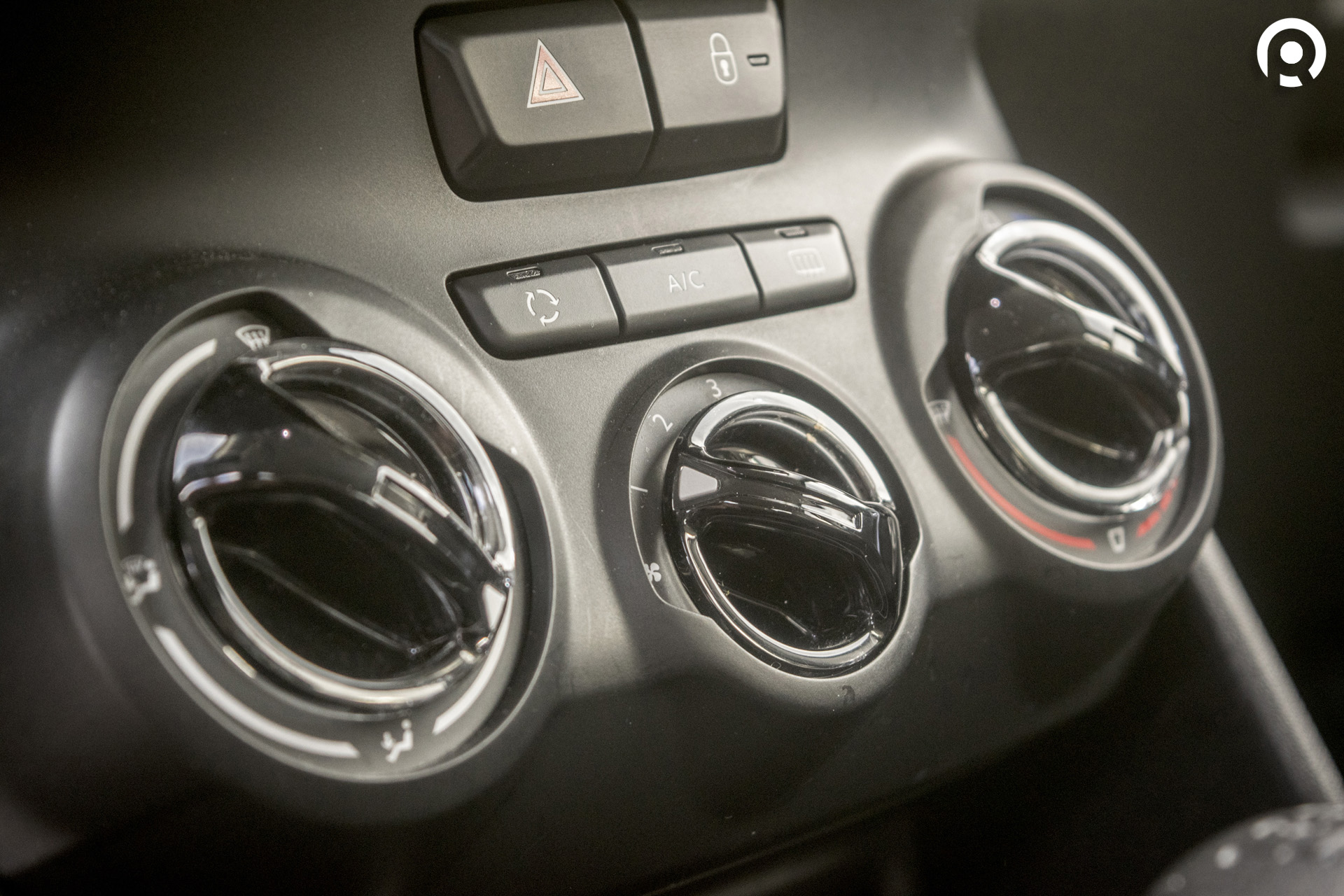


One clear strength of the 2008 is the efficient use of interior space—both for passengers and luggage. The rear seats are particularly impressive, with a high seating base and plenty of legroom. However, there are also some practical shortcomings: the door pockets are too small, and the cup holders are among the most impractical I’ve seen in a modern car. They’re so small they can barely hold anything more than a cheap takeaway coffee cup.
On the road
The test car was equipped with the base 1.2-litre three-cylinder petrol engine, producing a modest 82 hp and 118 Nm of torque. Unsurprisingly, this results in a 0–100 km/h time of 13.6 seconds and a top speed of under 170 km/h. In line with these modest figures, fuel consumption is also modest—typically between 4.5 and 5.8 l/100 km.

I’m already familiar with this engine, having encountered it in the Peugeot 208 and even the Citroën C1. So, I wasn’t surprised to find that it runs smoothly and quietly at idle—for a three-cylinder unit.
Driving through the relatively calm streets of Eindhoven (home to Philips, DAF, and PSV), I noticed something else—the engine is tuned to provide decent low-speed pull, especially when paired with the five-speed manual gearbox. In urban conditions with speed limits up to 70 km/h, the car accelerates quite well, and you wouldn’t guess it needs 13.6 seconds to reach 100 km/h. Clearly, it runs out of breath beyond that speed.
That said, driving in the city is pleasant and undemanding. The engine remains quiet at low revs, and even when pushed—where it becomes noticeably louder—the sound isn’t unpleasant. In fact, being a three-cylinder, it has a bit of character.
As for the suspension, it’s difficult to judge on Dutch roads, which are almost perfect. Fortunately, there’s a solution for that—Belgium.

After a few days of daily use, I headed towards Brussels. The moment I crossed into Belgium, the motorway surface deteriorated dramatically—something not too different from what we’re used to on the Trakia motorway. Perfect—that’s exactly what I needed.
Road noise had already been the dominant factor, as aerodynamic noise is well suppressed in the 2008. What stood out here, however, was the suspension. It offers a very good balance between comfort and stability, with a clear bias towards comfort. In fact, I’ve rarely been in such a small car that deals with bumps and imperfections so well.
Of course, this comes at the expense of cornering stability, where the car leans noticeably. But then again, the 2008 is not a car that encourages enthusiastic driving, so high cornering speeds are unlikely to be a priority for its buyers.
As for fuel consumption—if you drive economically, you can get close to 4.5 l/100 km. However, due to the lack of a sixth gear and the higher ride height, motorway consumption is higher than ideal—around 6.8 l/100 km.
Conclusion
In conclusion, I have to admit—to myself and to the world—that perhaps I’m missing something. After spending a week with the 2008, I still struggle to fully understand its market success.
Then again, I like cars. There’s a large group of people for whom a car is simply an object—a means of getting from A to B. Perhaps the 2008 appeals to them with its low purchase price and low running costs.
At the risk of provoking some disagreement, I’d say the 2008 is well suited to beginner drivers and those who aren’t particularly confident behind the wheel. Why? Because they’ll benefit from its ease of use in the city and the higher driving position, which provides a sense of security and better visibility.
That said, even for this type of driver, I believe there’s a better alternative—the Opel Crossland X.
Eng. Tsvetan Iliev


Бих посъветвал автора да тества 2008 с дизелов двигател. Според мен ще “почувства” лъвския дух на 2008 – цата.
Иначе за 1.2 бензин – бе коментар!
Такъв двигател и на VW Jetta е “жива мъка” ????