
How many of you have heard of Polestar? Probably not that many—but here’s the thing: the brand is about to become far more popular, thanks to its increasingly close relationship with Volvo.
Exactly 20 years ago, Polestar (under a different name at the time) started as a company managing Volvo’s team in the Swedish Touring Car Championship. In the years that followed, it focused on preparing Volvo race cars, and about 10 years ago it moved to Gothenburg, where it also began developing engines.
That’s when Polestar became Volvo’s official tuning partner for road cars—initially limiting itself to ECU remapping of turbocharged engines (or, in more colloquial terms, “chipping” turbo engines).

I won’t go into too much detail, but in 2014 Polestar launched its first “real” car—the Volvo S60 Polestar. A model aimed at rivals like the BMW M3—at least in terms of performance, as sales were nowhere near the Bavarian’s. The following year, Polestar was acquired by Volvo, starting a new chapter where it became a kind of in-house performance brand—similar to M Power and AMG.
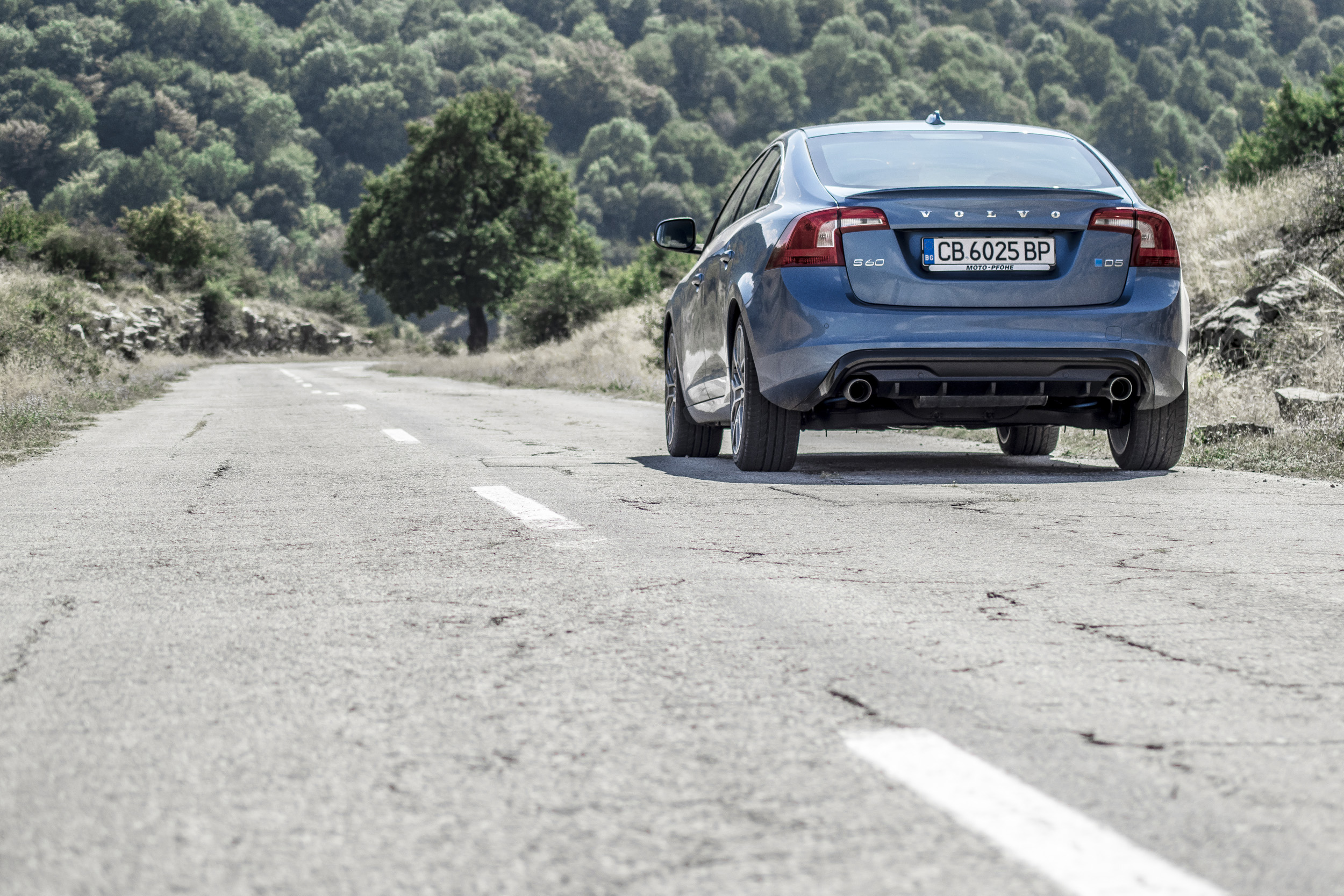
The car I’m presenting today is not the hardcore Polestar version of the S60, but a standard Volvo S60 D5 optimised by Polestar. However, this is far from a simple upgrade—it includes quite a few changes and improvements, which I’ll go through below.
Design

The current, second-generation S60 has been on the market for six years, and its retirement is approaching. That’s not just due to the usual lifecycle of modern cars, but also because Volvo itself has undergone major changes—new ownership, a new direction (thankfully!) and a completely new design language. And a new design language always makes previous models look slightly dated.


That said, the S60 doesn’t look bad or outdated on the road. Its design is clean and pleasant, combined with a dynamic silhouette that arguably looks even more relevant today than when the model was first introduced.
Volvo seems to see the S60 as a perfect platform for bold experiments. As an older model with declining sales, its image is less at risk. You might remember the raised sedan I tested a few months ago—the Volvo S60 Cross Country. Now we’re at the opposite extreme: an S60 D5 Polestar with lowered suspension, sporty bumpers and huge wheels.
It’s fascinating how many different personalities one model can have.


More specifically, the Polestar changes include 19-inch lightweight alloy wheels (which I really like), an optimised stainless-steel exhaust system (with performance benefits), lowered suspension with new springs and dampers, and a stiffer anti-roll bar. Finally, there are small touches like a spoiler and black-painted side mirrors.
The result is tasteful and restrained, although I think a more aggressive front bumper would have improved the overall visual impact.
Interior

Inside, the changes are even harder to notice—sport pedals (quite nice, actually) and a logo on the gear lever. That’s it.


Otherwise, the S60’s cabin is cosy, solidly built and pleasant in design. The issue is that this is where the car’s age becomes most apparent.
The infotainment system is complicated to operate and, while updated and functionally complete, it lags behind more modern systems in the segment. It’s nowhere near the newer Sensus system from Volvo (which I tested in the Volvo XC90 and found very impressive).
There’s also a “digital cockpit”, which was quite advanced when it debuted in 2012, but now feels dated and lacks the customisation offered by newer models.

Still, time hasn’t affected the core strengths of the interior—arguably the most important ones. There’s plenty of space, including in the rear, a good number of storage areas, and excellent practicality. I particularly like the storage pockets at the front of the seats—very convenient and something I haven’t seen in other cars.
And most importantly: the seats. They are exceptionally comfortable, combining softness with strong support in all directions. Everyone has their preferences, but I haven’t sat in better seats than those in the S60.


On the road
We’ve already mentioned some of the Polestar upgrades—revised suspension and a new exhaust system. Additionally, there’s a sports air filter and an ECU remap.
The result is a slight increase in power from 225 hp to 233 hp, and torque from 470 Nm to 500 Nm. This translates to 0–100 km/h in 6.3 seconds, with official fuel consumption between 4.0 and 5.4 l/100 km.

On the main test day, I picked up the car from Moto-Pfohe in Lyulin and decided to head towards what I jokingly call the “Wild Northwest”—around Vratsa.
Before I had even driven a kilometre, I realised something unexpected: the Polestar optimisation is far more hardcore than I anticipated. The suspension is so stiff that the Mini Cooper I drove earlier felt like a luxury limousine in comparison. Honestly, I didn’t expect that—Volvo is known for comfort, and this level of stiffness feels unusual.

Soon I found myself on the road via Berkovitsa, which was pleasantly empty. The engine and gearbox response impressed me—quick and eager. Combined with solid power, overtaking becomes effortless.
Subjectively, the car even feels quicker than the official figures suggest. Perhaps the stiff setup and enhanced engine and exhaust sound amplify the sensation of speed. I felt more connected to the machine.
Curious about the sound of the four-cylinder diesel with the Polestar exhaust? I even recorded a video (while accidentally wandering near a military base… and getting politely asked to leave):
After playing around with acceleration, I changed route towards Svoge via Iskrets. The road surface was good enough to push the car a bit.
I like the sound, and in this case, I can say that switching from a five-cylinder to a four-cylinder engine didn’t bother me. From the driver’s seat, under full throttle, it sounds quite good. What I did miss, however, was something more fundamental—all-wheel drive. This level of torque combined with front-wheel drive just doesn’t make much sense. The chassis has far more potential than what FWD allows, and in certain situations, understeer becomes a serious issue.
On my way to Svoge, I experienced several moments of strong understeer. Aside from this easily solvable issue (a 4×4 version), the car is genuinely fun to drive. It’s a very interesting combination: ultra-stiff suspension and direct steering with good feedback, paired with seats straight out of a relaxed luxury sedan.


As for the “Wild Northwest”—Vratsa initially felt quite civilised (its centre is actually pleasant), until I saw a 15-year-old Mercedes CLK drifting between speed bumps, cars driving in the opposite lane, and someone casually throwing beer cans out of a Golf IV…
Anyway, leaving the colourful anecdotes aside, I continued towards Okolchitsa, where I again enjoyed the car’s direct steering and strong engine.
On the way back, I took the main road and the Hemus motorway. There, the car remained stable with moderate cabin noise, but didn’t feel entirely at home due to the uneven surface and stiff suspension.
Fuel consumption? Around 7 l/100 km overall—unsurprising given the car’s tendency to encourage spirited driving.
Conclusion
The Volvo S60 with the Polestar package is an interesting car and a good starting point for Volvo and Polestar’s official collaboration.
However, there’s one major issue—I struggle to define its target audience, especially in markets like Bulgaria.
There are actually several problems:
First, the ride is very stiff. On long journeys, it becomes tiring unless the road surface is perfect—and in Bulgaria, such roads are limited.
Second, the price. The Polestar package costs around €15,300. That makes a car like the tested S60 D5 Polestar roughly €58,700 in total. That’s not outrageous for the class, but here’s the catch: the full-fat S60 Polestar AWD costs only about €8,200 more—and that car is absolutely worth it. It offers all-wheel drive, significantly higher performance and a 0–100 km/h time of just 4.7 seconds.
In contrast, the optimised D5 feels somewhat confused—too expensive for what it is, yet not focused enough to be a true performance car.
Third, marketing. Volvo will need to work on building the right image if it wants to attract buyers interested in Polestar-style performance.
My conclusion? The Polestar package doesn’t suit the lower-powered engines. It makes the car less comfortable for everyday use, without making it focused enough for serious driving. If you want a Polestar—go for the full version.
Eng. Tsvetan Iliev

