Ever since I founded the blog in the autumn of 2015, I have had the chance to drive the three newest additions to the class of large family sedans, or as it is categorised in Europe — the D-segment. Those cars were the Ford Mondeo, Skoda Superb and Renault Talisman — models in a class characterised by an excellent balance between price and what you get in return. In other words, you receive “a lot of car” for your money, both literally and figuratively, since most modern cars in this segment are now approaching five metres in length.
So at one point Opel asked me whether I would like to test their D-segment sedan and I thought the idea was actually rather good. Yes, the Insignia has already been on the market for eight years and we are expecting a completely new generation very soon, which naturally makes the current model less attractive, but at the same time it is interesting to see whether a car dating back to 2008 can still compete with modern rivals in terms of quality.
Besides, the Insignia is not just any D-segment sedan. This is the car that won the European Car of the Year award for 2009 and in 2011 was declared the least problematic model in its class by Dekra.

The model I tested was the hatchback version with a two-litre diesel engine producing 170 hp (an updated EURO6-compliant version introduced in 2014), paired with a six-speed manual gearbox, Cosmo trim level and generous optional equipment worth around €5,100.
Design

I remember seeing the Insignia for the first time on Oxford’s ring road back in the autumn of 2008. I was sitting on the top deck of the university bus and immediately recognised the car from a distance because it made a strong impression on me. In fact, it seems to me that this was the car that started the trend for more stylish and dynamic-looking D-segment sedans.
Thanks to its attractive design and particularly successful facelift in 2013, the Insignia still looks more than good even today. Yes, it cannot match the beauty of the Mazda 6 and Ford Mondeo, nor does it have the futuristic styling of the Renault Talisman, but it certainly still looks pleasant and modern.


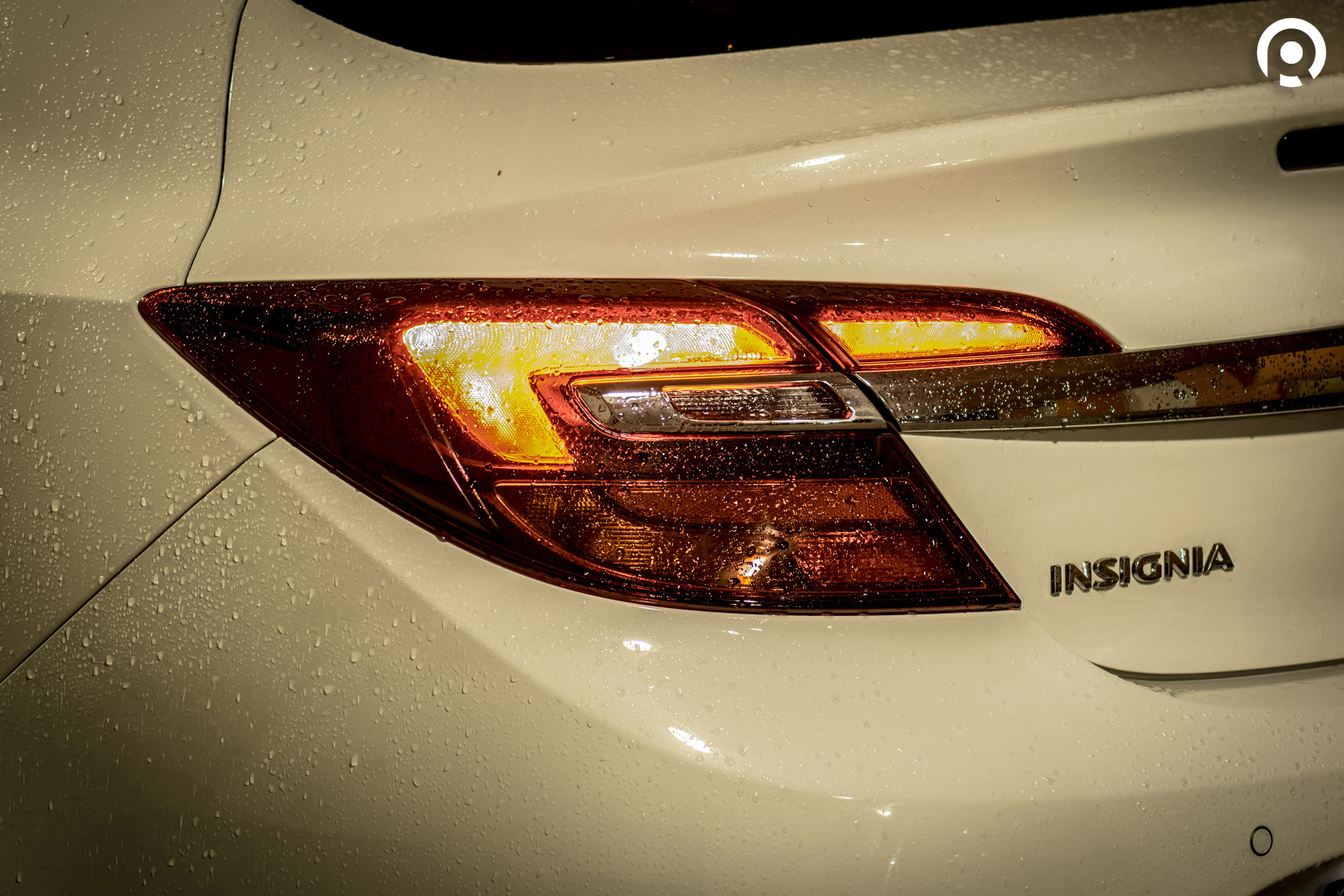
In other words, the Insignia is ageing with dignity and style.
Overall, by today’s standards the car looks restrained, yet still carries a dynamic stance because its proportions were designed that way from the beginning. The specific car I drove also stood out thanks to its wheels, which initially looked rather ridiculous in photographs, but in reality are actually quite interesting and add a subtle touch of aggression to the car’s appearance.
Interior
Inside, the Insignia feels considerably more restrained. The design is neutral and to some extent clearly belongs to the previous decade, but overall it still works well. Thanks to the 2013 facelift, the centre console gained a more modern appearance and no longer feels overloaded with buttons like before.
The touch-sensitive climate control panels and the controls for the heated and ventilated seats immediately stand out. They alone reduce the number of physical buttons by six to eight while also adding a slight “smart device” atmosphere to the cabin. On the other hand, the instrument cluster looks somewhat retro and is not particularly easy to read.

Otherwise, the materials used inside the cabin are genuinely good and at least to me they did not feel inferior to those in the newer models in this segment. The same applies to the build quality. The only real difference is the presence of more hard plastic around the centre console.
The Insignia also scores points thanks to its comfortable seats. I was genuinely satisfied with them and the test car featured four-way lumbar support as well as very good lateral support. The seats are also perfectly sized and the overall driving position felt comfortable to me — both armrests are positioned exactly where I want them to be.


The rear seats can also boast good comfort and sufficient space, with the only potential issue being headroom for taller passengers — the inevitable sacrifice of modern sloping rooflines.
As for the infotainment system, the Insignia remains perfectly competitive. Navigation through the menus is easy, the available functions are exactly what you would expect and the most interesting feature is the touchpad controller that provides physical feedback — you move your finger like on a normal laptop touchpad while feeling (and hearing) little taps underneath, making menu navigation easier. Very cool, although personally I would still prefer a traditional rotary controller.
In fact, I have only one criticism regarding the system — the display is not bright enough and suffers from glare under direct sunlight.
Another interesting feature that I had never encountered before is the onboard computer’s ability to show the main energy consumer — for example, the seat ventilation system consumes slightly over 0.5 litres of fuel per hour.
On the road

On a particularly rainy day, I collected the Insignia from the Opel dealership and decided to escape the weather by heading towards Elena. I escaped successfully, but the rain eventually caught up with me anyway.
I must admit that the moment I started the engine, I briefly wondered whether Opel had accidentally given me a petrol version. Whatever sat under the bonnet simply did not sound like a four-cylinder diesel. My confusion continued when I looked at the rev counter and noticed that the redline started at 5,500 rpm — unusually high for a diesel engine.
In any case, nobody had made a mistake. The car was exactly what it was supposed to be — a four-cylinder diesel with 1,956 cc displacement, 170 hp, 400 Nm of torque and 0–100 km/h in a not particularly quick 9 seconds.

While escaping Sofia, the car impressed me with its manoeuvrability. Around the city it moved quietly and overall both the steering and gear changes are smooth and effortless. Even within the urban environment, it became obvious to me that this would be a relaxing car both to drive and to travel in.
That impression was further reinforced on the road towards Veliko Tarnovo. Even at higher revs, the engine maintains its quiet and balanced operation, while the stronger sound heard under heavier acceleration is more hoarse and low-frequency than rattly. That pleasantly surprised me.
Aerodynamic refinement is similarly impressive — wind noise is well suppressed apart from the usual turbulence around the mirrors and A-pillars. In terms of overall noise levels, the most noticeable source (aside from the pleasant sound of the Bose audio system) comes from the wheels and road surface, as the suspension and wheel arch insulation do not quite perform well enough.
The suspension itself is distinctly comfort-oriented and handles the short transverse bumps so typical of the Hemus motorway very well. At the same time, it prevents excessive body roll, although vertical body movement remains noticeable.
Overall, my journey to Elena was comfortable and relaxing. Frequent gear changes were unnecessary because the engine is flexible and provides sufficient pulling power across a wide rev range. I also reached my destination with fuel consumption of 6 l/100 km, which seemed like an excellent result considering I drove without thinking about economy and with a fully loaded car — exactly the way most large family sedans are actually used.

The next day I decided to drive through the Republic Pass before continuing along the Sub-Balkan road and eventually reaching the area around Plovdiv while driving relatively economically. Naturally, I still could not resist pushing the car harder through a few twisty sections, where once again I passed a 20-year-old BMW 3 Series sitting in a ditch — the last few times I have driven through that area, there has always been some ageing BMW lying somewhere beside the road… incompetent and unprepared “racers” simply never stop.
Otherwise, the Insignia is definitely not a car designed for overly dynamic driving, but it still offers good grip and relatively late understeer, which arrives gradually and predictably while remaining easy to control. Overall, the car inspires confidence in its abilities, but it remains first and foremost a large vehicle intended for calm and comfortable travelling.
As for my attempt at economical driving, I reached Plovdiv with fuel consumption of 5.3 l/100 km.
After joining the Trakia motorway, I once again noticed something I had never encountered before — adaptive cruise control combined with a manual gearbox. I genuinely respect Opel’s decision to offer such a system without forcing customers into choosing an automatic transmission.
In fact, Opel generally offers remarkable flexibility regarding drivetrains and virtually every possible combination of engines, front-wheel drive or all-wheel drive and manual or automatic transmissions is available. Hopefully this will continue with the arrival of the new model, although I have some doubts because in today’s automotive world such flexibility is not particularly profitable.

Another thing that left an unpleasant impression during the drive back to Sofia was the fact that no more than 20 percent of drivers used their indicators while changing lanes… Bulgarian driving culture in action…
Conclusion
I have to admit that I approached the Insignia expecting it to perform noticeably worse than the newer models in its class and overall, expecting not to like it very much. I also have to admit that this initial attitude turned out to be completely unjustified.
The Opel Insignia does not fall behind the newer representatives of the D-segment. The car delivers a well-rounded package alongside comfortable and economical travelling. Overall, it feels like a car designed for more mature and practical people.
I like the fact that it is offered with a wide range of engines, an extensive colour palette and numerous attractive wheel designs, giving buyers a good level of personalisation — something not particularly common in this segment. Equipment levels are also generous, while prices remain reasonable.
The test car, with its powerful engine, driver assistance systems including adaptive cruise control, navigation, ventilated leather seats and so on, costs slightly above €30,600.
Still, as is typical towards the end of a model’s lifecycle, buying one now could be disadvantageous because of stronger depreciation once the new generation arrives. Then again, the exact same reason could make it an excellent deal — dealers become more willing to offer generous discounts, especially on the last cars in stock, while it should not be underestimated that an older model is most likely already cured of all the small and not-so-small problems that often accompany the launch of a completely new car.
Eng. Tsvetan Iliev