
Opel is one of the oldest automotive brands in Germany. In fact, the company originally started by producing sewing machines, later moved to bicycles and eventually to cars. I begin with this short history lesson because a few years ago the brand went through a historic transformation, and the second-generation Mokka is the first Opel after that change to appear on Roadhunter.
The transformation in question was a change of ownership. After nearly 90 years under the umbrella of General Motors, the company was acquired by PSA and soon afterwards became part of the Stellantis group.
This shift brought positive financial results for Opel and introduced a new wave of models using French technology. Mokka is among the first completely new vehicles born from this cooperation and, at first glance, it looks very promising. Today we are checking how this new partnership has influenced the second generation of the popular urban SUV — and to make things more interesting, we are testing it in its fully electric form.



Design
A few years ago I shared a rather unflattering personal opinion about the design of the previous generation Mokka. I said that its rounded shapes combined with the short front end reminded me of something halfway between a minivan and a plush toy. Times change, however, and in my view the new model is among the most attractive representatives in its class.

With the new Mokka, Opel introduces the design language we will see on its upcoming models in the years ahead. The front end is, in my opinion, the most distinctive and appealing element of the car. Apparently the Germans think so too, as they have even given this “face” a name — the Opel Vizor. The front panel (which clearly isn’t a traditional grille) combined with the headlights forms a single, bold visual element. The result is a modern and rather strict appearance in which I personally see several subtle retro references to Opel models from decades ago.

From the side the car looks compact and tight, with a very short rear overhang. The visual separation of the roof from the body adds a touch of dynamism to the overall appearance.
The test car is actually the most dynamic-looking version of the model because it comes in GS Line trim (the sport line). In this version, all elements that are light grey or chrome on other trims are finished in black. The wheels are black as well. Combined with the bright green Matcha colour, the effect is genuinely striking.

In my opinion the designers have done a great job this time. That is particularly important for a model competing in a class where styling sells — and where the number of competitors is enormous.
Interestingly, Mokka is the final project of Opel’s long-time chief designer Friedhelm Engler before his retirement after 30 years with the company. Well, Herr Engler clearly made an effort 🙂


Interior

Inside, the compact Opel looks just as modern. At the same time, I personally see another charming retro reference in the overall layout — something that reminds me of Opel models from the 1980s, especially the Opel Ascona.
Whether intentional or not, Opel clearly liked the result because they even named part of the interior design. It is called Opel Pure Panel — the combination of the digital instrument cluster in front of the driver and the infotainment display. Both screens are integrated into a single block that is slightly curved toward the driver.
If you are wondering about the meaning behind the name, Opel claims that these displays focus only on the most essential information, promoting a form of digital detox. With two configurable screens? Well… if they say so.

The infotainment system itself is decent without being particularly impressive. It is neither the most intuitive nor the fastest system on the market, but you quickly get used to it. More importantly, Mirror Link — meaning Apple CarPlay and Android Auto — comes as standard on all versions except the base Edition.
Since we are talking about screens, I want to highlight something else and actually congratulate Opel for the decision. Climate control and temperature adjustment are handled through traditional hardware buttons. This is becoming increasingly rare today. The modern trend is to control everything through the central touchscreen, which can be difficult and distracting while driving — especially on roads like ours.

I would also like to mention the parking camera, because here the technology is not quite as advanced as the rest of the car suggests. There is only a single camera mounted at the rear. On its own it is rather impressive, offering a 180-degree real-time view, and when reversing it creates an image that transforms into a simulated 360-degree view. It is an interesting solution, but a true multi-camera 360-degree system would have been a welcome option.


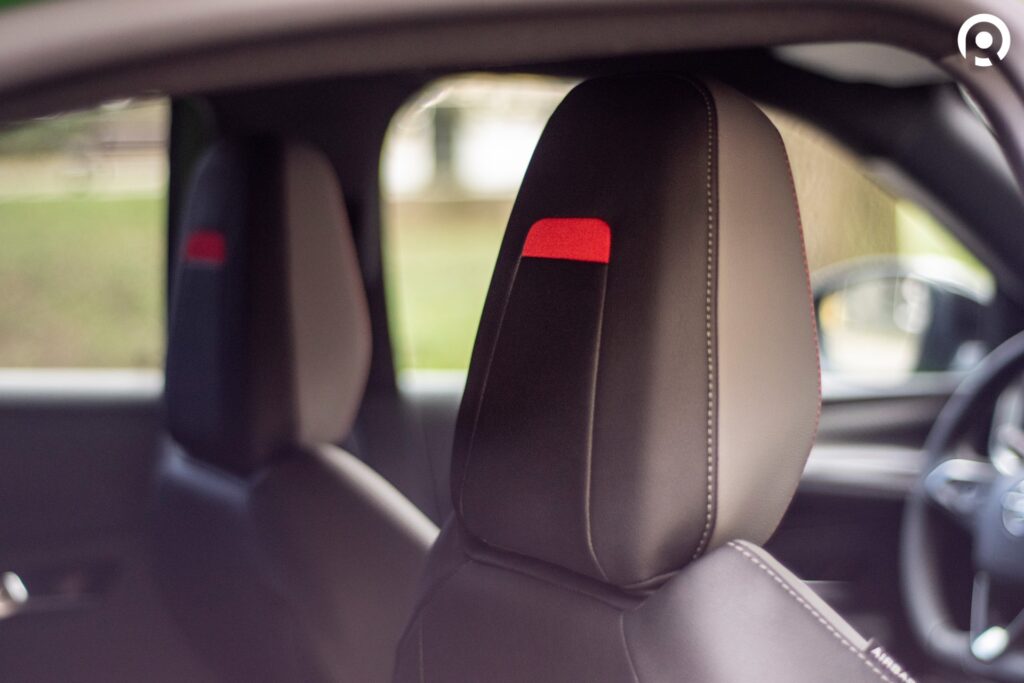
As for materials and build quality, the situation can be described as firm but solid. Everything feels well assembled and robust, but there is quite a lot of hard plastic. This is not necessarily a problem because the textures make it less intrusive and the overall feeling remains solid. The issue appears when you remember that this is not a cheap car — especially not in its electric version.
Practicality in the front is good, with wide door pockets, cup holders and several small storage areas. In the rear things are less impressive. The door pockets are small, but the real limitation is the overall space for legs and knees, which is rather modest.

On the road
Opel Mokka-e shares its technical foundation with the Peugeot 2008. Nothing unusual here. After all, Opel was acquired by PSA Group in 2017, and the company later became part of Stellantis in 2021 following the merger with Fiat Chrysler Automobiles. But let’s leave these rather tangled corporate relationships aside.
Mokka is offered with 1.2-litre three-cylinder petrol engines producing either 100 hp or 130 hp. Surprisingly, a diesel option is still available as well — a 1.5-litre four-cylinder producing 110 hp. As you can probably tell from the model name in the title of this review, however, none of those engines are the focus here. The test car is the fully electric Mokka-e.

The car is powered by an electric motor producing 136 hp and 260 Nm of peak torque. It is mounted under the bonnet and drives the front wheels. The lithium-ion battery pack has a capacity of 50 kWh and is located in the floor of the car beneath the seats. It consists of 216 cells arranged in 18 modules.

Acceleration from 0 to 100 km/h takes 9.0 seconds, while top speed is electronically limited to 150 km/h. As for range, the official figures suggest approximately 310–320 kilometres on a single charge.

On the road, Mokka-e behaves in a very refined manner. It moves smoothly and quietly, something that is undoubtedly a result of its electric drivetrain. The absence of gear changes and the effortless way in which it accelerates — without the strained noise of a small combustion engine — creates the impression of a car from a higher segment.
Next to the gear selector there is a small B button. Activating it increases regenerative braking when lifting off the accelerator (normally regeneration occurs mainly when the brake pedal is pressed). Driving this way reduces the need to use the brakes and improves the overall efficiency of the system.
The small Opel feels most at home in the city. With a length of 4.15 metres, finding a parking spot is rarely a problem. There is also the undeniable advantage that in many cities electric vehicles are still exempt from paid parking zones — at least for now.
Visibility is good thanks to the slightly higher seating position, which is a typical SUV advantage. The downside of that same height — increased aerodynamic resistance — simply does not matter much at low urban speeds. In addition, Mokka-e rides very comfortably and filters out road imperfections well, even with the larger wheels fitted to the test car.

Outside the city the Opel continues to behave competently and remains quiet even at higher speeds. The electric drivetrain delivers performance that we would normally expect from a slightly more powerful combustion engine. The steering is neutral — not dull, but far from engaging — and when pushing harder through corners the car begins to understeer relatively early. Overall, it is a pleasant car to travel in, as long as you have enough battery to reach your destination.
My direct experience with the car ended rather quickly because the next day my colleague Denis and I headed off on a secret mission where the Mokka-e became his vehicle. What we encountered there and what his impressions were will be revealed on February 27 at 17:00 in our new show on the Roadhunter YouTube channel.

…and you probably didn’t expect me not to mention charging, right?
I have driven quite a few electric cars, but always within the city and its surroundings. With Mokka-e I travelled further away from Sofia for the first time and, quite literally and figuratively, “got myself into a movie”. The literal part you will see on YouTube. The figurative one came from unexpected problems with charging stations.
We had planned charging stops at three stations and eventually had to add two more. We experienced issues with three of the first stations — actually, with all of them.
The first two problems were software-related. In one case charging started but could not be stopped because the station had internet issues. After ten minutes of trying to reach support on a Saturday evening I eventually managed to unplug the cable and leave. In the second case the stations simply refused to start charging at all.
It is also worth noting that we filmed in fairly cold weather, which reduced the real-world range of Mokka-e to around 180 kilometres. That means energy consumption of roughly 25 kWh per 100 km. Charging at public stations at those rates results in roughly €9 per 100 km, while charging at home on a night tariff could cost around €1.40 per 100 km, which is significantly cheaper.

These observations about charging infrastructure and costs are not meant to discourage people who like electric cars. What I want to emphasise is that their use is still somewhat specific. They look like the cars we have been driving for decades, but they require a certain change in habits. Charging infrastructure will certainly improve over time, but for now my opinion remains that the natural habitat of electric cars is the city.
Conclusion
The new Opel Mokka is among the most attractive proposals in its segment. In my opinion it shares that position with its technological sibling, the Peugeot 2008, and perhaps also the Nissan Juke.
Mokka grabs attention with the brand’s new design language combined with a palette of bright colours. The green of the test car is undoubtedly my personal favourite.
The interior is modern and generally practical, although rear seat space is somewhat limited. The materials are mostly hard plastics, but despite that the cabin still manages to create the impression of a well-built and quality car.
Prices for Mokka start at roughly €20,200. Personally, I would recommend aiming for the Elegance trim level. With it you get most of the desirable equipment along with the more powerful base engine for about €24,200.
The numbers for the electric version are quite different. In addition to being more than 300 kg heavier, it is roughly €12,700 more expensive than the equivalent petrol model. Mokka-e starts at around €35,500 and can reach just over €40,800 in its highest trim level.
Personally I quite like the car and I believe Mokka — and especially the electric version — would work well as a second vehicle for families who spend most of their time in the city and want to stay in step with modern mobility.
eng. Tsvetan Iliev

