As a child I was fascinated by interesting cars. After all, during the 1990s the Bulgarian car fleet still consisted largely of former socialist dreams or old Western sedans and hatchbacks. Naturally, whenever I saw something like a Porsche 911 or a Mercedes-Benz SL, I was seriously impressed. But alongside those encounters with German sports cars, another memory comes to mind.
It was 1994, somewhere near the seaside. Parked next to the beach was a white Jeep Wrangler with the doors and roof removed. Its tall body, large tyres and unmistakably “military” appearance immediately captured my attention.
Why do I start with this story? Because it is fascinating how generations of the Wrangler have changed, the world around us has evolved, and the type of people who drove those impressive cars back then now either drive nothing or cruise highways in something like a Toyota Sequoia. Yet despite all those changes, today I still perceive the Wrangler exactly as I did in 1994.

That is because the model is a true classic, the very archetype of the Jeep brand — and for off-road vehicles it represents what the Porsche 911 is for sports cars.
Design
Although the first generation of the Wrangler appeared at the end of the 1980s, its design language dates much further back. In 1940, the United States Army issued a request for a lightweight off-road vehicle. Willys-Overland won the contract and began production.
After the war, the company introduced a civilian version known as the CJ (Civilian Jeep). That model established the design language we see with the first Wrangler in the 1980s — a concept that has not undergone major conceptual changes since. The biggest change came in 2007, when a four-door version was introduced.

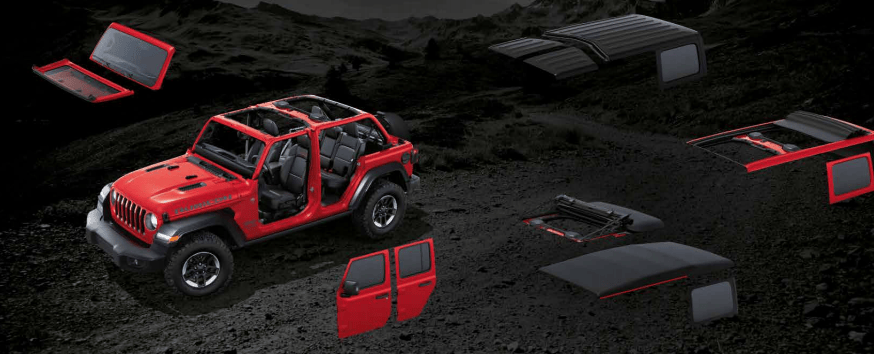
Speaking of doors, they are not mandatory. One of the Wrangler’s most distinctive features is its Lego-like modular body concept, which allows you to easily transform the car. The doors can be removed, the windscreen can fold forward, and the roof consists of removable panels. The result is a striking resemblance to the utilitarian original from over 80 years ago.

It is also worth noting that this concept allows for three roof options: a hard top (as on the test car), a hard top with an electrically opening soft section, a fully soft roof.
Perhaps I introduced more history in the design section than usual, but in this case the two go hand in hand. The result is a vehicle defined by rugged lines, exposed hinges, pronounced wheel arches, massive bumpers and numerous retro-inspired details.


I will finish the design section by mentioning the extensive customisation possibilities. Wrangler buyers can choose from numerous accessories and a very interesting colour palette. The colours themselves are vibrant, but their names are even more entertaining: Punk’n Metallic (orange), Hellayella (yellow) and Bikini (greenish). They amuse me, although they also sound like someone at Jeep allowed a particularly creative redneck to name them.

In short, this is an icon of the Jeep brand and one of those vehicles that has remained unmistakably recognisable for decades.
Interior
The interior of the Wrangler continues the theme with utilitarian shapes. The first thing I want to mention is that although the design remains rugged, the quality of materials has improved significantly. Jeep models from 15 years ago were often criticised — typically in American fashion — for poor material quality and interior finish.
Here, however, the rugged design is combined with a noticeable touch of luxury. There are more soft surfaces than I expected, good textures, metal and metallic finishes. Overall, the interior both looks and feels solid.

In the automotive world it often happens that ergonomics suffer as a result of design trends. Here the opposite is true — and I appreciate it. In keeping with the Wrangler’s spirit, the car features large, traditional analogue buttons. Excellent! I do not want capacitive controls, and I have yet to hear someone say they find them particularly convenient.


An interesting detail is that the audio system is controlled by buttons located on the back of the steering wheel. At first I even thought they were paddle shifters. I wondered why such a feature would be needed in a car like this. I pressed one and… changed the song. Once you know what they do, it is actually a very convenient solution.
The Uconnect infotainment system features an 8.4-inch display and is standard in the Sahara and Rubicon trims. In the base Sport version the screen is only five inches and lacks Apple CarPlay and Android Auto. The system itself offers relatively basic functionality but works well and uses large interface buttons, making it easy to operate.

Another standard feature on the Wrangler Sahara is the Alpine audio system, which sounds very good and is powerful enough to overcome the wind noise when driving with the roof removed.
As for modern technology in the cabin, one thing I did not like was the 7-inch information display between the speedometer and tachometer. Its reactions are slow and eventually become slightly irritating. Otherwise, the Wrangler offers generous interior space, comfortable seats and a reasonable number of storage compartments.

Door pockets are replaced by mesh nets, but there is a deep compartment under the centre armrest, cup holders and various practical storage solutions.


Finally, there is one unusual but clever detail. Since the Wrangler will inevitably encounter mud, the interior floor can be washed with a hose. The carpet is waterproof and removable, and the floor includes drainage plugs.
Overall, I like the Wrangler’s cabin. It combines practicality, space and the unmistakable classic Jeep character.
On the road and off it
One pleasant autumn morning I arrived at the showroom of Vitosha Auto. The last time I visited it was full of models from Infiniti, but after the brand’s withdrawal from Europe the situation has changed. Now the showroom is filled with vehicles from Jeep and Alfa Romeo, as Vitosha Auto has become their official representative.

Waiting for me outside was a white Jeep Wrangler Unlimited Sahara. The car is equipped with a 2.0-litre petrol engine producing 272 hp and 400 Nm, paired with an eight-speed automatic transmission. For many buyers the following numbers probably do not matter much, but the Wrangler accelerates to 100 km/h in 7.6 seconds and reaches a top speed of 180 km/h. More relevant figures include ground clearance of over 24 cm and the ability to cross water obstacles up to 76 cm deep.

Once seated behind the wheel I headed towards the exit of Sofia. The first impression came from the vehicle’s shape and driving position. The height, upright windscreen and long bonnet create a very distinctive driving experience. It feels unusual — and therefore turns driving into an event rather than just another commute.
Interestingly, the rugged appearance does not translate into rough road manners, at least in the city. At 50–60 km/h, the Wrangler is relatively quiet and easy to drive. After leaving Sofia I pressed the accelerator fully and something unexpected happened. The white Jeep launched forward with surprising enthusiasm. Perhaps my expectation of driving a slow off-roader amplified the sensation, but soon I was cruising at 140 km/h on the Trakia Motorway.


At that point the quiet and refined behaviour ended. Engine and road noise remain relatively low — or perhaps they are simply masked by the dominant wind noise. The modular roof increases air turbulence, and some panels and latches can produce occasional creaks. This is simply part of the Wrangler experience.

I left the motorway and headed towards the Sub-Balkan road, where driving the Wrangler felt relaxed and enjoyable. The vehicle is not excessively noisy and rides reasonably well. Occasionally the tyres squeal slightly in corners, the steering is slow, and the brakes require some adaptation. Yet these characteristics add a raw charm rather than detract from the experience. Eventually I stopped and removed the front roof panels. After a few minutes they were stored in the boot and I continued towards my off-road destination.


Leaving the asphalt near Bunovo, Sofia Province, I followed a rocky dirt road climbing towards the Balkan mountains.
Initially I kept the car in rear-wheel drive, curious to see how far it could go. Wrangler uses solid axles, which provide excellent traction on difficult terrain.
Soon deep puddles and fresh mud appeared — yet the Jeep continued effortlessly.

After about ten minutes I reached a fork. One road made a long detour around a steep hill, while the other led directly up it. Naturally, I switched to low-range gearing. Moments later I was already at the top. From there the journey continued through mud, slopes and rocks all the way to Chavdar Hut. The route was far from extreme off-roading, but for someone without much experience it was still a challenge — one the Wrangler handled with complete ease.
The only thing that could have made the experience even better would have been removing all four doors and the entire roof.

After about 250 km of driving in all kinds of conditions, including several hours off-road, average fuel consumption reached 11.3 l/100 km.
Conclusion
The Jeep Wrangler is a capable toy for grown-ups. In that sense it reminds me of the Suzuki Jimny and the Mercedes-Benz G-Class — vehicles defined by classic design, genuine off-road capability and a huge amount of character. Many years after seeing it on that beach, I finally met one of my childhood heroes. Often such encounters lead to disappointment. Not this time.
The Wrangler won me over completely. It is a fascinating and highly enjoyable car, and it is no surprise that it remains so iconic on its home market in the United States. Driving it truly feels like an event.
Of course, the Wrangler is a very specific vehicle. Its off-road abilities and modular body come with compromises: high aerodynamic noise, occasional creaks from removable panels, relatively high fuel consumption and less refined behaviour on asphalt.
The price is also far from low — starting at around €52,000, while the attractive Sahara and Rubicon versions cost roughly €5,000 more.
Still, I believe the Wrangler is an extremely appealing choice for people who love nature, unusual cars and adventure.
Eng. Tsvetan Iliev