When we think of MINI, we usually imagine big character wrapped in a not-so-obligatory compact package. The third generation of the MINI Countryman once again proves that the brand can combine memorable design, practicality and driving enjoyment in a single product.
The new Countryman has grown significantly – longer, taller and with a much stronger SUV presence. It is no longer just a “compact crossover”, but a fully fledged family car that blends MINI’s modern spirit with new technologies and noticeably more space.
The John Cooper Works version I had the chance to test sits at the very top of the range – a combination of performance, sporty character and functionality. It continues MINI’s tradition of being different, while not being afraid to grow and adapt to the needs of modern drivers.
We are testing the MINI Countryman JCW.
Design

At first glance, the new Countryman looks bigger in every direction and carries a much clearer SUV identity. It differs considerably from previous generations, yet the continuity in design is evident and, most importantly, it is instantly recognizable as a MINI.
The new design language relies on more defined lines combined with minimalism, which to me gives it a slightly concept-car feel.
This is not just any Countryman, though – this is the John Cooper Works. The front end is aggressively styled, with gloss black decorative elements and accents finished in Chili Red. From the side, the car appears noticeably longer than before, while the gently sloping roofline towards the rear adds a sense of visual weight to the overall stance.

The side profile is distinctive – no small achievement in a segment full of similar-looking compact SUVs. The upright windscreen, visually separated roof and the interestingly shaped C-pillar, featuring the John Cooper Works logo, all contribute to that identity. The large wheels, inspired by a racing flag motif, and the oversized Chili Red brake calipers add further character.
I particularly like the rear design. The elongated taillights make the car appear wider and more planted. There is something slightly “hooligan” about this rear end, enhanced by the four exhaust tips and the aggressively styled bumper with a faux diffuser.

Aerodynamically, the Countryman performs impressively well, with a drag coefficient of Cd = 0.26.
MINI has always emphasized personalization – body colors, contrasting roofs, materials and accessories. Here, they go even further, offering customizable light graphics for the daytime running lights and rear light signatures, with three selectable options. It’s the first time I’ve encountered such a feature, and it’s a clever way to exploit the flexibility of modern LED technology.


Overall, I genuinely like the design of the new Countryman – and that applies to the standard versions as well.
Interior
When I first saw the new MINI interior design, I thought: it looks good, but this might be an ergonomic nightmare.
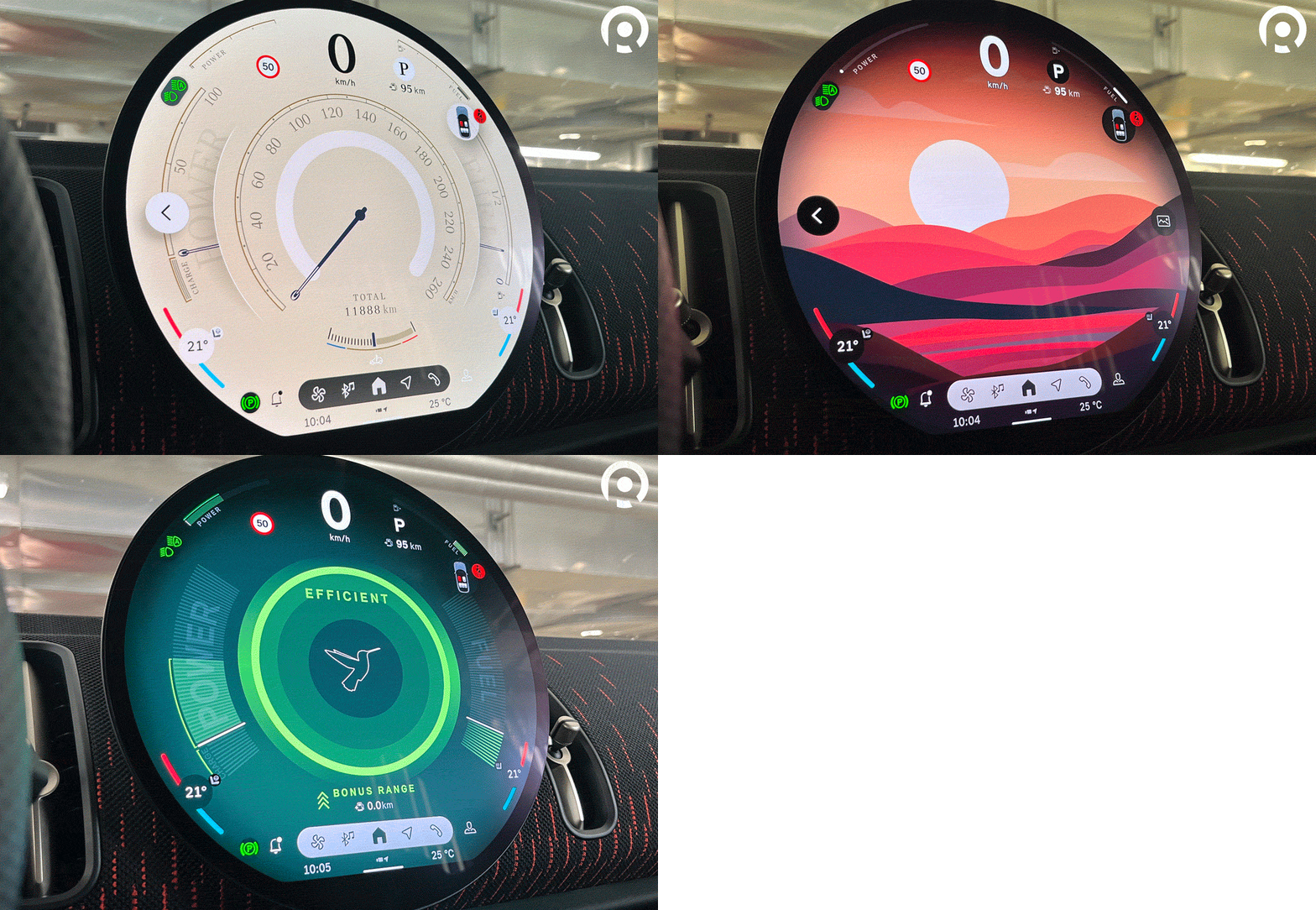
It’s extremely minimalist, reminiscent of classic cars from an era when dashboards were simple simply because there was nothing to put on them. Today, however, we have countless features and technologies – most of which are integrated into the infotainment system, centered around a large 24 cm circular OLED display. This is a clear reference to the centrally mounted speedometer of older MINI models.

The interior blends innovation with nostalgia. There are numerous subtle references, such as the strap-like elements inspired by MINI’s motorsport heritage. These appear on the steering wheel and even as the handle for opening the central console storage compartment – a very attractive detail in my opinion.
The dashboard and door panels are finished with a knitted recycled polyester textile. In the JCW version, it’s predominantly black with red accents, while other trims offer bolder color combinations.


Overall perceived quality is solid. I’ve heard mixed feedback from some customers, but I suspect that more conservative buyers simply find the radical design change difficult to accept. Hard plastics are present, mainly in lower areas of the cabin, but the overall impression is of a well-assembled interior.
The only detail that genuinely bothers me is the interior door handles. It’s something you touch every time you exit the car, yet they feel cheap and overly plastic.
Our test car features a head-up display – something I consider essential in any vehicle where the speedometer is located in the center of the dashboard. Interestingly, the information is projected onto a small plastic panel rather than directly onto the windshield – a solution more commonly found in more affordable vehicles. Fortunately, its placement here is unobtrusive and doesn’t interfere with the driver’s field of vision.


As for the infotainment system, my concerns proved unfounded. I’m genuinely impressed. The display quality and resolution are among the best I’ve encountered. The system includes an AI assistant that works well overall, although it occasionally has its less-than-intelligent moments. You can also use Alexa or Siri if preferred.
The menus are intuitive and easy to navigate. Considering I am generally critical of capacitive surfaces and the lack of physical buttons in modern cars, my satisfaction here says a lot.
In terms of space – particularly in the second row – the Countryman scores highly. It is comfortable, spacious and features a high seating position. The only drawback specific to the JCW are the large sports seats in the front, which somewhat restrict forward visibility for rear passengers.
On the Road
The MINI Countryman JCW shares its platform with the BMW X2 M35i. Under the bonnet lies a familiar 2.0-litre turbocharged petrol engine producing 300 hp and 440 Nm of torque. Top speed is electronically limited to 250 km/h, while 0–100 km/h takes 5.4 seconds. Power is delivered through an eight-speed dual-clutch automatic transmission.

Let’s get to the essence of the test.
I sat in the driver’s seat and turned the engine start toggle – an interesting touch. The engine wakes up with a brief, nervous rise in revs, reminding you that this is indeed a JCW.
In the city, the car behaves calmly in standard mode. Road noise is well controlled, and both engine and exhaust remain discreet. The suspension is on the firm side, but on Sofia’s uneven streets it never becomes uncomfortable. If you’re looking for ultimate ride comfort, you probably wouldn’t choose a MINI – especially not a JCW.

One feature that impressed me is the automatic parking system. Well known from my many encounters with BMW models, it works quickly and precisely – to the point where even I find myself using it. The ability to memorize the last 50 meters of driving is particularly useful. I used it several times when reversing out of a tight parking space at my office – the car retraces its path while the driver only controls throttle and brake.

The more interesting part of my experience with the Countryman JCW came during a summer Roadhunter Roadtrip. A group of enthusiasts gathered and we headed west from Sofia. On the twisty roads after Pozharevo, I finally explored the car in Sport mode – somewhat awkwardly still called “Go-Kart” mode.
The JCW allows fast driving with stable and predictable road manners. However, I wouldn’t describe it as particularly engaging when driven dynamically.

The suspension keeps the car planted with high grip levels and minimal body roll. Steering is precise, but lacks feedback and emotional connection. Due to modern regulations, the car is simply too quiet and too refined. There is artificially generated sound in the cabin, which is better than nothing and adds some emotion, but considering the aggressive exterior, four exhaust tips and numerous JCW logos, I would have preferred something more authentic.
The engine-transmission combination feels polished, perhaps overly so. It almost feels as if it has been softened in the name of regulations. Launches from a standstill are slightly sluggish, and there’s a noticeable lack of urgency at higher revs, affecting in-gear acceleration.

At the end of the day, the Countryman JCW is undeniably a pleasant car. But I expected more from a JCW. The thrill I remember from previous-generation MINI JCW models is missing – though I fully acknowledge that these two cars serve very different purposes.
Conclusion
With its new generation, the MINI Countryman has become a truly complete family car – and as such, I like it very much.
The design is fresh and memorable within the otherwise crowded and often dull compact SUV segment. The interior is spacious, functional and filled with interesting materials and details. It feels like modern comfort. This MINI is designed to appeal.
The infotainment system, which sits at the center of the experience, genuinely surprised me. It is intuitive and enjoyable to use.
As for the JCW version specifically – it won’t satisfy you if you’re looking for a true sports car experience. Yes, it’s fast, and that makes dynamic driving easier and more effortless. But it’s not focused enough, not emotionally engaging enough. It should be seen more as a top-tier family Countryman rather than a hardcore performance MINI.
Prices have increased noticeably compared to the previous generation, but considering the overall rise in car prices across the industry, the new Countryman remains a rational – and in some ways even good-value – choice.
Personally, I would lean towards one of the more affordable versions.
Ing. Tsvetan Iliev