In the automotive world, Rolls-Royce is arguably the most enchanting name of all. A brand traditionally associated with royalty and Hollywood celebrities. This fairy-tale image is well justified, as until the mid-20th century, many of the company’s clients were of noble origin.
Interestingly, at the beginning of the century nearly 20% of all Rolls-Royce cars produced were delivered to India, where they served the Maharajas. One of the most famous examples is the Rolls-Royce Phantom I of Umed Singh II, modified specifically for tiger hunting. Speaking of Phantom, the fourth generation of the model was produced in just 18 units – all delivered to kings… and dictators.
The world, however, changes. The second half of the twentieth century broadened the audience of the noble brand, welcoming film and music stars as clients. Perhaps the most famous example is the Rolls-Royce Phantom V owned by John Lennon, which he famously repainted in psychedelic colours using paints entirely unsuitable for an automotive body.


Today, sales exceed 6,000 cars annually. Royal lineage no longer defines status in the same way, and some of the most influential people in the world now come from sport, music and cinema. The common thread between “then and now” remains the same – those who want the very best gravitate toward Rolls-Royce. Take Jay-Z and Beyoncé, who reportedly commissioned a unique Rolls-Royce Boat Tail worth close to $30 million. At least that is what is said, as Rolls-Royce never publicly discusses its clients.

My personal story with Rolls-Royce began in childhood – on paper. I remember an advert for a Rolls-Royce Silver Spirit in one of Sofia’s dealerships in the early 1990s. Later, I created Photoshop collages of myself in a Rolls-Royce Corniche. Years after that, I even wrote motivational letters applying for work in Goodwood.
And then, unexpectedly, I received an invitation to test one of the brand’s most intriguing models. The first Rolls-Royce in history with all-wheel drive. It is time to step into a remarkable world. We are testing the Cullinan Black Badge.

Design

In two words, the design of the Cullinan is unmistakable.
It may be the first SUV in the brand’s history, but even if you know little about cars, one glance at this colossus is enough to say: Rolls-Royce. You may add a few more adjectives – imposing, traditional, opulent, mysterious.

I will admit that my personal perception was not entirely straightforward, especially when it came to the side profile. The windows initially seemed disproportionately tall relative to the overall height of the vehicle. The shape of the C and D pillars reminded me of a London taxi. But at the same time, they also reminded me of the royal Phantom V – and that is a far more accurate association.
Ultimately, the charisma surrounding the name, the classic detailing, and the extraordinary achievement of creating a design that works equally well in the desert, in the mountains or parked in front of an opera house led me to a simple conclusion: I like it.
Configuration plays a major role in how each Cullinan is perceived. There are around 44,000 exterior colour options. In my view, the test car was configured correctly.


This particular car comes from the Black Badge line. Visually, this means black accents – the grille surround, window trims and, of course, the Spirit of Ecstasy mascot. But Black Badge is more than aesthetics. It brings increased engine output and a more driver-focused character. Today’s world produces increasingly young and self-made ultra-successful individuals. Black Badge is aimed precisely at those who prefer to sit behind the wheel themselves.
What makes this Cullinan even more special is that it comes from the Bespoke portfolio. Every Rolls-Royce leaving Goodwood is unique, but those seeking something truly extraordinary turn to Bespoke. This is the division responsible for masterpieces such as the Boat Tail. At the end of 2022, Bespoke presented the Inspired by Fashion series, reflecting contemporary fashion trends and demonstrating the almost limitless possibilities of colour, texture and material combinations.
Attention to detail is astonishing. The coach line – that thin white stripe along the body – is hand-painted using brushes made from squirrel hair. It can be any colour, even double-lined. It is not the product of digital precision, but of one highly skilled hand.


The rear doors open in the opposite direction of travel, facilitating entry and exit. Umbrellas are integrated into the rear doors. And stretching awkwardly to close a door after seating yourself would be undignified – therefore, all four doors can be closed electrically at the push of a button.

In the boot, surprises continue. The Viewing Suite reveals two elegant leather seats and a small table that slide out at the press of a button. The craftsmanship is solid and impressive, though the seating position is somewhat upright and lacks leg support.

At 5.3 metres in length, the Cullinan is unmistakably Rolls-Royce. Classical and restrained, it provides the perfect canvas for infinite Bespoke individuality.
Interior
The interior of the Cullinan makes me feel like a child in a museum. As if the moment I touch something, someone will come and scold me. The craftsmanship, the forms, the materials – everything feels like a piece of art.

The Bespoke configuration of this particular car is striking. The primary colour is Arctic White, complemented by Navy Blue, with Peony Pink accents. The combination sounds bold on paper, yet in reality it feels balanced and sophisticated.
Interestingly, the decorative trim is not traditional wood veneer, as one would expect in a Rolls-Royce. Instead, we have woven carbon fibre. But not the kind you see in sports cars or aftermarket tuning projects. This weave is unlike anything I have seen before, creating a distinctive three-dimensional effect. It is covered with six layers of lacquer, cured for 72 hours and then hand-polished. The entire process takes 21 days.

Details are what create the magic inside this car. Leaving aside the fact that what feels like half a herd of cows has contributed to the leather upholstery, almost every other element is metal.
The door trim and lock pin – metal.
The wiper stalk and gear selector – leather-wrapped with contrast stitching.
The grab handles on the roof – leather and metal, and even the headliner itself is trimmed in leather.
The air vent controls and the vents themselves – metal.
The mirror adjustment controls and window switches – metal.
Even the coat hook on the B-pillar – metal.
I think you get the idea.


Naturally, all this has its price – and part of that price is weight. Despite the aluminium platform, the Cullinan weighs 2,690 kg unladen. I did, however, find one surprising omission: the steering column shroud is plastic rather than leather-clad. A small detail, but in this environment it stands out.
From the driver’s seat, the view is of a classic Rolls-Royce interior, yet modern technology is discreetly integrated. The instrument cluster is digital, but styled in a clean, analogue manner. As is typical for the brand, there is no traditional tachometer. Instead, you get a power reserve gauge displaying the percentage of available power.
There is also a head-up display projecting additional information onto the windscreen, and the central infotainment screen can be hidden behind a panel when not in use. The system itself is derived from BMW, with brand-specific refinements, and remains one of the most intuitive on the market. A night vision system is available as well, activated via a clearly positioned button in the lighting control cluster. Intuitive. Logical.


Climate control deserves special mention. The philosophy in a Rolls-Royce is that the car should perform its duties perfectly without unnecessary fuss. That principle is reflected here. There are no temperature readouts in degrees. Instead, elegant rotary controls transition from blue to red. You can adjust the temperature separately for the upper body and the footwell. Fan strength is not displayed in numeric levels but in refined settings: Soft, Med, High, Max.

Moving to the rear – this is where the true magic unfolds, especially in this example fitted with optional individual seats.
Two electrically adjustable armchairs offer ventilation and massage functions. They are separated from the luggage compartment by a glass partition, which further enhances acoustic isolation and reinforces the cocoon-like atmosphere.
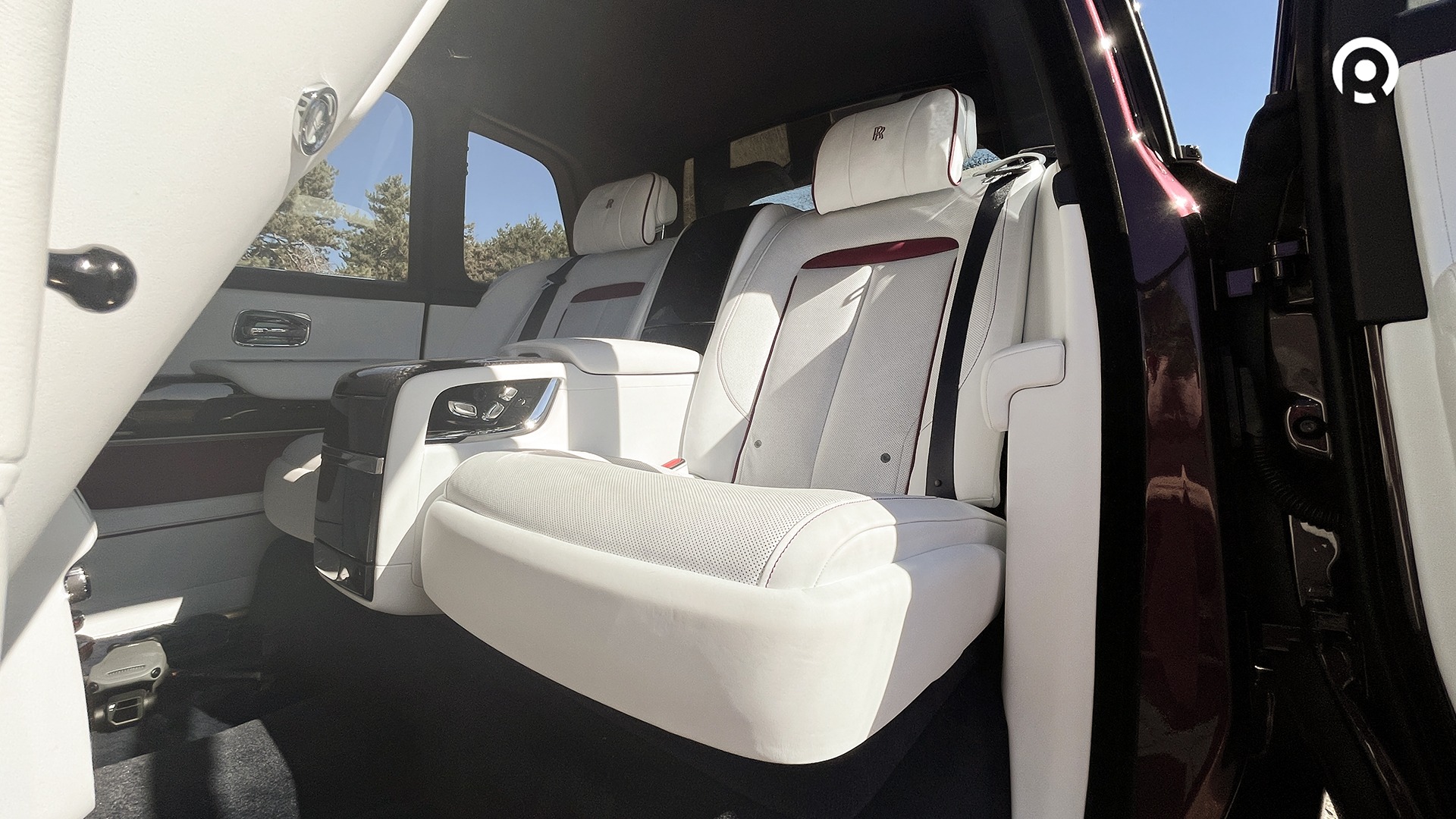
Between the seats sits a substantial centre console. On top are the seat controls; beneath a discreet lid is a duplicate infotainment controller. Further back lies a compact refrigerator designed to hold a champagne bottle and two cooled glasses. Naturally, the glasses can be securely fixed in place – because if your lifestyle includes drinking champagne in the back of a Rolls-Royce, spills are not part of the experience.
Should something stronger be required, the console hides another secret: a decanter for whisky, accompanied by two additional glasses.


Entertainment does not end there. Electrically operated picnic tables fold out from the front seatbacks, revealing rear infotainment screens.

It is impossible to describe this interior without mentioning the thick lambswool carpets – calling them “mats” feels almost disrespectful. And above, the Starlight headliner: hundreds of tiny fibre-optic lights recreating the night sky over Goodwood. Their arrangement is not random. It is astronomically mapped.
If I had to point out one imperfection, it would be the effort required to open the rear-hinged doors from the second row. The positioning of the hinges and seats demands slightly more force than expected.


Still, this remains the most impressive automotive interior I have ever experienced. It is impossible to fully translate the sense of calm into words. Luxury here is not a statement – it is a tool, creating an extraordinary experience. Even the highest tiers of premium brands fade in comparison to what has been achieved in Goodwood.
On the Road
The giant Rolls-Royce Cullinan Black Badge is powered by an engine worthy of its size and weight. A 6.75-litre V12 delivering 600 hp and 900 Nm of torque. The colossus reaches 100 km/h in 5.2 seconds, while the official fuel consumption stands at 16.6 l/100 km. In reality, it is slightly higher – but the 100-litre fuel tank ensures a respectable range.

One day I found myself in front of the only Rolls-Royce service centre in Bulgaria, key to the Cullinan in hand and a certain, entirely justified excitement. I pressed the button and the perfectly balanced engine came to life exactly as I imagined – as if it hadn’t started at all. For a moment, the loudest sound inside the cabin was the electric motors adjusting the steering wheel into driving position.
With heightened attention, mostly due to the car’s sheer size, I ventured into the streets of Sofia.

As expected, the sensation of driving the Cullinan was genuinely special. The high seating position, the long bonnet and the Spirit of Ecstasy at its tip never let you forget what you are driving. What impresses immediately, however, is the extraordinary silence in the cabin. There is more than 100 kilograms of acoustic insulation here, including within the tyres themselves. The result is barely perceptible road noise at urban speeds.
Soon I left one of the few decent boulevards in our rather unfortunate capital and turned onto a typical crooked street filled with endless subsidence and fading remnants of recently applied road markings. I write this more from memory of previous drives there, because in the Cullinan things feel different. The adaptive air suspension reacts not only to body and steering inputs, but also to information from cameras scanning the road ahead, adjusting settings in anticipation of the next unavoidable pothole. The result is genuinely impressive, especially for an SUV. Body movement is reduced to an absolute minimum, and the interior craftsmanship – particularly the unique dashboard construction – eliminates any potential squeaks or rattles that could disturb the experience.


Urban driving is surprisingly manageable. Rear-wheel steering contributes to easier manoeuvring, although the turning circle remains a substantial 13.2 metres. The car’s width can be intimidating at times, but the effortless way it moves compensates for that, as does the natural respect it commands on the road. All of this is accompanied by the profound sense of calm the vehicle radiates.

Leaving Sofia, I headed towards the Sub-Balkan road. Out of habit, just after the city-limit sign, I pressed the accelerator to the floor. The needle of the power reserve gauge swept rapidly from over 90% to zero, accompanied by a discreet yet clearly audible and rather pleasant V12 growl. The result was a brisk sprint to 100 km/h – effortless, undramatic, yet convincingly quick.
Further along, I settled into a relaxed cruise, marginally above the speed limit. Under these conditions, the Cullinan glides elegantly and remains exceptionally quiet, with only a slight aerodynamic whisper emerging. The instantaneous fuel consumption drops below 10 l/100 km.
Things became more interesting after passing Saranzi. I had planned to drive calmly, but the sight of a proper road with flowing bends awakened the familiar road-hunting instinct in me. This is still a Rolls-Royce – there are no vulgar “Sport” modes here – but the gear selector features a button marked “LOW”, which, translated into plain language, is essentially Sport… or something close to it.
Even in this setting, the car retains its typical character. The immense power allows rapid progress along winding roads. The issue is that, despite the pronounced sensation of effortless motion – which often makes me forget the car’s weight – once you approach a bend, things can feel slightly intimidating. The brakes do an admirable job restraining the giant, but the inertia of nearly three tonnes makes itself very clearly felt.


After a few corners that were decidedly not in the spirit of the car, I returned to its natural rhythm – calm, dignified and refined travel.
Before long, I pressed another button, one that is not traditionally associated with the brand and appears here for the first time: Off-road. There are no complicated settings to choose from. You want to leave the asphalt? Press this single button and the car takes care of the rest.

That is precisely what I did. Combined with the highest suspension setting, I left the national road network behind and ventured onto the meadows of the Sub-Balkan region. It never crossed my mind to attempt serious adventures, but driving a Rolls-Royce along dirt tracks was an unforgettable experience. The car continues to impress with its comfort, and the suspension articulation is far from negligible.


By the end of the day, I returned to the city satisfied with the experiences. The Cullinan Black Badge is the most functional model in the company’s history. It glides gracefully along the road, delivers swift acceleration without effort, belongs in the most refined places in the world – and yet, it can also take you for a drive through the Balkan Mountains.
Conclusion
In short, the Rolls-Royce Cullinan has, to a large extent, ruined all normal cars for me.
The masterfully crafted interior and the extraordinary materials transported me into a different world – as if this were not the cabin of a car, but something else entirely. The sense of calm it delivers, both on the road and beyond it, showed me how differently one can perceive the world from behind the wheel. I say half-jokingly that I no longer want sports cars – I want luxury. But not entirely as a joke.
The Cullinan is undoubtedly the most luxurious SUV on the market. Does it make logical sense? In the realm of ultimate luxury, logic often plays a secondary role. Yes, in my view, if you do not plan to drive off-road or live in a place with long, harsh winters, a lower car would probably make more sense. But people love SUVs regardless of how they actually use them.
As an SUV, the Cullinan performs convincingly. The boot is large, practicality is strong – especially if you keep the standard three-seat rear bench – and its off-road capabilities are far from negligible. In fact, it could easily serve as the only car for someone with nearly unlimited means.
What is truly impressive, however, is that even as an SUV, the Cullinan has preserved the charm and magic of Rolls-Royce.
Tsvetan Iliev