I am sure all of you have noticed the remarkable progress Korean manufacturers have made year after year across their model ranges. The market ultimately delivers the final verdict, and in 2021 the best-selling compact SUV in Europe turned out to be the Hyundai Tucson.
Such consumer confidence in one of the most competitive segments on the market deserves attention. That is precisely why we decided it was time for the first Hyundai test to appear on Roadhunter.

Design

In typical Asian fashion, the current-generation Tucson shares almost nothing visually with its predecessor. With the fourth generation, Hyundai opted for bold styling decisions aimed at making the model stand out among the countless compact SUVs on the road.
Although I see several controversial details and elements reminiscent of other brands, I believe the overall result is successful and genuinely appealing.
The wide wheel arches give the car a muscular stance, while the sharply defined body creases add visual drama. In some angles, the Tucson even reminds me of a Lexus model – though, I would argue, executed in a more cohesive way.


The front design is perhaps the most polarising element. The main headlights sit lower than expected, but the true signature feature is the daytime running lights seamlessly integrated into the grille. When switched off, they are practically invisible. When illuminated, they create a distinctive and recognisable light signature.
At the rear, the lighting theme continues with a horizontal light bar connecting the two clusters. The overall look reminds me of a blend between the Ford Mustang and the SEAT Leon.
One detail I particularly appreciate is the rear wiper. When not in use, it remains hidden beneath the roof spoiler – a solution similar to that used by Range Rover.

My overall opinion of the Tucson’s design is positive. The car looks modern and dynamic, and its styling creates a clear impression of a premium product.
Interior
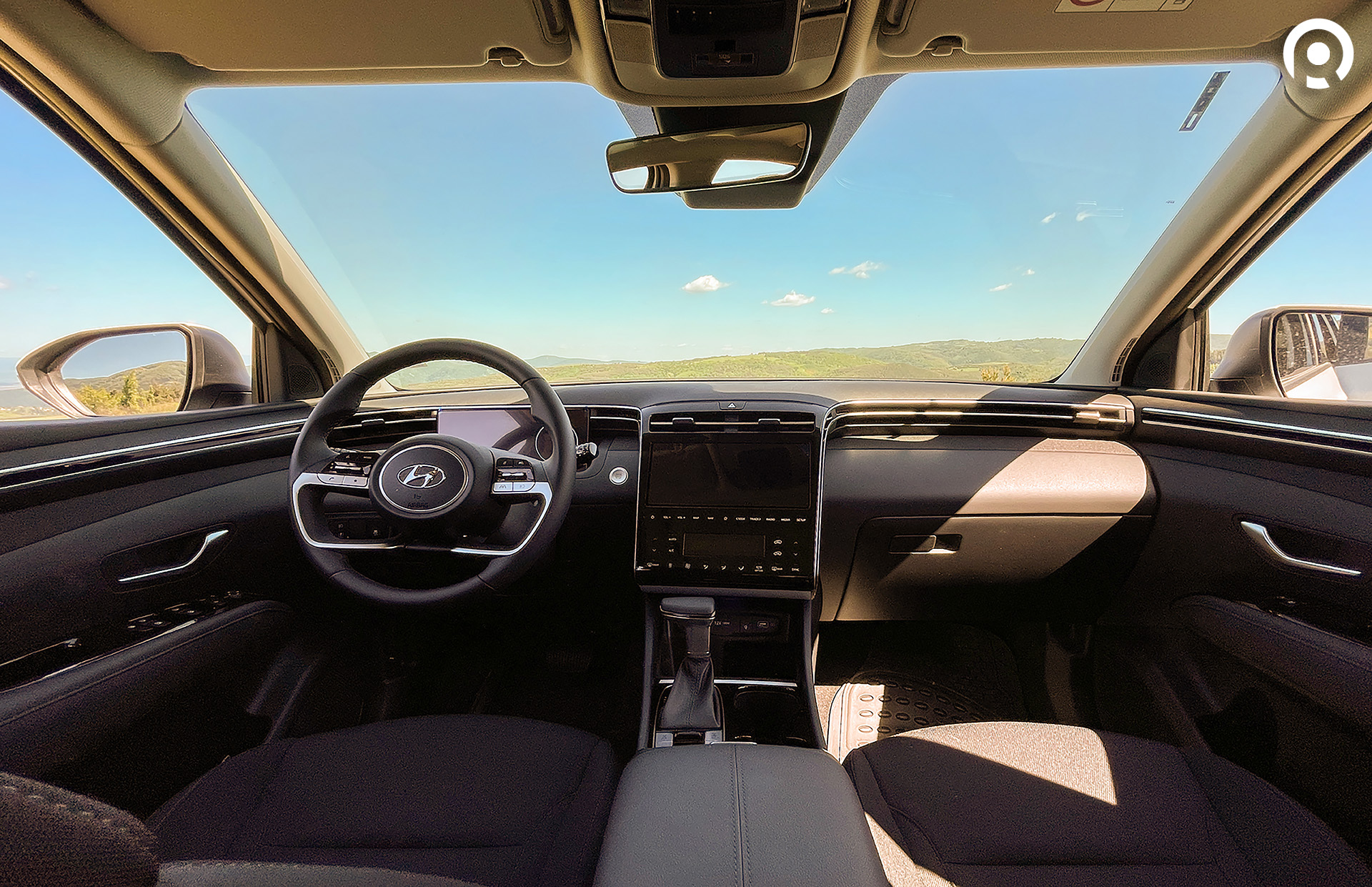
The “premium” impression created by the exterior naturally raises expectations once you step inside the Hyundai Tucson. Unfortunately, those expectations are not fully met. My first impression was not particularly positive. The seat upholstery feels rather inexpensive, but the main issue lies with the centre console.
I once visited the Philips Museum in Eindhoven and remember a section dedicated to futuristic household appliances from the 1980s. The Tucson’s centre console carries exactly that spirit. It feels as if the designers grew tired and decided to place a large, flat plastic surface simply to fill the space. On top of it, they added a series of touch-sensitive “buttons”, regardless of how awkward they might be to operate on the move. To complete the picture, there is a small display for the climate functions that resembles something from a calculator. I really, really do not like it.


I will end this critical note with the gear selector, which also feels somewhat dated. It looks as though it belongs to the late 20th century. To be fair, hybrid versions use a different setup, which I consider a clear improvement.
If we set these two elements aside, the rest of the cabin is actually quite pleasant in terms of design. I appreciate the low dashboard line and the way it wraps around the driver and front passenger. The steering wheel feels well shaped, and details such as the buttons and stalks are nicely executed.

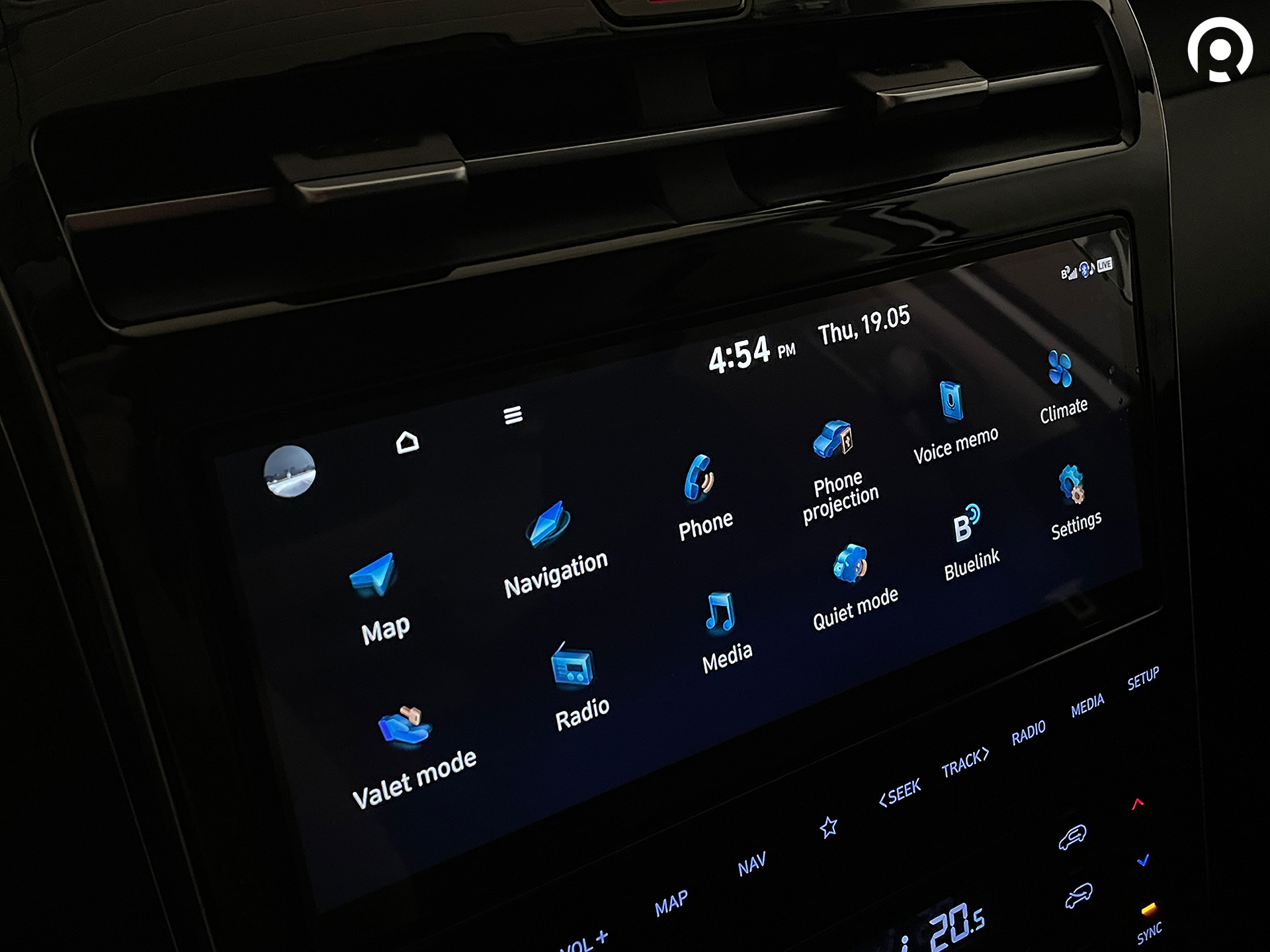
The 10.25-inch digital instrument cluster is well integrated, and the infotainment screen is of identical size. The system itself is intuitive, with a simplified menu structure that makes everyday use easy. What I do miss is wireless Apple CarPlay, which I would expect in this class. On the positive side, the built-in wireless charging pad works properly – something that cannot always be said these days. In many cars, the phone either slides around or overheats instead of charging.
The second row scores highly in terms of space. The seat base is positioned relatively high, and legroom is among the best I have experienced in this segment. Rear storage compartments are rather narrow, while the situation in the front is generally good.


Overall, the build quality feels solid and the amount of hard plastic is acceptable. However, even without my strong dislike of the centre console, the Peugeot 3008 offers a far more impressive interior in terms of materials, craftsmanship and – in my opinion – design.
On the road
The Hyundai Tucson offers a wide range of powertrains. There is a 1.6-litre diesel available with 115 hp or 136 hp. The petrol engine is also a 1.6-litre unit, producing 150 hp, and is offered as a 48V mild hybrid with either 150 hp or 180 hp. There is a full hybrid version with 230 hp, and at the top of the range sits the plug-in hybrid with 265 hp. Buyers can choose between front-wheel drive and 4×4, and three transmissions are available – manual, dual-clutch automatic and a traditional automatic.

Without knowing which version I would be driving, I visited the most convenient Top Rent A Car office and soon found myself behind the wheel of a white Tucson. It turned out to be the 48V mild hybrid with all-wheel drive and a seven-speed dual-clutch transmission. Officially, 0–100 km/h takes 9.0 seconds, and combined fuel consumption is rated at 7.1 l/100 km.
In reality, the car proved slightly quicker – my measurement showed 8.79 seconds to 100 km/h. Fuel consumption, however, differed in the opposite direction. During my test, the average stood at 10.8 l/100 km.

In city driving, the Tucson feels quiet and generally refined. The engine is well insulated, and road noise is low. Bumps and potholes are handled without unpleasant thuds. The suspension is on the firmer side for an SUV, but never uncomfortable.
Soon, however, I encountered something odd. On certain occasions when pulling away, there was a noticeable jerk, almost like clutch slip from the gearbox. I am inclined to believe this may have been an issue with the specific test car rather than a general characteristic, but even so, such behaviour in a car with only 2,000–2,500 km on the clock is not ideal.
One feature I appreciated in Sofia’s traffic was the system that alerts you when the car in front moves off at a traffic light and you fail to react. Given how often drivers seem distracted, it is genuinely useful.
Leaving the city, I headed towards Zheleznitsa and later Bistritsa to explore both dynamic behaviour and light off-road capability.

Under more enthusiastic driving, the Tucson feels lively enough. As mentioned, acceleration is slightly better than the official figure, and power delivery is smooth, without noticeable turbo lag. It is sufficient for relaxed and confident overtaking. In corners, the car remains stable and controlled. Body roll is well managed, and for a compact SUV it is relatively engaging to drive – though far from truly sporty. Its behaviour is neutral, partly because the engine does not have enough power to easily overwhelm the chassis.

After finishing the spirited driving, I turned off the asphalt near Bistritsa. I manually activated the 4×4 system (normally it engages automatically when needed, with power primarily sent to the front wheels) and proceeded along a gravel road that was not particularly demanding.
Interestingly, I soon detected the smell of overheated clutch, reinforcing my suspicion that the gearbox might have had an issue. After a short break, I switched to manual mode and continued without further problems. There is a short, steeper section on that route where many “soft-roader” SUVs I have tested struggle due to poor torque distribution. The Tucson handled it without drama, earning a point in its favour.

One final remark: the Tucson delivers a surprising number of notifications. Besides the alert when the car ahead moves off, it can remind you about a forgotten phone when you switch off the engine. More unusual is the message prompting you to “check rear seats” if something has been detected there. It is a small detail, but one that reflects the family-oriented nature of the model.
Conclusion
The Hyundai Tucson is an interesting model that deserves your attention if you are looking for a compact family SUV. Interior space is well utilised, practicality is strong and the equipment list is generous. The ride is relatively firm, but not uncomfortable, and the car is among the more pleasant-to-drive models in its segment, even if it is far from truly engaging.
Fuel consumption, however, is less impressive. The petrol engine is simply too thirsty, with real-world figures significantly higher than the official WLTP numbers. Another concern is the gearbox – occasionally rough when pulling away and, in this particular case, seemingly affected by an additional issue. The hybrid version with its traditional automatic transmission might prove to be the better choice.
Pricing is where the Tucson regains strong ground. The tested car costs approximately €31,600 (converted from 62,000 BGN). For a comparable model with 4×4, the Volkswagen Tiguan would require roughly €5,000 more (converted from 10,000 BGN difference). In this price range, the Peugeot 3008 and Opel Grandland do not offer all-wheel drive at all and come with smaller 130 hp petrol engines.
For many buyers, that combination of space, equipment and price will be more than convincing.
eng. Tsvetan Iliev