Why does this article not need a title? Because whatever I write, you probably won’t pay attention to it anyway — too busy thinking about the new BMW “kidney” grille and deciding exactly how ugly it is.
I have a vivid memory that similar accusations were made at the beginning of the Chris Bangle era about twenty years ago. Over time, however, people got used to those designs, BMW’s sales did not suffer, and today the streets are full of models from that period.

In other words, controversial design apparently is not enough to scare away buyers.
In any case, this is the new coupe from BMW in its M440i version, and in the following lines we will look at the car beyond its highly debated “kidneys”.
Design
Alright, the kidneys are big. And although they are clearly a reference to BMW’s distant past, they might also carry a slight hint of the Far East.
But let’s leave the horror they provoke aside and move on.

Everyone can judge the details for themselves, but overall the car relies on classic coupe proportions. The car is low and elongated, with a short front overhang, a longer rear overhang and a long engine bonnet. The windscreen is relatively upright, while the rear of the cabin flows down smoothly.
I believe these well-balanced proportions will ensure the design ages well, while also giving the car a distinctive and attractive presence. Personally, I find its proportions very harmonious — even more so than those of the larger BMW 8 Series Coupe.
One thing that caught my attention is the treatment of the C-pillar. The famous Hofmeister kink — or any modern interpretation of it — is missing here. In my opinion this makes the car’s profile slightly harder to recognise as a BMW.


There is something else that I really like. If you visit the official BMW website you will see the following description of the BMW 4 Series Coupe (G22) design:
“Design that makes you shiver.”
…
“Provocative, independent, sharp: with its unmistakable exterior design, the BMW 4 Series Coupe presents itself as a rebellious individualist.”
Often when you read official descriptions of a model you see phrases like inspiring, sporty or dynamic design. In reality, however, the car sometimes ends up looking like a refrigerator with nothing sporty, dynamic or inspiring about it. I genuinely like that BMW seems honest in its description here.
Is the car provocative? Absolutely — considering how widely discussed it is and how many people pointed at it on the street. Some openly commented on how ugly they thought it was, while others admired it sincerely. That is what provocation looks like. And if someone finds it ugly, well… it might indeed make them shiver — perhaps out of horror.

My own opinion? When I saw the first spy photo I thought someone was joking. When I saw the official photos I did not particularly like it, but I never went to extremes with my criticism. After spending several days with the car I got used to it quickly and eventually stopped paying attention to the grille altogether. My impression is that with the right configuration the car can actually look very good — without forcing you to break the piggy bank. At least according to my taste.

What is your opinion?
Interior

Inside we find a typical BMW interior, with a design familiar across the brand’s entire lineup. It evolves slowly — which is perfectly fine, simply because it is already very good.


I particularly like the build quality and functionality.
BMW offers plenty of personalisation options — nine types of upholstery and eight types of decorative trims. In this particular car we see optional Vernasca leather in brown combined with the standard Aluminium Tetragon trim for the M440i. I like the combination.

The sport seats look great and are also very comfortable. Finding an ideal driving position was quick and easy for me. From a practical perspective, storage space is also quite good. The door pockets are relatively narrow and shallow, but their front sections can accommodate a larger bottle. To the left of the steering wheel there is a closable storage compartment, which is very convenient for items such as keys or a remote control for a garage gate. There is also space under the centre armrest, while in front of the gear selector you will find two cup holders and a phone compartment, which in this case also offers wireless charging.
Speaking of charging, however, I once again had some problems. The phone charges extremely slowly, and on one occasion it became so hot that it temporarily froze. Perhaps this is because the phone slides around while driving, but whatever the reason, I am beginning to think I would skip the wireless charging option, which in this case costs around €465 (as part of a package with other features).

Things became more interesting when I finally gathered the courage to try the rear seats.
The concept of the car and the sloping roofline suggested that the back row would be uncomfortable even for short trips.
Well, I was wrong.

Getting in and out of the rear seats requires a certain level of gymnastic ability, as well as Buddhist patience, because the front seats slide forward electrically after you tilt the backrest — and they do so very slowly.
However, once seated in the back I realised there is actually much more space than expected.
The seat bases are positioned high enough, and the knee room is sufficient for me to imagine a comfortable journey to the seaside, for example. In my case I also had no issues with headroom, although I can imagine that the practical height limit for passengers here is around 180 cm.
Beyond space, rear passengers also get a central armrest with cup holders, two USB ports, and three-zone climate control.
Not bad at all. What could be a downside is the limited outward visibility caused by the narrow rear windows. And eventually the trip will end — meaning it will once again be time for a yoga lesson disguised as exiting the car.

On the road
The BMW 4 Series Coupe (G22) is available with petrol and diesel engines starting from 184 hp. As the name suggests, the version you see here sits somewhere between the standard 4 Series and the full-blown BMW M4 (G82). This is the BMW M440i xDrive Coupe. The car is powered by BMW’s excellent 3.0-litre inline-six engine, producing 374 hp and 500 Nm of torque. It is assisted by a 48V mild-hybrid system consisting of an 11 hp starter-generator and an 11 Ah battery.
Thanks to the power, the eight-speed automatic gearbox and xDrive all-wheel drive, the car accelerates from 0–100 km/h in an impressive 4.5 seconds. Official fuel consumption is quoted between 5.7 and 9.0 l/100 km, although the chances of someone buying an M440i and driving it like during an emissions test are… rather small.

My meeting with the car began in BMW’s garage. After the brief roar with which the engine woke up, I switched to Eco Pro mode and headed into the city. Here the car behaves exactly as expected, with the typical BMW finesse. The naturally balanced engine feels smooth and relaxed, the gearbox shifts almost imperceptibly, sound insulation is good, and the suspension deals well with the countless small imperfections on the road. Bumps, patched asphalt, potholes, manhole covers that for some reason are not level with the road surface and other obstacles typical for countries where public funds tend to disappear… all of them are handled reasonably well.

When encountering larger bumps, however, the suspension becomes noticeably quite firm, regardless of the driving mode. But that is hardly surprising.
While driving in the city I had an unexpected encounter with one of the assistants — the parking assistant. I rarely use such systems because by the time they finish parking, I would already be out of the car sending my parking-zone SMS. However, the one attempt I made with the “four” left me pleasantly surprised. The manoeuvre was quick and precise.

As for fuel consumption in the city, my result was 9.5 l/100 km. That included mostly calm driving in heavy traffic, but also several strong accelerations when I happened to be first at the traffic lights.
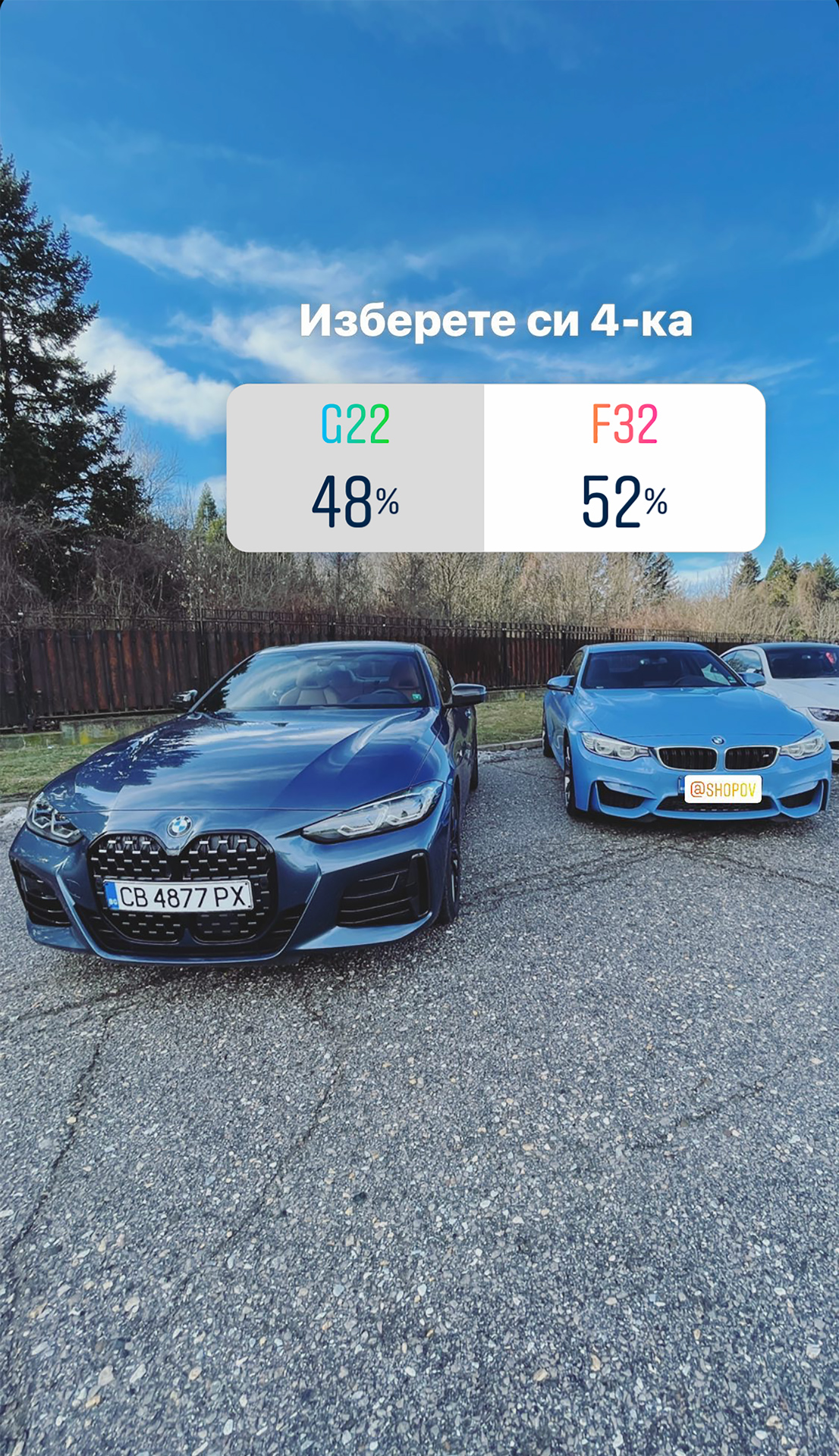


The next day began with a short meeting that gave me the opportunity to compare the controversial grille of the new car with its predecessor (in this case an M4). A poll I ran on our Instagram profile showed that — at least for now — the old design is still slightly preferred.

From there I set off in search of some proper corners. I headed towards the Struma Motorway and planned to continue towards Panichishte.
On the motorway I decided to try the semi-autonomous driving system. Yes, this is a car meant for driving, but why shouldn’t it also be capable of transporting you comfortably?
In practice the system follows the road using not only lane markings but also the cars ahead, adjusts its speed and can even take speed limits into account. I tested it not only on the motorway but also on other roads, and overall it worked quite well.
Still, there were moments when it struggled to keep the car perfectly centred in the lane.
At one point I encountered pedestrians walking on the road — which is absolutely wrong, of course. I moved slightly to the left to avoid them, and the car immediately attempted to steer back towards them in order to stay centred in the lane.
The result is that while the system works quite well overall, there are situations where I simply cannot trust it completely. Instead of relaxing me, it occasionally increases my tension.
The only situation where I felt 100% satisfied was in start-stop city traffic, where the car replaces the driver perfectly — it starts on time, stops on time, and even if something happens the consequences are unlikely to be serious at low speeds.

On the motorway I also noticed that the cabin is slightly noisier than expected. Around 120 km/h, aerodynamic noise becomes quite noticeable. The frameless side windows certainly do not help in that respect. The car never becomes truly loud, but it slightly reduces the impression of acoustic comfort compared with lower speeds.

The interesting part began after leaving Sapareva Banya. I pressed the driving mode button several times until reaching Sport+, and then pressed the accelerator to the floor. Accompanied by the glorious sound of the inline-six engine and impressive stability, the car launched forward at a speed approaching the limits defined by Bulgarian traffic law. I measured 0–100 km/h in 4.4 seconds and 0–200 km/h in 15.4 seconds — although to be clear, that measurement was not made on the road to Panichishte but earlier on a closed track near Sapareva Banya.

The winding road that followed provided the real driving pleasure. The steering is precise enough to be engaging, but without feeling overly sharp. The “four” climbed the mountain road with remarkable stability, even on slippery asphalt.Interestingly, even in Sport+ mode, the stability systems did not allow the car to deviate from its trajectory. They intervened quite aggressively, limiting throttle when exiting corners. I did not dare disable them completely because the conditions were not ideal.


Despite that, the driving experience remains very enjoyable. The instant acceleration combined with the engine’s roar creates a genuinely exciting experience.
Still, I have previously experienced this same engine in the BMW Z4 M40i, which is about 200 kg lighter and drives only the rear wheels. In that car the thrill level is significantly higher.
But in my view the M440i has a different purpose — accessible performance combined with everyday usability.
At the end of the test I should mention something else important for everyday life — fuel consumption.
Naturally I did not achieve the manufacturer’s figures. However, with mostly normal driving, observing most speed limits, accelerating quickly whenever possible and enjoying a few dynamic sections along the way, that was to be expected.
Average consumption for the entire test was 10.2 l/100 km. The overall average settled at 9.5 l/100 km, while on the motorway it dropped to 7.9 l/100 km. Considering the performance on offer, that is more than reasonable.

Conclusion
This is yet another car from BMW that I returned reluctantly — simply because it is good. Good enough that I no longer care whether the front grille is ugly or not. The car behaves in a refined and composed way on the road. It can be driven calmly, yet it can quickly transform into a beast when you ask it to. The interior feels very solid, while space for two — and even four passengers — is perfectly adequate.
The intelligent assistants work quite well. The driving assistants are helpful, although there are situations where I cannot fully trust them. The parking assistant is fast and precise, while the laser headlights are, quite simply, brilliant.
As always I am pleased with the infotainment system and its controls, while the large head-up display projecting extensive information onto the windscreen also makes a very strong impression. It is just a pity that the price of this option is relatively high — around €1,185 — although it is certainly worth it.

Overall, I believe the M440i is ideal as a single car for people who love performance but still want everyday usability — whether they are driving in the city or heading to the mountains for a ski trip.
So what is the problem?
On our market I suspect that potential buyers of the M440i probably already have one or two other cars in their garage. In that case the model becomes somewhat redundant.
If you are looking for a second or third car purely for fun, the more exciting choice is the Z4 M40i — which is even a few thousand euros cheaper. And if you are already spending that kind of money, not far from the price of the test car (around €76,500 with options) you will find the M4.
Eng. Tsvetan Iliev