
I’m well aware that the Fabia shares its underpinnings with the VW Polo, while the Octavia is closely related to the Golf. Which is exactly why, when I first saw the Scala, I wondered—where does it actually fit?
A budget car like the Peugeot 301? Unlikely. It looks far too good for that.
And then it clicked—the successor to the rather forgettable Rapid Spaceback, but this time with far more serious ambitions. In fact, the Scala is targeting the family hatchback segment—cars like the VW Golf, Renault Megane, Opel Astra and the rest.

Its trump card? A body size typical for the segment, combined with the technology of a smaller city car. The result—more accessible pricing.
An interesting mix of classes. Whether the recipe works—we’re about to find out.
Design

Despite aiming at the C-segment, the Scala isn’t a typical representative. Its silhouette combines elements of a hatchback with a hint of an estate. That means no trendy sporty lines, but instead more rational proportions and a larger usable body volume.
This directly benefits passenger space (more on that in a moment) and especially the boot. With 467 litres, it offers around 100 litres more than most rivals in the class.

One thing I particularly like is the wide colour palette—four non-metallic colours, including the increasingly popular “steel grey”, and ten metallic options. Pair that with around ten wheel designs ranging from 16 to 18 inches, and you’ve got a genuinely rich choice.

What’s interesting is how much you can alter the car’s appearance. Options like the Image package (around €200 on Style trim) add an extended rear spoiler, full LED tail lights, black mirror caps, and most notably—a rear window that extends further down towards the number plate.
Personally, I’d strongly recommend this package—it adds a noticeable touch of elegance.
Overall, the Scala looks conservative, but not outdated. And that’s a combination that will appeal to more mature buyers.


Interior
The interior follows the same philosophy—conservative, functional, and free of surprises. This is a place where practicality is the main focus, even in the details.
A clip for parking tickets on the windscreen? Present. An umbrella hidden in the driver’s door? Of course. Door pockets that can hold large bottles? Naturally.
Add around €40, and you can even get storage drawers under the front seats. Personally, if I put something there, I’d probably forget it exists—but for more organised people, it’s a useful option.

Alongside the clever storage solutions, you’ll also notice where the attractive price comes from—the materials. The quality is around, or slightly below, that of competitors. There’s plenty of hard plastic, and I’m not particularly fond of the seat fabric (though that might be subjective). The good news is that everything feels well assembled, and for those who care, a leather interior is available.
Still, if interior quality is your top priority in this segment, I’d point you towards the Mazda 3.


The infotainment system comes with a freestanding display—6.5 inches for base models, 8 inches (as in our test car) from Ambition trim, and an optional 9.2-inch system bundled with a digital instrument cluster for about €1,470. Personally, I find that option unnecessary.
The system in the test car is intuitive, quick, with a bright display and colourful graphics. A nice touch is the presence of shortcut buttons for frequently used functions. The downside? They’re capacitive—modern, yes, but not particularly convenient. Physical buttons are far easier to use while driving, especially on roads like those in Bulgaria.

The biggest strength of the Scala’s interior is space. The boxy shape pays off—besides the large boot, passenger room is excellent. This is most noticeable in the rear, where legroom rivals that of larger cars.

In short—classic design, strong practicality, plenty of space, good build quality and slightly underwhelming materials. That’s the Scala interior.
On the Road
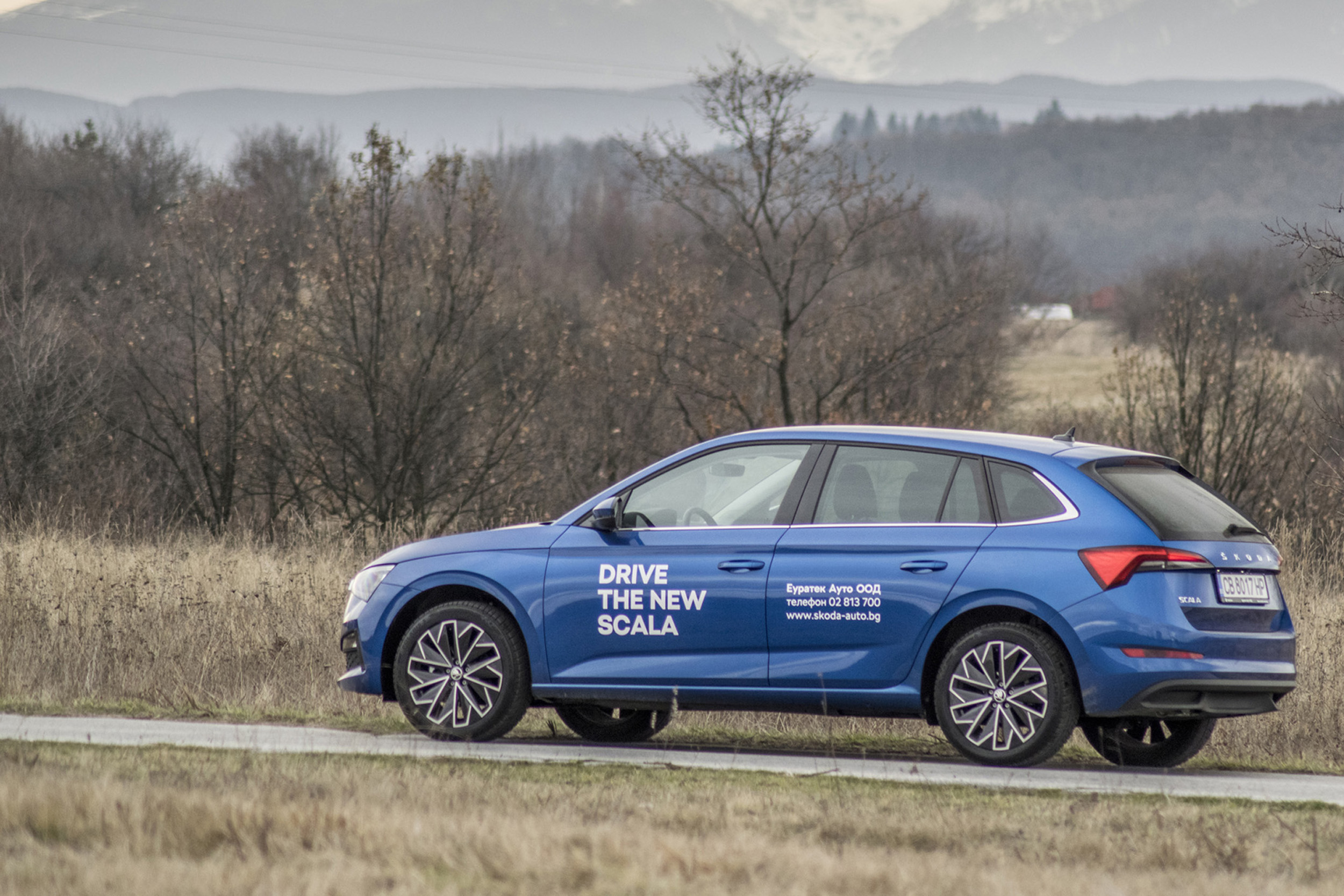
The Škoda Scala is offered with three petrol engines—a three-cylinder unit with 95 or 115 hp, and a four-cylinder with 150 hp. There’s also a 1.6-litre diesel with 115 hp. The more powerful petrol engines can be paired with a seven-speed DSG dual-clutch transmission.
I had the chance to drive what I consider the sweet spot—a 1.0-litre petrol engine with 115 hp and a six-speed manual gearbox. It delivers 0–100 km/h in 9.8 seconds, a top speed just over 200 km/h, and a claimed average consumption of 5.5 l/100 km.

After a string of dry, sunny days, I picked up the car—and of course, it started raining. Sofia’s dust turned into mud, and I was left wondering how to take photos that would actually show the car’s colour.

My first impressions came during the perfect test scenario—Friday before Christmas. Chaos everywhere. People rushing to parties, crowds hunting for gifts (I bought mine in November and avoided the madness), and traffic that could test any car.
In these conditions, the Scala stands out with its ease of driving. Light steering, smooth gear changes—everything feels effortless, somewhat reminiscent of a Honda Civic. The start-stop system works as expected, and overall, the car behaves predictably.
There are two downsides, though.
The first has nothing to do with driving itself—but I noticed it when my phone battery died despite being plugged in. Like the Mercedes A-Class, the Scala only offers USB-C ports—no USB-A—which, at least for me, is inconvenient.
The second issue is the mirrors—they’re simply too small, limiting rear visibility. Not ideal in busy city traffic.

The next day, I headed out towards Vakarel. Again, poor timing—I ended up in heavy outbound traffic. In stop-and-go conditions, the engine shows one of its weaknesses. It could be more refined at low revs. Yes, it’s a three-cylinder, so some imbalance is expected, but the unit in the Peugeot 208 I drove recently felt smoother.
What I do like about this engine is its character. It’s lively and sounds surprisingly good. At one point on the Trakia motorway, an overly enthusiastic driver in a Škoda Superb created an opportunity to test acceleration. Two gears down, full throttle—and the small Czech hatchback pulled strongly, accompanied by a pleasantly raspy engine note.


For longer journeys, the Scala is well suited. It’s not overly noisy, stable at motorway speeds, and while the suspension feels slightly firm at low speeds, it becomes comfortably compliant outside the city. An adaptive suspension is available for around €400, though it lowers ground clearance by 15 mm—which might not be ideal for Bulgarian roads.
Naturally, I also took it through some twisty roads near Zheleznitsa. The car remains stable when pushed, but the steering is vague and lacks feedback. It’s difficult to judge the limit of grip or when understeer sets in. You can drive it quickly if needed—but you won’t particularly enjoy it.
That’s not where its strengths lie.
Real-world fuel consumption? Around 5.7–6.3 l/100 km with this engine.
Conclusion
The Škoda Scala is an extremely sensible car. It does everything well—but it’s a bit… dull. Or, if you prefer—a bit too mature.
Its strengths are clear—practicality, clever solutions (umbrella, integrated funnel for washer fluid, under-seat drawers), spacious interior and a generous list of optional equipment at reasonable prices. It doesn’t have any glaring weaknesses either. Yes, materials could be better, the engine more refined, the driving experience more engaging—but these are minor points.
Especially when you look at the price.
The model starts at just under €14,800, while a well-equipped version with the 115 hp petrol engine and manual gearbox will cost around €19,500–€20,500. That’s roughly €5,000 less than typical C-segment rivals—which is significant.
At around €20,000, the Scala is a genuinely strong alternative in the segment. However, if you opt for the diesel and start adding options, the price can climb beyond €28,000–€30,000—at which point it struggles to compete with better-equipped Golf, Focus and others.
In my opinion, the Scala is ideal for buyers looking for a compact family car at a reasonable price. My recommendation—go for the Style trim, the 115 hp petrol engine, and a manual gearbox.
Eng. Tsvetan Iliev

