
As of today, Mercedes is the automotive company with the most diverse model range in the world – from compact city cars, through hypercars, all the way to limousines and classic off-roaders.
Over the past 15 years, we’ve seen the brand fill the gaps between its traditional models, resulting in a truly impressive portfolio. One of the models that started this massive expansion was the CLS.
The first generation appeared in 2004 and was introduced as a four-door coupé (a term I’m not particularly fond of). In reality, it was a more expensive and less practical E-Class dressed in elegant styling. Its success was significant and led to similar models from competitors, such as the Audi A7 and BMW 6 Series Gran Coupé.

In 2018, the third generation of the Mercedes CLS arrived – and that’s the one I’ll be talking about here.
Design

Compared to previous generations, the current CLS has lost some of their extravagant elegance. While I personally like the result, I do have some doubts about whether the market will fully embrace this change.
The connection to earlier CLS models is still visible in the characteristic sloping roofline and the frameless doors. However, this version has a noticeably more “rebellious” appearance, which I believe comes from sharper detailing and, to a large extent, the design of the rear lights – more compact and, in my eyes, slightly retro (in a good way).
This combination of lines and elements leads to something quite interesting and unexpected – when viewed from the side, I immediately associate it with an American muscle car.

Otherwise, we have the familiar Mercedes design language, enhanced here by the AMG package, which adds an extra dose of aggression. Even so, I find the CLS appropriately aggressive without overdoing it, and it certainly has much more character than the E-Class it’s based on.

Overall, I like the exterior design – balanced proportions, recognisable styling, and interesting details. The only thing that bothers me is the exhaust outlets, which are not where you think they are. The chrome tips you see are purely decorative, while the actual exhaust pipes are hidden underneath the bumper.
Interior

The cabin of the CLS is largely familiar from the E-Class. In the front seats, the only noticeable difference at first glance is the shape of the speaker grilles in the doors. This means the design is already a few years old, and Mercedes has moved forward with newer models.
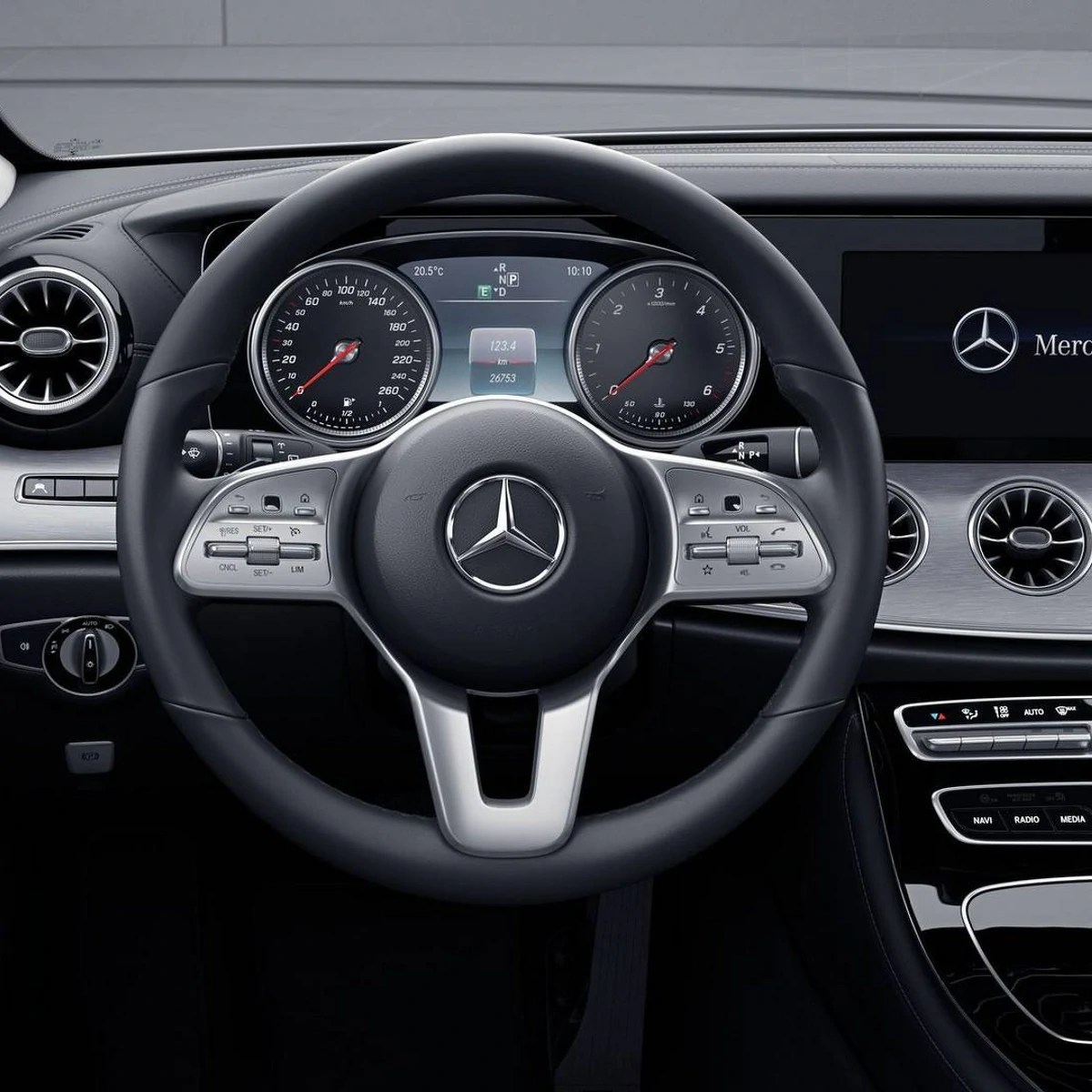
The standard setup includes analogue dials combined with a basic information display.
Despite that, this interior remains one of the stronger offerings in the class – modern, stylish, and high-quality. The main highlight is the so-called Widescreen Cockpit, an optional feature costing just over €1,000, which combines a 12.3-inch digital instrument cluster with the infotainment display.
Does it look modern? Yes. But in my opinion, it’s unnecessary. The standard display is already large and high-quality, and it pairs beautifully with classic analogue speedometer and rev counter, creating a more refined atmosphere.

As for the infotainment system itself, it’s one of my favourites at the moment. It’s intuitive, the graphics and display quality are impressive, it works quickly, and most importantly – there’s no touchscreen. Instead, you operate it via the classic rotary controller on the centre console – simple, convenient, and free from fingerprint smudges.
The only thing I’d like to see is a dedicated button to turn off the screen, because at night it can be distracting, and currently you have to dig through menus to do so.


Beyond the digital elements, the CLS impresses with comfortable seats offering plenty of adjustment and excellent storage space – large door pockets and generous room under the centre armrest.
Interestingly, though, there are no cupholders as standard – you need to add the optional “storage package” to get a double cupholder in the centre console.
There’s also another odd detail – the steering wheel isn’t perfectly centred, sitting about a centimetre off. It didn’t affect ergonomics for me, but some people might find it annoying.
Material quality and build are top-notch, and I like the wide range of colours and trim options available. My only criticism is the standard piano black finish on the centre console, which scratches easily. Fortunately, this can be solved with optional trims in fibreglass, carbon fibre, or wood.

I was also pleasantly surprised by the rear space – there’s plenty of legroom. However, the elegant roofline comes at a cost, as headroom is limited. Taller passengers will definitely notice it.
On the road
Gone are the days when cars like this came exclusively with six-cylinder engines. The base versions now use four-cylinder units, but fortunately, the CLS I drove was around €20,000 above the base model.
That means it came not only with plenty of extras but also with the CLS350d 4Matic – powered by a 2.9-litre inline-six diesel producing 286 hp and 600 Nm of torque. Combined with a nine-speed automatic transmission, it accelerates to 100 km/h in 5.7 seconds. Claimed fuel consumption is 6.9 l/100 km.
Time to set off.

I started with a short but time-consuming city drive. At idle, the engine sounded a bit more “diesel-like” than I expected. However, once moving, the inline-six proves to be one of the smoothest and quietest diesel engines I’ve driven.
As expected, city driving is pure Mercedes – excellent insulation and a sense of calm I truly appreciate. It feels like being inside a cocoon, shielding you from the chaos of Sofia’s roads.
Ride comfort is very good, though there’s room for improvement. The test car had the standard comfort suspension with lowered ride height, but optional adaptive suspension (€1,200) and, more importantly, the multi-chamber air suspension (€2,300) can take comfort to another level – one that makes you forget the state of Bulgarian roads.
In heavy afternoon traffic, the CLS consumed just under 12 l/100 km (6.6 l/100 km on empty Saturday morning streets).

The next day, I planned my route according to the weather forecast. No rain in Vratsa? That’s where I’m going.
After a long escape from Sofia, I hit the motorway and floored the accelerator. The big Mercedes gained speed quickly and effortlessly. The nine-speed gearbox deserves credit here – fast, smooth, and always in the right gear. Overall, the drivetrain is excellent.
At motorway speeds, the car remains pleasantly quiet, although wind noise is slightly more noticeable compared to the E-Class (likely due to the frameless windows). In that sense, the optional acoustic comfort package (€1,350) might be worth considering.

What’s interesting about the CLS is that despite its sporty image, it remains a comfort-oriented car. Still, once I reached Vratsa, I switched to “Roadhunter mode” – heading towards Okolchitsa peak, engaging sport mode, and pushing the car uphill.
Here, the weight becomes evident – 1,935 kg is significant and clearly felt in corners. Nevertheless, thanks to precise steering and good road connection, driving remains enjoyable, though not particularly sporty.
Grip levels are impressive, aided by both the suspension and the 4Matic all-wheel-drive system. I did notice some initial understeer, but never reached actual loss of traction.
So yes, the CLS allows for fast driving and handles confidently, but if you’re looking for a truly engaging driving experience, this isn’t the car for you.


After Okolchitsa, I returned to Sofia via the Iskar Gorge, achieving 5.8 l/100 km with economical driving. By the end of the test, the average stood at 8.2 l/100 km.
In real-world daily use, I’d expect around 7.5 l/100 km – a good result and not far from the official figures.
Conclusion
The CLS is another strong model from Mercedes, with a clearly defined individuality – mainly thanks to its distinctive design.
Its road behaviour is typical Mercedes, which in this case is a good thing – comfort, refinement, and the ability to cruise at high speeds when needed.
The CLS350d drivetrain is excellent. The engine and gearbox work together seamlessly, leaving little room for criticism. In my opinion, the four-cylinder engines in the CLS300d and CLS350 are best avoided, as they feel like a compromise in a car that deserves a refined six-cylinder unit.
I appreciate the wide range of personalisation options, the excellent ergonomics, and the spacious front cabin. Practicality is further supported by a generous 520-litre boot.
The downside, of course, is rear headroom. If you regularly carry taller passengers, the more conventional (and more affordable) E-Class would be the better choice.
Eng. Tsvetan Iliev


Comments are closed.