
Not long ago, I was surprised to discover that the second generation of the Audi Q3 had quietly arrived on the market. Without much noise (or perhaps I simply wasn’t paying enough attention), the Germans introduced the successor to their successful compact SUV. What’s particularly interesting is that even at first glance, the differences compared to the first-generation Q3 are unusually significant for Audi – which makes this model all the more intriguing.

Design

Not too long ago, Audi was one of the brands that made very small steps in evolving the design of its cars, with minimal differences between model families. Somehow, that trend has changed – and for the better. The current Q lineup is larger than ever, yet each of the five models has a clearly defined identity.
Perhaps this expansion is exactly what led to the more radical redesign of the second-generation Q3. The car looks bigger (and it actually is), more premium, and more characterful.

I also appreciate the fact that Audi now offers proper colours for the Q3, rather than just various shades of grey. There’s a bright non-metallic blue, and of course the orange (also non-metallic) of the test car. It suits the car well, highlighting its lines and details, while matching the aggressive S-Line package fitted here.
Overall, the Q3 has an attractive design and pleasing proportions. Special attention has been given to the lighting signatures both front and rear – something we’ve come to expect from Audi.

I also like the window line and how it blends with the pronounced rear haunches. What I don’t like, however, is the excessive use of plastic elements on the bumpers that imitate air intakes, exhausts, and other features – but are, in reality, just decorative plastic. It feels unnecessary. In this context, I find the S-Line package a bit too much and even somewhat tasteless. A more balanced and elegant choice would be the Advance trim with optional painted elements.
Interior

The interior of the Q3 represents an even bigger step forward compared to the previous generation. Here we see Audi’s latest design language, built around large flat surfaces, sharp edges, and an overall digital feel. In terms of theme, it actually reminds me of the Peugeot 508 I recently experienced.
There are, however, a few oddly “retro” elements that don’t fit the otherwise modern cabin. For example, if you don’t pay extra for keyless entry and start, you’re left using a traditional key inserted into an unlit slot on the steering column – something that feels like stepping 20 years back in time. I want a button, or at least some illumination.
Another detail that feels out of place is the gear selector – it’s simply not a good-looking piece. And since I’ve started with the negatives, let me continue. In certain areas, material quality is disappointing: the plastics around the door handle feel hollow and cheap (and you touch them every time you open the door), the large empty plastic panel near the volume control seems unnecessary, and the cup holders lack any cover, making the area look unfinished.


Fortunately, the positives outweigh the negatives. Overall material quality is good, and the build quality is solid – exactly what we expect from Audi. I like the presence of physical climate controls, finished in metal, and the steering wheel buttons are the traditional rotating type, which remains the most practical solution for adjusting volume or navigating menus.


The seats are another highlight. In this case, they are sporty, offering excellent lateral support, and the optional fabric and Alcantara combination looks and feels great.
The MMI infotainment system is also easy to use, despite the absence of a rotary controller. It’s fast, the graphics are clean, and the display size is just right. I was also impressed by how quickly the system connected to my phone – seamless and stress-free.

What impressed me most, however, is the space and practicality – strengths carried over from the first generation. There are large door pockets in both rows, plenty of smaller storage areas, and overall very good space utilisation. Rear passengers sit comfortably, with a well-positioned seat that ensures a natural posture.
On the road

The test car I drove carried the “40 TFSI” badge. Naturally, I thought: “Great, this should be something powerful.” Well… not exactly. Someone in Audi’s marketing department has come up with one of the most confusing naming systems on the market.
“TFSI” means petrol – that part is clear. But what does “40” stand for? It’s not engine size, not cylinder count, not horsepower… and yet it somehow relates to power. In this case, “40” equals 190 hp. Logic seems to have left Ingolstadt 🙁

In reality, the car is powered by a 2.0-litre four-cylinder engine producing 190 hp and 250 Nm. Top speed is 220 km/h, while 0–100 km/h takes 7.4 seconds. Fuel consumption ranges between 6.0 and 9.4 l/100 km – although this information is surprisingly hard to find on Audi’s official website.
I started my drive in the natural habitat of this type of car – the city centre, during busy afternoon traffic. And just to be clear, I find the widespread use of SUVs as purely urban vehicles somewhat questionable, but that’s the reality.
In the city, the Q3 is pleasant to drive. It’s easy to manoeuvre, visibility is good, and overall noise levels from the road, engine, and imperfections are well suppressed.
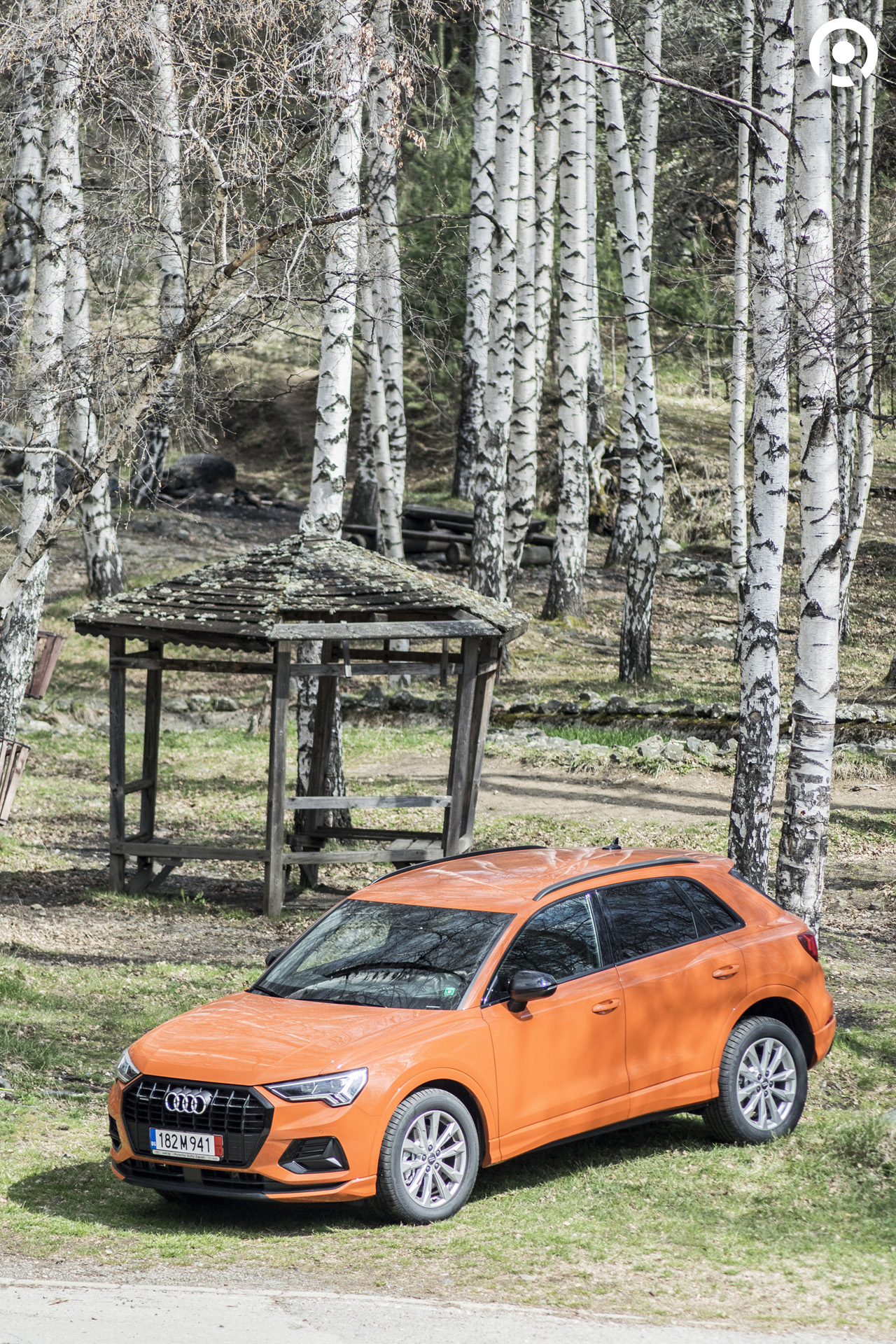


With the S-Line package, the car features a slightly lower and firmer suspension. You can feel it over bumps and cracks in Sofia’s streets, but it’s still within acceptable limits. What I didn’t like, however, was the gearbox behaviour – particularly its sluggish response when pulling away from a standstill. The first time it happened was when joining a main road from a stop sign. I pressed the accelerator… and… and… yes, eventually we moved.
Fuel consumption in heavy city traffic was around 12.2 l/100 km. This included slightly more aggressive starts and a car that had covered less than 100 km. In everyday use, it should be more efficient, but reaching the official 9.4 l/100 km in the city might be optimistic.

The next day, I headed towards the Rila mountains for some spirited driving. This is where the Q3 genuinely surprised me. Despite my expectations, the car handles enthusiastic driving quite well – it’s actually fun. A big step forward compared to the previous generation.
The steering is quick and precise, grip levels are very high, and the suspension keeps the body well controlled through corners. Progressive brakes and the fast-shifting seven-speed S-Tronic transmission complete the picture.
The engine sits right on the edge of being genuinely exciting. It performs very well, but while 190 hp is perfectly adequate for everyday use, it falls just short in those rare moments when you want more excitement. For those who do, there’s the more powerful 45 TFSI version with 230 hp.

Overall, I’m pleased with how the Q3 behaves at its limits – there’s a strong sense of harmony between all components.
Driving more calmly, I began to notice some downsides. At normal speeds of 80–90 km/h, there’s more noise than expected for a premium car. Road noise and aerodynamic turbulence around the A-pillars and mirrors are noticeable. The engine itself is quiet at low revs and even sounds pleasant when pushed.
On relaxed out-of-town drives, fuel consumption can drop below the official 6 l/100 km, showing that efficiency is achievable with a gentle driving style.
Conclusion
The second-generation Audi Q3 has grown not only in size but also in overall capability. The biggest improvement is in driving dynamics, where the Q3 is now among the best in the compact SUV class.
The segment is expanding rapidly, and competition is fierce, but Audi has created a product that meets customer expectations – premium presence, a modern interior, and high practicality all play a key role here.
Of course, not everything is perfect. The Q3 has its flaws – including some questionable interior materials and a relatively high price. In Bulgaria, the starting price for a 150 hp petrol version with front-wheel drive and manual transmission is around €35,000, compared to €31,000 for the BMW X1 and €32,000 for the Volvo XC40. And realistically, you’ll need at least another €5,000 in options, with some extras priced rather ambitiously.
This may not be an issue for committed Audi buyers, but for those still deciding in this highly competitive segment, it could be a decisive factor.
Eng. Tsvetan Iliev


Comments are closed.