
Back in the mid-1990s, Mercedes-Benz decided to expand its model range in a bold… and not particularly well-thought-out way. The idea was to enter the subcompact segment with the A-Class.
Why was it questionable?
Because the target audience wasn’t clearly defined. On one hand, the goal was to attract younger buyers. On the other, the design resembled a small MPV, something far more likely to appeal to an older crowd… and not exactly the most enthusiastic part of it.
There was also the fact that Stuttgart’s engineers simply didn’t have much experience with compact cars. They tried to build a car with uncompromising safety, using an innovative “sandwich” body structure, where the engine and gearbox would slide under the cabin in case of a crash.
Impressive in theory. In practice, the car flipped during sudden manoeuvres.
That led to a very expensive recall and the introduction of ESP as standard, a system that at the time was reserved for top-tier models like the S600 and CL600.
That’s enough history.

More than 20 years later, the concept has evolved significantly. With the third generation, Mercedes finally delivered something that genuinely appealed to younger buyers. And now, with the fourth generation, the idea is refined further.
The car is larger, more premium and firmly positioned as a stylish, expensive representative of the C-segment.
Design

Unveiled at the Geneva Motor Show, the A-Class is one of the first models, alongside the Mercedes-Benz CLS, to adopt the brand’s new design philosophy, “Sensual Purity”.
The idea is simple, clean surfaces combined with attractive shapes and flowing lines.
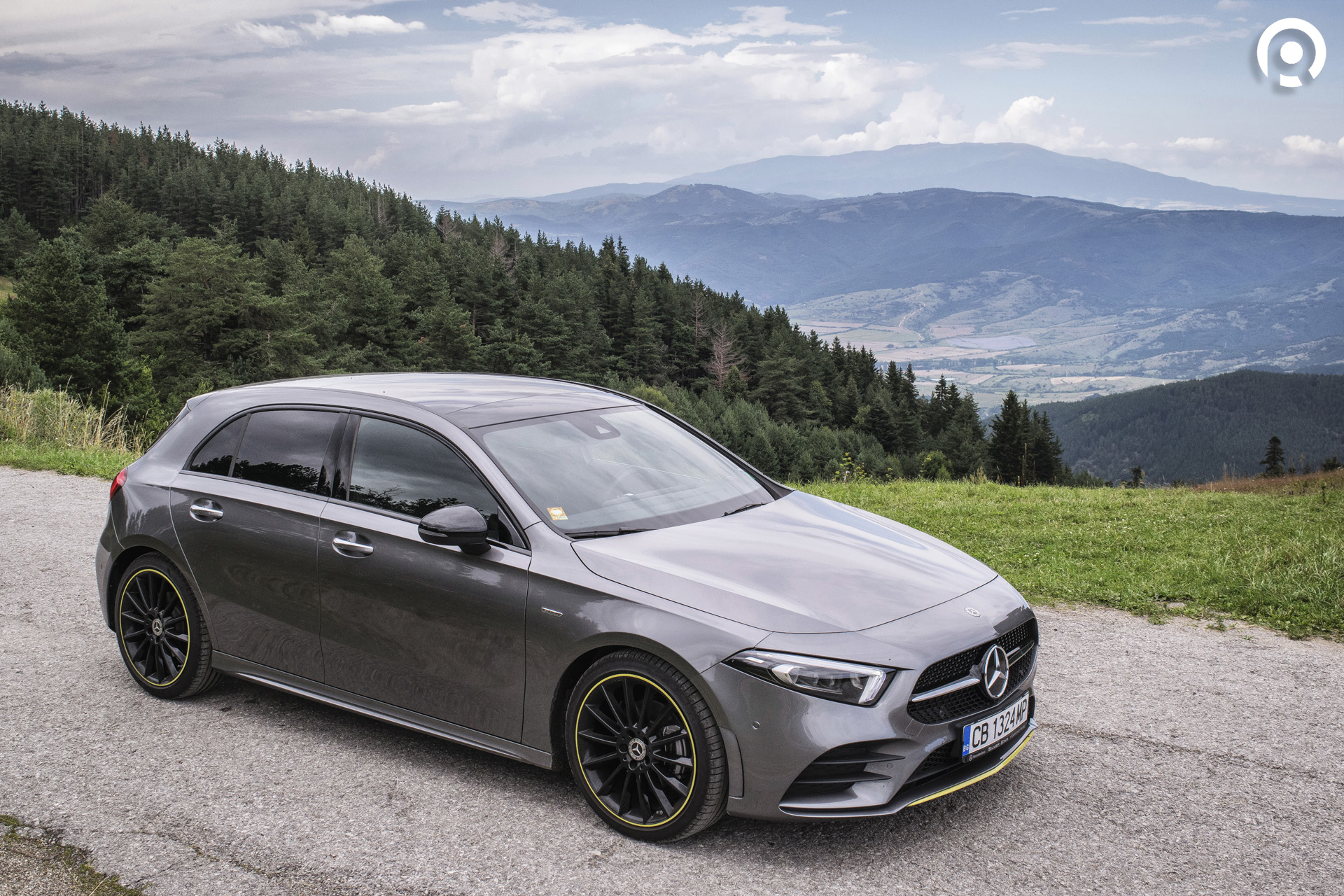
The front end immediately stands out. It has a strong resemblance to the larger four-door coupe from Mercedes, or as I like to describe it, the face of an angry great white shark that just lost its surfer.


Overall proportions follow the previous generation, but are improved thanks to the increased length and width. One detail I particularly like is the window line, which, unlike many “ordinary” C-segment cars, does not rise towards the rear. It gives the car a more mature and balanced stance.
What I don’t like is the rear.
The taillights don’t express enough identity. Remove the badge and this could easily be mistaken for an Opel, Audi, Kia or Toyota.

There’s also another issue.
The test car is the limited Edition 1 version, with AMG styling, 19-inch black wheels and bright accent colours. It looks aggressive and eye-catching. But recently I saw a base silver A-Class on the street, and without the sporty elements, it looked… a bit too ordinary for a car wearing the three-pointed star.
So yes, the design works, but it is slightly more restrained than it probably should be.
Interior
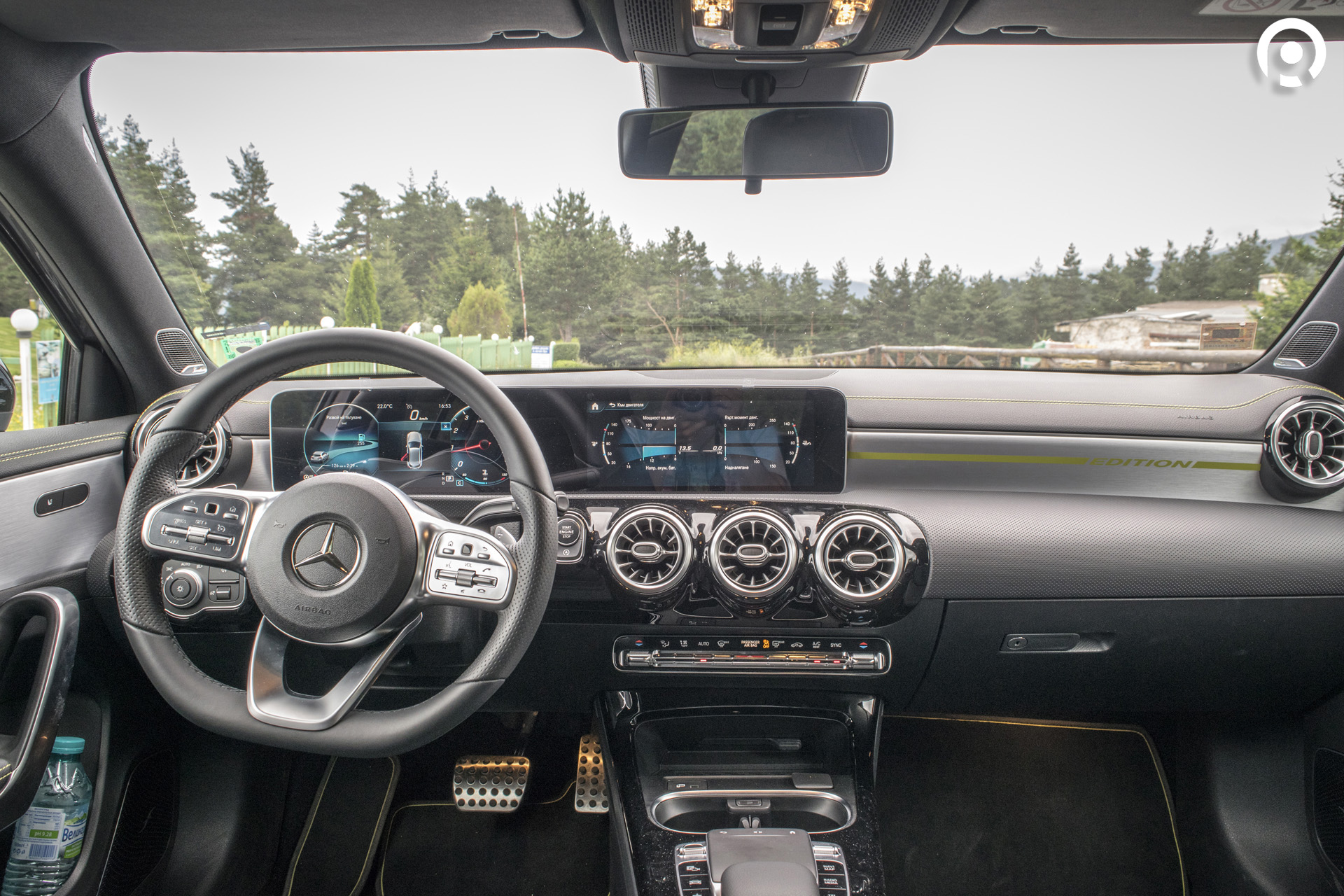
The interior of the A-Class is a fully digital spectacle.
It is dominated by the MBUX system, with its 10.25-inch display, paired with an equally large digital instrument cluster. Together, they form one large, continuous screen setup that will certainly impress the PlayStation generation.
Personally, I’m slightly less enthusiastic.
The digital cluster allows you to display almost everything that the infotainment screen can show. Which makes me wonder, do we really need both screens?
It feels like part of the purpose is simply to impress in the showroom.


There are also some ergonomic compromises in the name of modernity. The traditional rotary controller is replaced by a touchpad. It looks cool and has good tactile feedback, but it’s harder to use while driving.
The same applies to the capacitive buttons on the steering wheel. I compared them to a Blackberry joystick when I first saw them, and I still find them less intuitive than proper physical controls.
Don’t get me wrong, I like technology. But when it comes to ergonomics, I’ll take practical over flashy every time. The MBUX interface could definitely be simplified.
That said, the system itself is excellent.
It’s fast, intuitive, visually impressive and capable of learning your habits. It even features basic AI functionality, similar to Siri, and can be activated with “Hey Mercedes”.
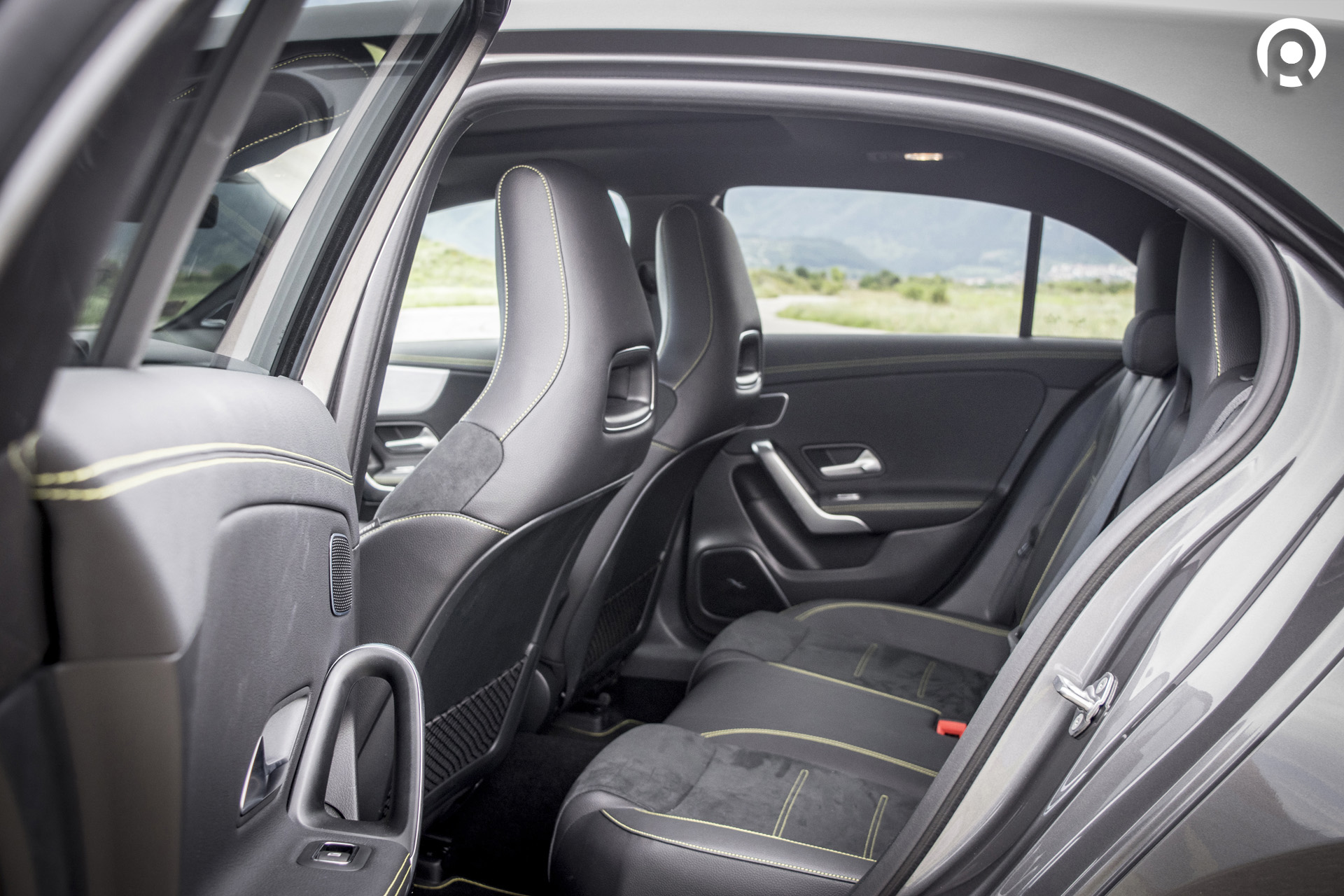
Build quality is solid and materials are of high quality. You’ll only find hard plastics in areas you rarely touch. The only disappointing element is the sunglasses compartment near the mirror, which feels below standard.
The design is minimal and elegant, with turbine-style air vents enhanced by ambient lighting. When you adjust the temperature, they glow blue or red accordingly. It’s a nice detail… although for me it slightly borders on gimmicky.

Space-wise, the front is excellent. Great seats, good ergonomics and visibility. The rear, however, is tighter. Headroom and shoulder space are fine, but legroom is limited.
On the Road

Time to drive.
Despite the aggressive looks, this particular A-Class is powered by a rather small 1.3-litre turbocharged petrol engine, paired with a seven-speed dual-clutch transmission.
Output stands at 163 hp and 250 Nm, enough for 0–100 km/h in 8.0 seconds. The car weighs just 1280 kg, which helps.
I set off towards Pancharevo and then Borovets.

As expected from a Mercedes, the car is quiet, comfortable and well insulated. Around the city, it rides smoothly, absorbs bumps well and keeps road noise low. The engine is barely audible, and overall refinement is above average for the class.
I connected my phone via MBUX and played music through the optional Burmester sound system, which, despite costing around €800, is absolutely worth it.
Then came a small surprise.
I wanted to charge my phone… and couldn’t. The car only offers wireless charging or USB-C ports. My not-so-old iPhone SE still uses USB-A. Apparently, I’m the outdated one here.


Leaving Sofia, I switched to Eco mode.
At higher speeds, the character doesn’t change much. The car remains quiet and comfortable, the engine feels responsive and the gearbox shifts smoothly and quickly.
Everything is fine… until you need to overtake.
Floor the throttle and things change. The gearbox hesitates briefly before dropping gears, and once it does, the engine revs rise with a rather unpleasant sound. It feels strained, even though the car accelerates well.
Still, I reached Borovets with an average consumption of 5.4 l/100 km, which is very good.
After a short break, I headed towards the twisty road to Panichishte. Sport mode engaged, more throttle, and here comes the surprise. The steering.
It is sharp, precise and unexpectedly quick. Not something I usually associate with Mercedes. Combined with the low weight, the car feels eager and agile through corners. Stability is excellent, with mild understeer at the limit, easy to control.
There is some body roll, even with the AMG suspension, but not enough to ruin the experience.
What does ruin it slightly is the engine sound. The 1.3-litre unit feels a bit out of its depth when pushed hard, and that also explains the hesitation from the gearbox.
Still, I was genuinely surprised by how engaging the A-Class can be to drive. The A250 4Matic with 224 hp sounds like the sweet spot. And the AMG version… well, that’s a different story altogether.
Conclusion
The fourth-generation A-Class is a car that can attract new customers to the brand.
It has a youthful appeal, compact dimensions and a modern, premium feel, making it well suited for urban life.
Of course, with prices starting at around €25,000 and realistically reaching €30,000–€40,000 for a well-equipped version, this is not exactly a “cheap” young person’s car.
In Western Europe, there are plenty of young professionals who can afford it. In Bulgaria, that group is much smaller.
Still, the A-Class has a place. If people with multiple cars start choosing something more suitable for city use instead of large SUVs and limousines, this could be it. Because the car has a lot to offer.
Its technology, especially MBUX and the driver assistance systems, is on par with much larger Mercedes models. It delivers a driving experience that is more engaging than expected, combined with the prestige and perceived quality of the three-pointed star.
Eng. Tsvetan Iliev


Comments are closed.