
For some reason, whenever the topic of so-called “compact executive cars” comes up — a segment I not entirely accurately translate as compact premium sedans — the first model that usually appears in my mind is the BMW 3 Series. Is that because the 3 Series is the oldest representative of the class still in production, or because it is an enormously successful model accounting for around 30% of BMW’s global sales? I have no idea, but I will try to find out over the next 24 hours.

Helping me answer that question is the recently facelifted version of the “3”, which has already been on sale for more than three years. To make the task easier, I was given a particularly attractive version of the model, equipped with a powerful six-cylinder diesel engine producing 258hp and 560Nm of torque. Sounds very promising.
Design
When it comes to design, the 3 Series is an absolute classic. Long bonnet, compact rear end and traditional proportions… although most representatives of this segment follow that formula, so there is nothing unusual there. Even now, however, you can still notice traces of the styling language introduced by Chris Bangle into BMW around 15 years ago — a style many considered scandalous, barbaric and sacrilegious, while I personally quite liked it. Of course, whatever remains of that era has now been heavily refined, and in this “3” it looks beautiful and elegant.


The latest facelift, while difficult for casual observers to notice, actually modernises the car’s appearance quite significantly.
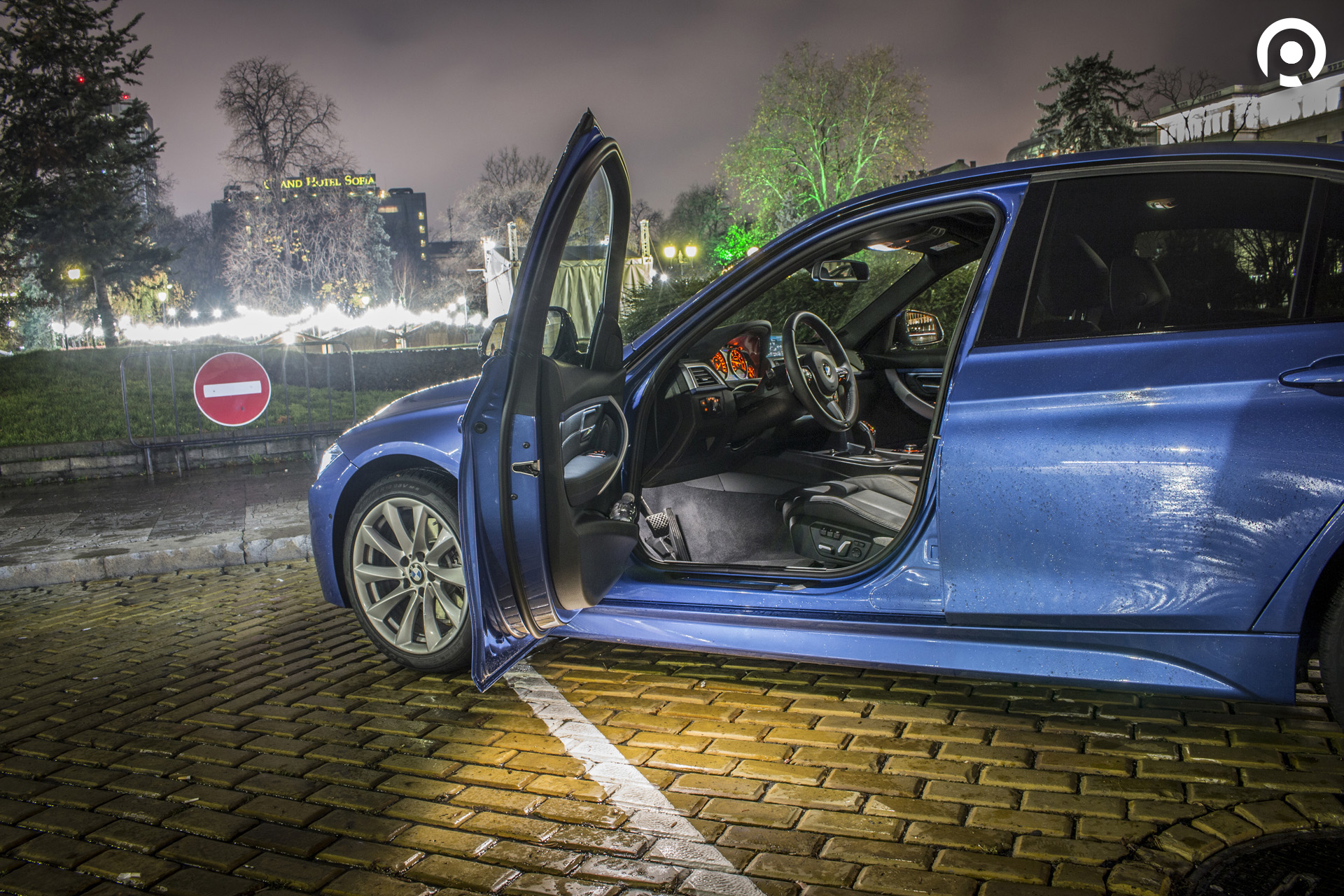
And in our particular case, we also have the exterior M Package, which gives the car an even more purposeful stance. Combined with the special blue paint, the “3” looks very appealing and certainly stands out in traffic.
Interior
Not long ago, I was rather disappointed by the interior of a significantly more expensive BMW — perhaps it was poorly configured. So, with mixed expectations, I stepped into the “3”. As it turns out, the interior here pleasantly surprised me instead. The build quality is excellent, every detail feels solid and as a driver or passenger you simply cannot tell where any cost-cutting has taken place — it does not show.

Otherwise, there is nothing unexpected inside. BMW’s entire range features fairly similar dashboards and centre consoles with their characteristic design. I must admit that visually, BMW interiors are not entirely to my taste. But I cannot deny the quality craftsmanship, the high level of ergonomics and the genuinely pleasant atmosphere this environment creates.


One thing I particularly like is the M steering wheel — it simply looks good. Another thing that impressed me were the seats — sports seats in this case, with optional lumbar support. There is no argument here: they are extremely comfortable, while also providing strong lateral support and a wide range of adjustments.


Space is also good, particularly noticeable in the rear seats. Of course, the class limitations remain, so you will not have excessive room in the back, but neither will you feel cramped. It is comfortable.
On the road
We have all heard BMW’s slogans praising the on-road abilities of the company’s models. Well, that is precisely why you are currently reading the most important part of this review.
The drivetrain of the BMW 330d xDrive is, quite simply, phenomenal. Let’s begin with the engine, whose key figures I already mentioned in the introduction. If you place a random person in the “3” and floor the accelerator, they will most likely ask: “This BMW has how many horsepower again?” And if you happen to be with someone less familiar with cars, their question will probably be: “It’s petrol-powered, right?” But let’s stay focused…
The car is seriously fast. I would like to say that this is purely because of the engine, but I cannot, because the entire drivetrain deserves the credit — the gearbox and the xDrive all-wheel-drive system included. Launches from a standstill are undoubtedly the most impressive part, and the official 0–100km/h time of 5.3 seconds actually feels somewhat conservative. This is thanks to the monstrous torque available at low revs.
The sound entering the cabin is also very pleasant. Honestly, I could not determine whether there was some synthetic sound enhancement coming through the speakers — personally I did not really notice anything artificial — but even if there is, it has been done extremely well. Engines like this genuinely make you wonder why anyone even needs a petrol car anymore. And do you know what the most interesting part is? Fuel consumption. During my test, it stayed between 7 and 8 litres per 100km, while figures below 7l/100km also seem easily achievable, even without driving like an “Austrian grandmother” — you know, the type who only takes the car to the pharmacy on Sundays before eventually selling it at Gorublyane.
Naturally, these results are also largely thanks to the brilliant eight-speed automatic gearbox from ZF Friedrichshafen.

Something that surprised me in the car’s behaviour was its slightly nervous reaction during abrupt changes in weight transfer. The electronic stability system controls the body perfectly well, but I expected the limit to be slightly further away. Still, the weather conditions during my drive were not ideal for this kind of testing, so I will not jump to definitive conclusions.
Overall, I was not completely impressed by the suspension. It is both firm and yet allows slightly more body roll in corners than I would expect from a car like this. Perhaps the adaptive suspension is a worthwhile option for the BMW 3 Series, especially considering its reasonable price of around €1,000.
Another unexpected detail for me was the aerodynamic noise at high speed. Since BMW has one of the world’s most advanced wind tunnels, I assumed the “3” would be quieter, but apparently the tunnel was occupied when they developed it. Do not get me wrong — the noise is by no means excessive — but it is slightly more noticeable than it ideally should be.
Technology

The headlights. Yes, the headlights are brilliant. Early BMW models equipped with LED headlights did not seem particularly impressive and hardly justified their high price compared to proven xenon systems. Here, however, things are completely different. The intelligent system works extremely well, road illumination in various situations is excellent, and it is genuinely satisfying to watch the headlights constantly react to the surrounding environment in order to maximise comfort both for the driver and for other road users.
Another system worth mentioning is BMW ConnectedDrive Advanced. Unfortunately, I did not manage to test it, but in short it integrates mobile applications from your smartphone directly into BMW’s infotainment system, allowing them to be controlled through the standard BMW interface. As part of the system, you can even remotely control certain vehicle functions through your phone… pretty cool, isn’t it?
Conclusion
The big question here is whether I found the answer to why the BMW 3 Series is so popular. I think I did. The “3” is a car with exceptionally well-rounded qualities. Yes, some competitors in the segment are better in certain areas, but weaker in others.
The BMW 3 Series achieves a balance that Aristotle and his concept of the “Golden Mean” would surely approve of. The model is an all-round talent and delivers strongly in every area that could matter to a potential buyer.
Eng. Tsvetan Iliev


Comments are closed.